

Welcome to our popular Personal Statement series where we present a successful Personal Statement, and our Oxbridge Tutors provide their feedback on it.
Today, we are looking through a Veterinary Medicine applicant’s Personal Statement that helped secure a place at Cambridge University. The Veterinary Medicine Course at Cambridge offers a world-class opportunity to study the scientific basis of veterinary medicine and clinical veterinary science.
Read on to see how this candidate managed to secure an offer from a world-class department.
Here’s a breakdown of the Personal Statement (the applicant uses most of the 4,000 characters available):
CHARACTERS
3,990
WORDS
657
SUCCESSFUL?
2/4
The universities this candidate applied to were the following:
CAMBRIDGE
OFFER
LONDON VET SCHOOL
OFFER
NOTTINGHAM
INTERVIEW + REJECTED
BRISTOL
INTERVIEW + REJECTED
Enrolling on our Cambridge Veterinary Science comprehensive Programme will give you access to Personal Statement redrafts.
With our Cambridge Veterinary Medicine Full Programme, your tutor will give you regular actionable feedback with insider tips on how to improve and make your Personal Statement Oxbridge quality for the best chances of success.
Discover our Premium Programmes today to learn how you can enrol and triple your chances of success.
Cambridge Veterinary Medicine Personal Statement
1. Why do you want to study this course or subject?
Witnessing the birth of a calf was a wonderful experience and has helped to confirm my long-term ambition to be a vet. This desire has been a motivating force in all my decisions at school. Veterinary medicine is a challenging and worthwhile career that encapsulates my profound interest in animal welfare, scientific enquiry and problem solving. It will satisfy my passion to work with people and animals as well as my love of science. It requires academic rigour, is scientifically-based and provides opportunities for further research either in laboratory or clinical settings. It involves considerable practical skills and the potential for great job satisfaction with the possibility of running my own practice.
2. How have your qualifications and studies helped you to prepare for this course or subject?
I attended VetMedlink at Nottingham University, thirty six lectures on all aspects of veterinary care. As part of this course I voluntarily undertook my own research into potential new uses of stem cells and submitted a paper which was marked and for which I received a distinction. This is due to be published on-line sometime this year. My focus was how stem cells inserted into the brain could be used in the future to improve intelligence and treat neural problems such as Alzheimer’s disease. Furthermore, I will be attending a course in November to enable me to administer aid to stranded or injured marine mammals.
As well as good examination grades, my other school achievements include prize certificates in mathematics and biology; I was especially pleased to win Gold Certificates in the UK Maths Challenge. This year I was commended for the quality of my answers in the Chemistry Challenge set by my school which required logical reasoning skills. I have a special aptitude for mathematics and attended six maths lectures at Greenwich University on themes which included matrices and types of mathematical proof.
3. What skills and experience have you got that show you are suited to this course?
My work experience has been thoroughly enjoyable and included working with a country vet, a farrier, at a private stables, a commercial reptile centre, a dairy farm and a small animal clinic. With the country vet I observed two successful treatments on cows to correct displacement of the abomasum by external manipulation and surgery. I helped with TB testing, learning the process, its importance and the wider context. Working with the farrier opened my mind to other people who interact with the veterinary profession. Whilst involved in cleaning and feeding at the private stables I developed a great respect for horses including an awareness of the danger they can pose for humans and other animals. At the reptile centre I handled a bearded dragon, monitor lizard and snakes whilst assisting in an educational talk and at Beaver World learnt to care for guinea pigs, rabbits, beavers, pheasants and fish. During my nine-day stay on a dairy farm I took part in the daily routine of milking, and as well as observing the birth of a calf, I saw the deterioration of a cow and the eventual decision to put her down. It was apparent that working in a small animal clinic involves many routine operations like the castration and spaying of cats and dogs. I learnt that diagnosis involves history-taking, examination and investigations such as blood tests and diagnostic imaging. To gain more experience I plan to work at a city farm, participate in the delivery of lambs and carry out placements at London Zoo and the London Aquarium.
I aim to involve myself whole-heartedly in university life, using my musical skills by playing the keyboard and perhaps playing in or starting a sports team. I truly believe I have the ability to work effectively with people and animals. I am excited about the veterinary course since it offers the opportunity to undertake research projects, understand the scientific basis of medicine, gain in-depth knowledge of veterinary practice and develop key practical skills. I am determined to become a vet and eager to begin the formal course of training in what I know will prove to be a fascinating field of study.
For more inspiration, take a look through our other successful Personal Statement analysis articles:
Break Free from the Personal Statement Spiral
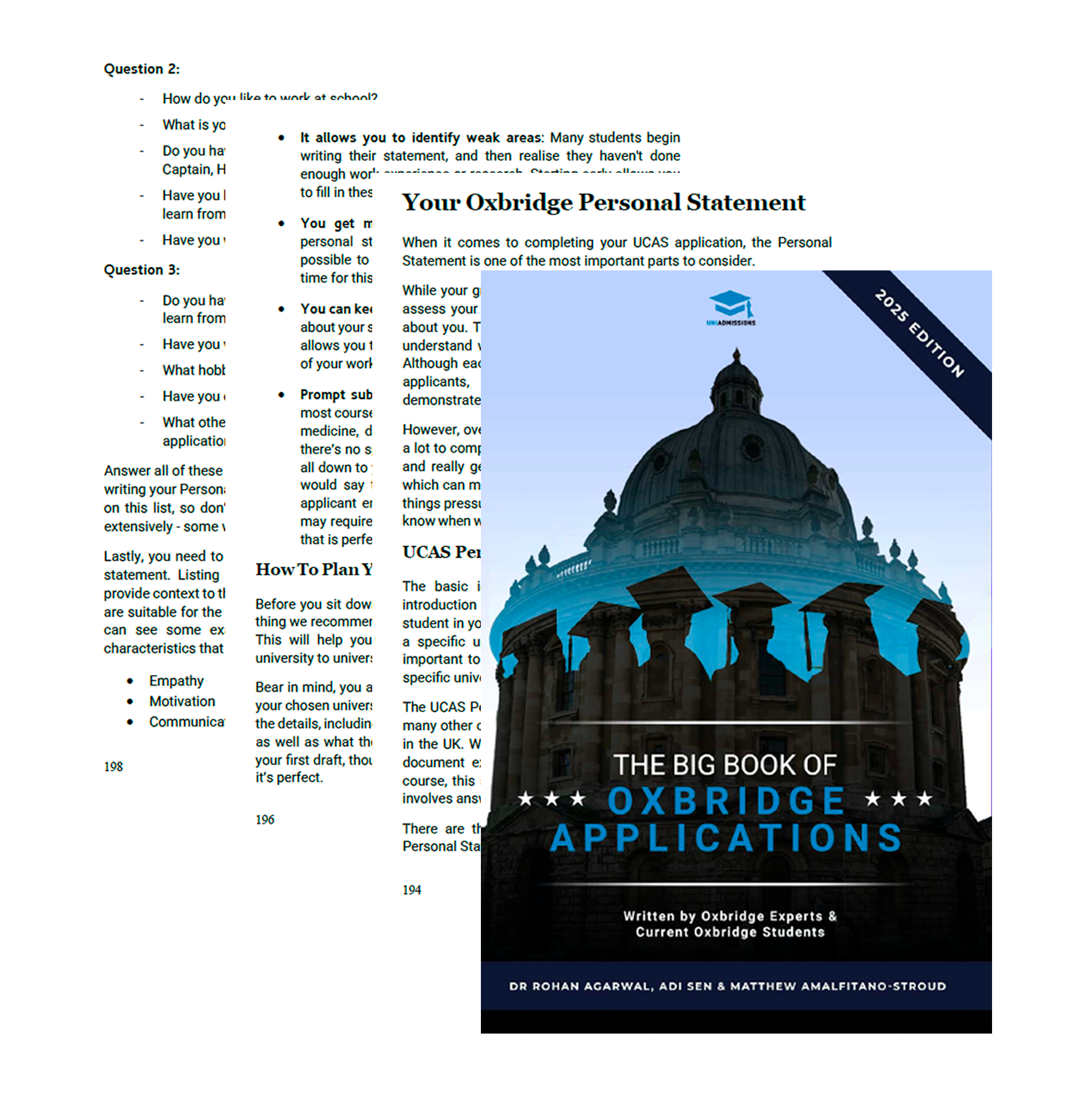
- A method to plan and write a compelling personal statement
- Proven strategies to stand out — even among top applicants
- 28 example Oxbridge Personal Statements
- Additional downloadable resources
Access "The Oxbridge Application Vault"
- 300+ page ebook for Oxbridge Applicants
- 25 page ebook for Personal Statement
- 2h+ online course to succeed in any exam
- Online Oxbridge Success Calculator
- 12 page ebook about UniAdmissions

Good Points Of The Veterinary Medicine Personal Statement
A well written and well-structured statement that provides a good insight into the student’s character and development, both academically as well as personally. The student demonstrates a good scientific foundation, achieving various degrees of academic excellence and also demonstrates a wide range of different work-experience attachments giving insight into different specialities of veterinary medicine. This is particularly important due to the wide range of differences between different animal species. The broader the experience before starting the degree, the better. Furthermore, the work-experience placements will provide valuable contacts for when the student will be required to conduct care attachments during his/her studies at university.
Bad Points Of The Veterinary Medicine Personal Statement
One of the central points of veterinary medicine not related to the academic side is the funding structure. Recognising the challenges that come in regard to the treatment of patients, as well as in regard to the interaction with owners, is an important component. Since the student experienced care in different practice settings, it is likely that he/she has come across this issue.
UniAdmissions Overall Score:
★ ★ ★ ★ ☆
Good statement giving good detail about the student and his/her motivation as well as his/her individual development. It could be improved by additional reflection on the challenges of veterinary practice, for example, the existing funding structures.
What Makes A Cambridge Veterinary Medicine Personal Statement Different?
While there’s no set standard for Veterinary Medicine personal statements, most applicants will cover similar topics, such as their academicwork, field trips and potentially relevant work experience. However, Cambridge isn’t as interested in these areas, and statements featuring just these topics won’t stand out. So, what can you do to make your statement different?
Firstly, while these typical experiences are important to cover, you need to explore them in depth rather than just providing surface level descriptions. Reflection is the key to a successful personal statement, which means exploring what you have learnt, how this knowledge has helped you develop your skills and how it changed your perception of Veterinary Medicine. This provides evidence of your genuine dedication to the subject.
However, beyond the experiences you’ve had, it’s also important to evidence your super-curricular engagement with the subject, including wider reading and research projects. While this may not seem like the most interesting topic to discuss, it is exactly what Cambridge is looking for in applicants. A huge part of studying at Cambridge is the ability to work independently and guide your own learning beyond the classroom. As such, displaying a high level of curiosity in your statement will highlight that you have what it takes to succeed in the course.
Cambridge aren’t looking for the applicants with the most impressive experiences – they are looking for the applicants that make the most of their time and resources to truly engage with their subject. This is what you need to prove in your writing.
It’s important to consider that this Personal Statement was not originally written in the three question format currently used by UCAS. Below is the original, unedited version of this statement in the previous free-form style.
Cambridge Veterinary Medicine Personal Statement (OLD FORMAT)
Witnessing the birth of a calf was a wonderful experience and has helped to confirm my long-term ambition to be a vet. This desire has been a motivating force in all my decisions at school. Veterinary medicine is a challenging and worthwhile career that encapsulates my profound interest in animal welfare, scientific enquiry and problem solving. It will satisfy my passion to work with people and animals as well as my love of science. It requires academic rigour, is scientifically-based and provides opportunities for further research either in laboratory or clinical settings. It involves considerable practical skills and the potential for great job satisfaction with the possibility of running my own practice.
My work experience has been thoroughly enjoyable and included working with a country vet, a farrier, at a private stables, a commercial reptile centre, a dairy farm and a small animal clinic. With the country vet I observed two successful treatments on cows to correct displacement of the abomasum by external manipulation and surgery. I helped with TB testing, learning the process, its importance and the wider context. Working with the farrier opened my mind to other people who interact with the veterinary profession. Whilst involved in cleaning and feeding at the private stables I developed a great respect for horses including an awareness of the danger they can pose for humans and other animals. At the reptile centre I handled a bearded dragon, monitor lizard and snakes whilst assisting in an educational talk and at Beaver World learnt to care for guinea pigs, rabbits, beavers, pheasants and fish. During my nine-day stay on a dairy farm I took part in the daily routine of milking, and as well as observing the birth of a calf, I saw the deterioration of a cow and the eventual decision to put her down. It was apparent that working in a small animal clinic involves many routine operations like the castration and spaying of cats and dogs. I learnt that diagnosis involves history-taking, examination and investigations such as blood tests and diagnostic imaging. To gain more experience I plan to work at a city farm, participate in the delivery of lambs and carry out placements at London Zoo and the London Aquarium.
I attended VetMedlink at Nottingham University, thirty six lectures on all aspects of veterinary care. As part of this course I voluntarily undertook my own research into potential new uses of stem cells and submitted a paper which was marked and for which I received a distinction. This is due to be published on-line sometime this year. My focus was how stem cells inserted into the brain could be used in the future to improve intelligence and treat neural problems such as Alzheimer’s disease. Furthermore, I will be attending a course in November to enable me to administer aid to stranded or injured marine mammals.
As well as good examination grades, my other school achievements include prize certificates in mathematics and biology; I was especially pleased to win Gold Certificates in the UK Maths Challenge. This year I was commended for the quality of my answers in the Chemistry Challenge set by my school which required logical reasoning skills. I have a special aptitude for mathematics and attended six maths lectures at Greenwich University on themes which included matrices and types of mathematical proof.
I aim to involve myself whole-heartedly in university life, using my musical skills by playing the keyboard and perhaps playing in or starting a sports team.
I truly believe I have the ability to work effectively with people and animals. I am excited about the veterinary course since it offers the opportunity to undertake research projects, understand the scientific basis of medicine, gain in-depth knowledge of veterinary practice and develop key practical skills. I am determined to become a vet and eager to begin the formal course of training in what I know will prove to be a fascinating field of study.
This Personal Statement for Vet Med is a good example of demonstrating motivation and development which is vital to Admissions Tutors.
Remember, at Cambridge, these Admissions Tutors are often the people who will be teaching you for the next few years, so you need to appeal directly to them.
Go to our Free Personal Statement Resources page for even more successful personal statements and expert guides.
Our expert tutors are on hand to help you craft the perfect Personal Statement for your Cambridge Veterinary application.
With our Cambridge Veterinary Science Full-Blue Programme, we help you craft the perfect Personal Statement, score highly on the ESAT and teach you how to Interview effectively.
Discover our Cambridge Veterinary Science Full-Blue Programme by clicking the button below to enrol and triple your chances of success.


