

Welcome to our popular Personal Statement series where we present a successful Personal Statement, and our Oxbridge Tutors provide their feedback on it.
Today, we are looking through an English applicant’s Personal Statement that helped secure a place at Cambridge University. The English Course at Cambridge balances a strong grounding in literary works. Let’s see how the candidate addresses this in their Personal Statement.
Here’s a breakdown of the Personal Statement (the applicant came very close to the 4,000 character limit):
CHARACTERS
3,987
WORDS
645
SUCCESSFUL?
5/5
The universities this candidate applied to were the following:
CAMBRIDGE
OFFER
DURHAM
OFFER
SUSSEX
OFFER
UCL
OFFER
KCL
OFFER
Cambridge English Personal Statement (NEW FORMAT)
Why do you want to study this course?
Growing up in a house where books have replaced wallpaper, acquiring a love of literature was inevitable. I love the way in which writers explore, question, and critique aspects of human nature through the presentation of their worlds and characters. My favourite pieces of writing are ones such as Levi’s ‘Order on the Cheap’, Gogol’s ‘The Overcoat’ or Hartley’s ‘The Go Between’, where a particular human tendency is both beautifully presented and meticulously analysed. In his short story, Levi explores curiosity by invoking that of his audience: readers become distracted by the narrator’s descriptions of his experiments and overlook their morally problematic side. Hartley employs an opposite technique, allowing the reader to be often sharply aware of the innocence and naivety of the protagonist. Gogol manipulates the reader even more, invoking a painful sense of pathos around the main character whilst at the same time daring us to find Akaky’s concerns a little ridiculous.
I find it fascinating how unexpected links can suddenly emerge between works: reading around a set text, Murakami’s ‘Blind Willow Sleeping Woman’, I read his ‘Kafka on the Shore’, which led me to read some of Kafka’s short stories, including ‘The Penal Colony’ and ‘A Country Doctor’. Whilst the works of the two writers are in many ways extremely different, I noticed some stylistic similarities. Both present protagonists whose apparently unexceptional lives are suddenly interrupted by a series of unexplained fantastical events. These events are often a metaphor for a wider-reaching process in the life of the narrator.
However, Eagleton’s book is just ‘an Introduction’: what draws me most to the study of English literature is not only that I love it, but that I want so much to learn more about it.
How have your qualifications and studies helped you to prepare for this course or subject?
I have to admit, however, that I am drawn to Levi’s short story not only because of its literary merits, but also because I sympathise with its main character: a man driven by his fascination with the process of creation. My favourite parts of my Chemistry A level were the ‘practicals’; I derived great excitement from the process of taking a simple substance, subjecting it to particular conditions, and thereby creating a completely different, and often much more complex, chemical. In ‘The Monkey’s Wrench’ Levi seems to emulate the same process in his development of the character of Tino. Starting from a simple first picture Tino is slowly developed, snippet by snippet, as the stories progress, until a fully evolved character finally emerges.
Eagleton’s ‘Literary Theory: an Introduction’ gave me another way in which to approach texts. As well as my visceral response and the various meanings extracted through analysis, the texts might exemplify the literary or political beliefs of a particular period. Further, members of different literary movements might approach them in very different ways – I enjoyed trying to put on the ‘mask’ of one movement or another and read a poem through it. Similarly, whilst studying ‘Othello’ I was interested by the hugely varying approaches of different critics, from Bradley who focused chiefly on character but seemed to forget the literary context, to Empson who concentrated almost solely on the changing meaning of the word ‘honest’ throughout time. Perhaps most significantly, Eagleton and the other critics reinforced the idea that engaging with a text is itself a creative process.
What else have you done to prepare outside of education, and why are these experiences useful?
But without a doubt, poetry has always been my favourite form of literature: I like listening to poems or reading them aloud, appreciating their rhythm and sound, before going back and analysing them. Some of my favourite poems are those in which the sound is almost as important as the words themselves, for example, Lawrence’s ‘Ship of Death’ or Frost’s ‘After Apple Picking’. In this vein, I have a YouTube channel on which I post my readings of various poems, and have also earned at least several pence through poetry busking in the streets of Waterloo.
Break Free from the Personal Statement Spiral
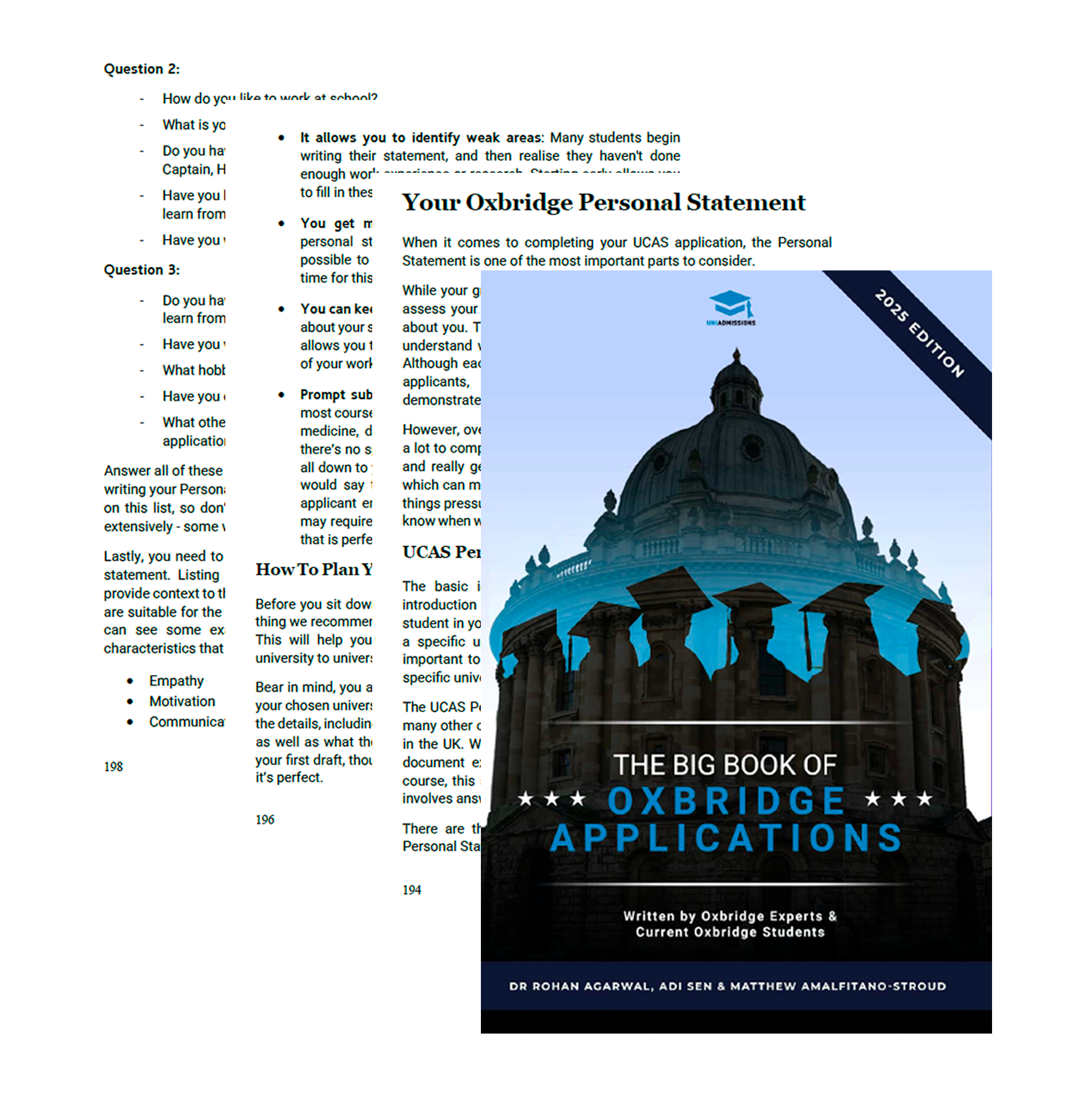
- A method to plan and write a compelling personal statement
- Proven strategies to stand out — even among top applicants
- 28 example Oxbridge Personal Statements
- Additional downloadable resources
Our Tutors' Feedback On This Cambridge English Personal Statement
Good Points
The candidate clearly demonstrates a keen and actioned interest in their chosen subject through the presentation of their reading and subsequent thoughts. They can articulate their present interests in their subject, as well as the sources of these interests, and their potential directions for further development. They indicate their ability to think laterally and creatively through their cohesive discussions of seemingly disparate texts, and are self-aware of their strengths and weaknesses as a reader. Their statement is fuelled by their evident personal enthusiasm for their subject, which makes it an engaging and urgent read.
Bad Points
The candidate has acquired a relatively personal tone, which veers into the casual or confessional at times; their point might have been made more clearly or precisely had they adopted more strictly academic modes of communicating. Their consideration of various works is quite itemised, insofar as their statement reads like a series of ‘nuggets’ of information, rather than a clearly-focused piece with argument and direction. The candidate does reference another subject they study for A-Level, but beyond that, they have not included much information beyond their academic reading and interests. While this could certainly be justified as an approach, it does leave the statement suggesting that the writer is not particularly engaged in questions or activities beyond specific areas of literature.
UniAdmissions Overall Score:
★ ★ ★ ☆ ☆
The statement is at times quite chaotic in style, due to its familiar tone and slightly haphazard structure. However, it more than compensates for this since its familiarity is clearly a result of the candidate’s sheer enthusiasm for the subject. In addition, the range of material that they consider is very impressive — it includes both primary texts (of various forms) and secondary reading. The candidate has, moreover, articulated their own ideas on these works, and even if their exact communication of these are not particularly precise, the level of thought and consideration is still strong.
Enrolling on our Oxbridge English comprehensive Programme will give you access to Personal Statement redrafts.
Your tutor will give you actionable feedback with insider tips on how to improve and make your Personal Statement Oxbridge quality for the best chances of success.
What Makes A Cambridge English Personal Statement Different?
A Cambridge English personal statement is more academically exploratory and intellectually reflective than a typical literature application. Cambridge uses the personal statement to assess academic potential, so the focus is not simply on showing a love of reading or listing favourite books, but on demonstrating how an applicant engages critically with literature and ideas. Strong statements often show curiosity, close analysis, and evidence of independent thinking, exploring not just what the applicant has read, but the questions, interpretations, and intellectual connections that emerged from that reading.
Successful applicants usually demonstrate broad and thoughtful subject exploration beyond the classroom, reflecting on literature in depth rather than summarising texts or experiences. This might involve discussing novels, poetry, drama, literary criticism, theory, or literature’s relationship with areas such as philosophy, politics, history, film, or art, but the strongest statements go further by explaining what the applicant found interesting, how one idea led to another, and how their thinking developed as a result. Cambridge particularly values applicants who can show analytical precision, intellectual curiosity, and the ability to make connections across texts, contexts, and disciplines.
Unlike some English applications that focus heavily on creative writing, personal reading habits, or broad enthusiasm for literature, a Cambridge English personal statement is typically more academic in tone and driven by critical engagement with ideas. The strongest applicants show that they can question, analyse, interpret, and think independently about literary works, using their reading and subject exploration to demonstrate intellectual depth rather than simply personal passion. A strong Cambridge English statement therefore feels less like a celebration of books and more like evidence of a mind actively engaging with literature as a serious academic discipline.
Cambridge English Personal Statement (OLD FORMAT)
Please note that the personal statement presented earlier in this guide was not originally written in the three-question format currently used by UCAS. Below is the original, unedited version of this statement in the previous free-form style.
—
Growing up in a house where books have replaced wallpaper, acquiring a love of literature was inevitable. I love the way in which writers explore, question, and critique aspects of human nature through the presentation of their worlds and characters. My favourite pieces of writing are ones such as Levi’s ‘Order on the Cheap’, Gogol’s ‘The Overcoat’ or Hartley’s ‘The Go Between’, where a particular human tendency is both beautifully presented and meticulously analysed. In his short story, Levi explores curiosity by invoking that of his audience: readers become distracted by the narrator’s descriptions of his experiments and overlook their morally problematic side. Hartley employs an opposite technique, allowing the reader to be often sharply aware of the innocence and naivety of the protagonist. Gogol manipulates the reader even more, invoking a painful sense of pathos around the main character whilst at the same time daring us to find Akaky’s concerns a little ridiculous.
I have to admit, however, that I am drawn to Levi’s short story not only because of its literary merits, but also because I sympathise with its main character: a man driven by his fascination with the process of creation. My favourite parts of my Chemistry A level were the ‘practicals’; I derived great excitement from the process of taking a simple substance, subjecting it to particular conditions, and thereby creating a completely different, and often much more complex, chemical. In ‘The Monkey’s Wrench’ Levi seems to emulate the same process in his development of the character of Tino. Starting from a simple first picture Tino is slowly developed, snippet by snippet, as the stories progress, until a fully evolved character finally emerges.
I find it fascinating how unexpected links can suddenly emerge between works: reading around a set text, Murakami’s ‘Blind Willow Sleeping Woman’, I read his ‘Kafka on the Shore’, which led me to read some of Kafka’s short stories, including ‘The Penal Colony’ and ‘A Country Doctor’. Whilst the works of the two writers are in many ways extremely different, I noticed some stylistic similarities. Both present protagonists whose apparently unexceptional lives are suddenly interrupted by a series of unexplained fantastical events. These events are often a metaphor for a wider-reaching process in the life of the narrator.
But without a doubt, poetry has always been my favourite form of literature: I like listening to poems or reading them aloud, appreciating their rhythm and sound, before going back and analysing them. Some of my favourite poems are those in which the sound is almost as important as the words themselves, for example, Lawrence’s ‘Ship of Death’ or Frost’s ‘After Apple Picking’. In this vein, I have a YouTube channel on which I post my readings of various poems, and have also earned at least several pence through poetry busking in the streets of Waterloo.
Eagleton’s ‘Literary Theory: an Introduction’ gave me another way in which to approach texts. As well as my visceral response and the various meanings extracted through analysis, the texts might exemplify the literary or political beliefs of a particular period. Further, members of different literary movements might approach them in very different ways – I enjoyed trying to put on the ‘mask’ of one movement or another and read a poem through it. Similarly, whilst studying ‘Othello’ I was interested by the hugely varying approaches of different critics, from Bradley who focused chiefly on character but seemed to forget the literary context, to Empson who concentrated almost solely on the changing meaning of the word ‘honest’ throughout time. Perhaps most significantly, Eagleton and the other critics reinforced the idea that engaging with a text is itself a creative process.
However, Eagleton’s book is just ‘an Introduction’: what draws me most to the study of English literature is not only that I love it, but that I want so much to learn more about it.
This Personal Statement for English is a great example of enthusiasm and passion. The candidate’s interest is clearly shown which is vital to Admissions Tutors.
Remember, at Cambridge, these Admissions Tutors are often the people who will be teaching you for the next few years so you need to appeal directly to them.
Go to our Free Personal Statement Resources page for even more successful personal statements and expert guides.
For more inspiration, take a look through our other successful Personal Statement analysis articles:
Our expert tutors are on hand to help you craft the perfect Personal Statement for your Cambridge English application.
With our Oxbridge English Premium Programme we help you craft the perfect Personal Statement, produce and submit the best Written Work and teach you how to Interview effectively.
Discover our Oxbridge English Premium Programme by clicking the button below to enrol and triple your chances of success.

