

Welcome to our popular Personal Statement series where we present a successful Personal Statement, and our Oxbridge Tutors provide their feedback on it.
Today, we’ve got a Personal Statement from an Oxford Mathematics student to review. The Mathematics at Oxford is one of the highest ranked in the UK and offers you the opportunity to excel in the subject!
Read on to see how this strong Personal Statement addresses how Maths can be a genuine passion for someone.
NEW PERSONAL STATEMENT FORMAT
As of 2025, UCAS Personal Statements will be presented with a new three-question format. Be aware that the Personal Statement featured in this guide was written in the previous free-form format. Despite this, the example will still be beneficial to read as the content included remains the same as what you should aim to write in your own work.
When reading this example, think about which question each paragraph answers. To learn more about the Personal Statement changes, read our dedicated guide to the new Personal Statements here.
Here’s a breakdown of the Personal Statement:
CHARACTERS
3,943
WORDS
627
SUCCESSFUL?
5/5
The universities this candidate applied to were the following:
OXFORD
OFFER
IMPERIAL
OFFER
WARWICK
OFFER
ST ANDREWS
OFFER
EDINBURGH
OFFER
Enrolling on our Oxbridge Maths comprehensive Programme will give you access to Personal Statement redrafts.
Your tutor will give you actionable feedback with insider tips on how to improve and make your Personal Statement Oxbridge quality for the best chances of success.
Oxford Mathematics Personal Statement
Question 1: Why do you want to study this course or subject?
What is a number? A strange question, perhaps, but one whose dearth of a satisfying answer is unrivalled in demonstrating the breathtaking complexity that mathematics embodies. The steady expansion of a number’s meaning and purpose accompanies equally breathtaking areas of exploration – beyond the natural, to the imaginary to the hypercomplex on 4, 8, 16 dimensions. Yet as mystical as these fields are they still manage to find ingenious applications in, and indeed make up the very fabric of, this very real world of ours. Mathematics has no shortage of examples here integral to our way of life; Fourier transforms in signal processing, alternating current circuits, quantum mechanics and so on. This exhibition of the infinite breadth and depth of mathematics proves endlessly fascinating to me.
My commitment and passion to the field of mathematics is evident, and I cannot think of a better way to express it than to pursue further education in mathematics, in doing so rendering myself not only a better mathematician but a better person through my utilisation of math as a boon to the development of myself and my community.
Question 2: How have your qualifications and studies helped you to prepare for this course or subject?
For my A Levels, I made the decision to read H2 Further Mathematics and H3 Mathematics in line with my burgeoning passion for math. Further Math imbued me with greater understanding of mathematical applications in both abstract and real areas. In H3 Math, I honed my skills of mathematical logic and proof techniques, developing my ability to apply my knowledge beyond the typical syllabus. Despite the rigorous demands of learning such a wide breadth of advanced mathematical concepts, I persevered through my passion for further discovery of the world of math. My dedication to developing myself mathematically shone despite my academic workload in taking online courses such as Stanford University’s “Introduction to Mathematical Thinking” on Coursera, in which I further reinforced my abilities in logic and problem-solving heuristics.
At 15, I received a scholarship with the opportunity to study abroad, and I was presented with yet another challenge and opportunity – to live and learn independently, abroad and away from my family. Despite this and the incoming Covid pandemic, I maintained strong academic results throughout my 4 years abroad, fully self-driven in my learning.
Question 3: What else have you done to prepare outside of formal education, and why are these experiences useful?
I was introduced to Math Olympiads at the age of 7, a passion which has aided me in diligently honing my skills in mathematical problem-solving and applying my knowledge to unfamiliar situations. Representing my school, state and country at numerous competitions such as the International Junior Math Olympiad has also afforded me invaluable chances to experience different cultures and confer with brilliant minds from my country and abroad. Balancing this with my academic work was a challenge that I took in stride, developing me into a self-directed learner with good time management skills. My interest in math had not remotely waned as evident in my continued and enthusiastic participation in competitions such as another Math Olympiad, in which I obtained a Silver Award in 2023.
In addition to this, my duties as the Vice-President of a local String Ensemble, which involved both musical aspects and logistics in event planning, provided me valuable skills of communication and teamwork. Dealing with last-minute changes were integral to the job, and I developed a cool head under pressure, which proved useful in my academic pursuits. The Protege Effect states the best way to learn is to teach – a lesson I took to heart in my mathematical pursuits by volunteering to teach younger students math, illustrating my intentions to spread the joy of math. Facing the difficulties in reading the mismatch between my understanding and my pupil’s as well as learning to prevent vagueness and clear the air around technical jargon provided invaluable wisdom in my efforts to develop myself as a more competent mathematician.
*Minor edits were made to this statement to remove identifying information about the student.
For more inspiration, take a look through our other successful Personal Statement analysis articles:
Break Free from the Personal Statement Spiral
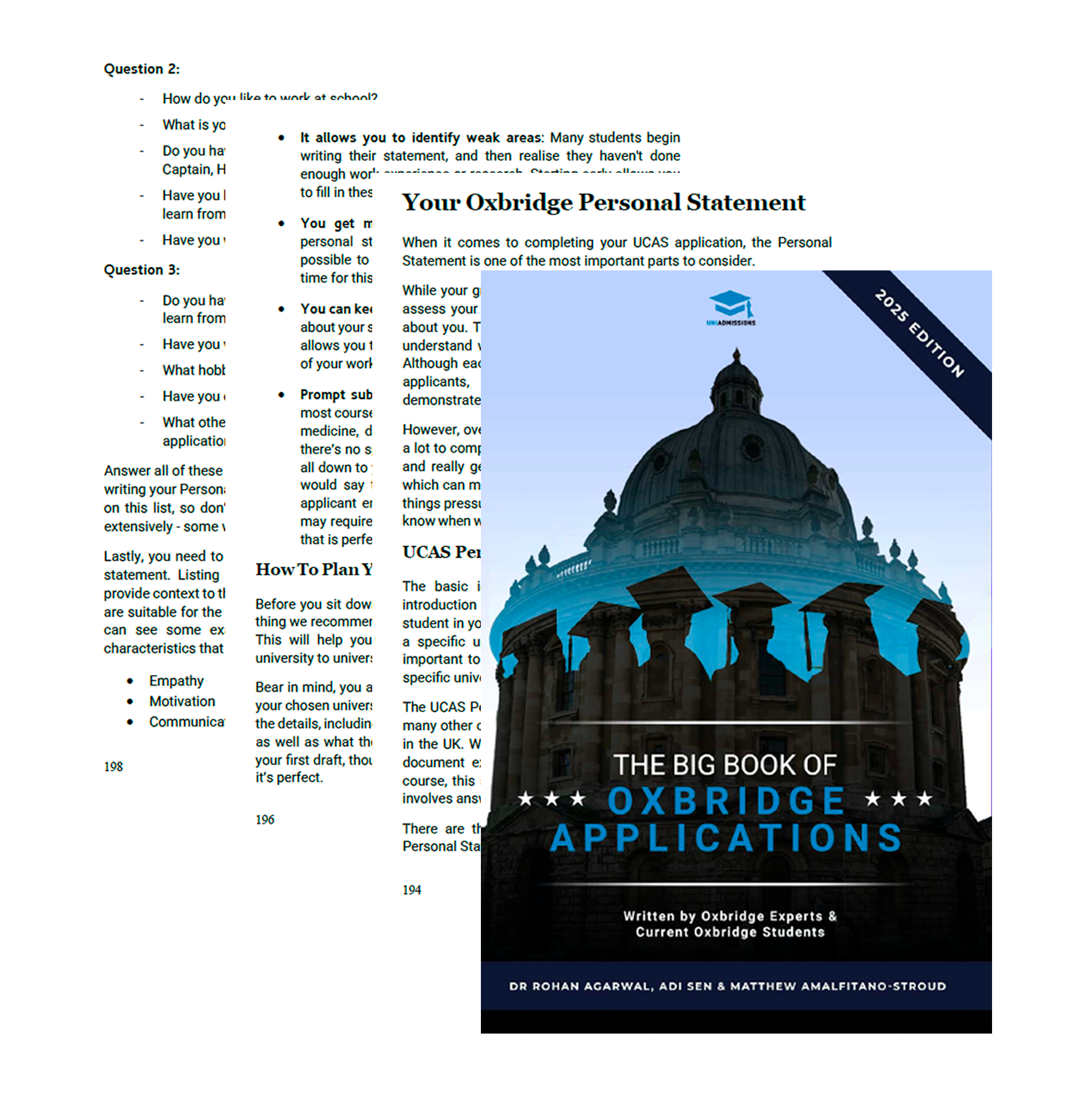
- A method to plan and write a compelling personal statement
- Proven strategies to stand out — even among top applicants
- 28 example Oxbridge Personal Statements
- Additional downloadable resources
Access "The Oxbridge Application Vault"
- 300+ page ebook for Oxbridge Applicants
- 25 page ebook for Personal Statement
- 2h+ online course to succeed in any exam
- Online Oxbridge Success Calculator
- 12 page ebook about UniAdmissions

Now, let’s hear from the writer of the statement to see what they have to say about it.
Good Points Of The Personal Statement
I used the following structure for my personal statement: First paragraph should be an area of the field you’re interested in. Then talk about the experiences which help you in the course itself, that is your A-level subjects and supercurriculars. The mention of Math Olympiad competition experiences would be a help if you have any, though not strictly necessary. I took a math-heavy A-level subject combination, so I made sure to highlight this and explain how it improved my mathematical knowledge. Extracurricular activities should be touched on briefly in a single paragraph, as most of the word limit ought to be course-focused. An important point which my personal statement executes rather well is explaining at each experience what exactly you learned and how it helped you improve mathematically or helped you to grow as a person. Simply listing supercurricular activities or experiences is not sufficient.
Bad Points Of The Personal Statement
For the first paragraph, find an interesting field or famous problem you can talk about, and make sure you familiarise yourself with the details as they may ask about it in the interview. For this, don’t write about anything too advanced to the point that you can’t fully understand it. I got lucky in that they didn’t ask but it’s safer not to take that risk. The personal statement should be more streamlined, as the word and character limit is much more limiting than the figure itself suggests. You should take care not to mention an excess of different examples/experiences /supercurriculars, instead focusing on a few important ones and explaining how they impacted you in greater detail. The conclusion may not have been necessary, and it would have granted more leeway for meeting the word limit. It’s worth including one only if you have extra words available. Oxford has also highlighted the inclusion of proof that you know what you’re getting yourself into when taking this course. In practice, this means math olympiads, books, online courses or math creators you enjoy (3 blue 1 brown is a common example). For this, it may have been worth leaning towards the supercurricular aspect rather than the extracurriculars in this personal statement.
UniAdmissions Overall Score:
★ ★ ★ ★ ★
I was very happy with how my statement was received, and I couldn’t believe it when I received offers from all five of my university options! I went through countless drafts of this, so my biggest piece of advice is not to be afraid of going back and making small edits as much as you need before submitting.
This Personal Statement for Mathematics is a great example of how to showcase a high level of ability. The candidate’s interest and achievements are clearly shown which is vital to Admissions Tutors.
Remember, at Oxford, these Admissions Tutors are often the people who will be teaching you for the next few years, so you need to appeal directly to them. Bear in mind you’ll have to meet other entry requirements before you can be eligible for an offer.
You can find more successful personal statements and our expert guides on our Free Personal Statement Resources page.
What Makes An Oxford Maths Personal Statement Different?
While there’s no set standard for Mathematics personal statements, most applicants will cover similar topics, such as their coursework, field trips and relevant work experience. However, Oxford isn’t as interested in these areas, and statements featuring just these topics won’t stand out. So, what can you do to make your statement different?
Firstly, while these typical experiences are important to cover, you need to explore them in depth rather than just providing surface level descriptions. Reflection is the key to a successful personal statement, which means exploring what you have learnt, how this knowledge has helped you develop your skills and how it changed your perception of Maths. This provides evidence of your genuine dedication to the subject.
However, beyond the experiences you’ve had, it’s also important to evidence your extra-curricular engagement with the subject, including wider reading and research projects. While this may not seem like the most interesting topic to discuss, it is exactly what Oxford is looking for in applicants. A huge part of studying at Oxford is the ability to work independently and guide your own learning beyond the classroom. As such, displaying a high level of curiosity in your statement will highlight that you have what it takes to succeed in the course.
Oxford aren’t looking for the applicants with the most impressive experiences – they are looking for the applicants that make the most of their time and resources to truly engage with their subject. This is what you need to prove in your writing.
Our expert tutors are on hand to help you craft the perfect Personal Statement for your Oxford Mathematics application.
With our Oxbridge Maths Full-Blue Programme, we help you craft the perfect Personal Statement, score highly on the TMUA and teach you how to Interview effectively.
Discover our Oxbridge Maths Full-Blue Programme by clicking the button below to enrol and triple your chances of success.
It’s important to consider that this Personal Statement was not originally written in the three question format currently used by UCAS. Below is the original, unedited version of this statement in the previous free-form style.
Oxford Mathematics Personal Statement (OLD FORMAT)
What is a number? A strange question, perhaps, but one whose dearth of a satisfying answer is unrivalled in demonstrating the breathtaking complexity that mathematics embodies. The steady expansion of a number’s meaning and purpose accompanies equally breathtaking areas of exploration – beyond the natural, to the imaginary to the hypercomplex on 4, 8, 16 dimensions. Yet as mystical as these fields are they still manage to find ingenious applications in, and indeed make up the very fabric of, this very real world of ours. Mathematics has no shortage of examples here integral to our way of life; Fourier transforms in signal processing, alternating current circuits, quantum mechanics and so on. This exhibition of the infinite breadth and depth of mathematics proves endlessly fascinating to me.
I was introduced to Math Olympiads at the age of 7, a passion which has aided me in diligently honing my skills in mathematical problem-solving and applying my knowledge to unfamiliar situations. Representing my school, state and country at numerous competitions such as the International Junior Math Olympiad has also afforded me invaluable chances to experience different cultures and confer with brilliant minds from my country and abroad. Balancing this with my academic work was a challenge that I took in stride, developing me into a self-directed learner with good time management skills.
At 15, I received a scholarship with the opportunity to study abroad, and I was presented with yet another challenge and opportunity – to live and learn independently, abroad and away from my family. Despite this and the incoming Covid pandemic, I maintained strong academic results throughout my 4 years abroad, fully self-driven in my learning. My interest in math had not remotely waned as evident in my continued and enthusiastic participation in competitions such as another Math Olympiad, in which I obtained a Silver Award in 2023.
For my A Levels, I made the decision to read H2 Further Mathematics and H3 Mathematics in line with my burgeoning passion for math. Further Math imbued me with greater understanding of mathematical applications in both abstract and real areas. In H3 Math, I honed my skills of mathematical logic and proof techniques, developing my ability to apply my knowledge beyond the typical syllabus. Despite the rigorous demands of learning such a wide breadth of advanced mathematical concepts, I persevered through my passion for further discovery of the world of math. My dedication to developing myself mathematically shone despite my academic workload in taking online courses such as Stanford University’s “Introduction to Mathematical Thinking” on Coursera, in which I further reinforced my abilities in logic and problem-solving heuristics.
In addition to this, my duties as the Vice-President of a local String Ensemble, which involved both musical aspects and logistics in event planning, provided me valuable skills of communication and teamwork. Dealing with last-minute changes were integral to the job, and I developed a cool head under pressure, which proved useful in my academic pursuits. The Protege Effect states the best way to learn is to teach – a lesson I took to heart in my mathematical pursuits by volunteering to teach younger students math, illustrating my intentions to spread the joy of math. Facing the difficulties in reading the mismatch between my understanding and my pupil’s as well as learning to prevent vagueness and clear the air around technical jargon provided invaluable wisdom in my efforts to develop myself as a more competent mathematician.
My commitment and passion to the field of mathematics is evident, and I cannot think of a better way to express it than to pursue further education in mathematics, in doing so rendering myself not only a better mathematician but a better person through my utilisation of math as a boon to the development of myself and my community.
*Minor edits were made to this statement to remove identifying information about the student.

