

5 things to know
Key Takeaways
- The average UCAT score in 2026 was 1918. That's the final mean total score across 42,359 tests, up 27 points on 2025's 1891. The number of tests also rose, from 41,354 in 2025.
- Quantitative Reasoning and Decision Making drove the rise. The 2026 subtest means were 602 for Verbal Reasoning (no change from 2025), 640 for Decision Making (up 12) and 675 for Quantitative Reasoning (up 14).
- You needed 2250 to reach the top 10% in 2026. The 9th decile rose from 2220 in 2025 to 2250, and the median (5th decile) moved from 1880 to 1920. Every decile boundary was higher than last year.
- Band 1 in the SJT got harder to achieve. Only 15% of candidates reached Band 1 in 2026, down from 21% in 2025, and 55% reached Band 1 or 2, down from 60%.
- A good UCAT score in 2026 is around 2050 to 2150, and a high score is 2250+. That's our view based on the deciles: 2050 to 2150 puts you roughly in the top 30% to 20% of candidates, and 2250+ puts you in the top 10%.
The UCAT (University Clinical Aptitude Test) was taken by more than 42,000 Medicine and Dentistry applicants in 2026 – but what is a good UCAT score to aim for?
With such strong competition for a limited number of places at Medical and Dental schools, it’s no wonder that all students want to find out whether they had a good UCAT score compared to the rest of the year’s cohort.
Unfortunately, there’s no definitive answer for what counts as a good UCAT score. Although there are suggested cut-offs, there is no such thing as a “score you need to get into X Medical School” as the UCAT forms only one component of the application and your Personal Statement, A-level grades, GCSE and Interview performance all need to be strong too.
That said, we can take a look at the mark distributions of the previous years to give you an idea of where a UCAT score stands within your cohort year. This article will do just this, as well as explore the UCAT requirements of some of the top medical schools and where you may wish to apply with the mark you get. Let’s dive in.
UCAT Results 2026
Testing for 2026 has now finished, so we have the final results for every UCAT test taker this year. A total of 42,359 UCAT tests were completed in 2026, around 1,000 more than in 2025 (41,354) and the highest total in the table below.
Here are the mean scores for each subtest of the UCAT in 2026:
UCAT 2026 Mean Score
1918
UCAT Verbal Reasoning 2026 Mean Score
602
UCAT Decision Making 2026 Mean Score
640
UCAT Quantitative Reasoning 2026 Mean Score
675
2026 is only the second year of the three-subtest UCAT, so 2025 is the only fair comparison. Overall, candidates scored 27 points higher on average, with Quantitative Reasoning and Decision Making behind the whole increase. Verbal Reasoning didn’t move at all.
The final figures came in well below the interim ones. In mid-September, with about half the cohort tested, the mean was 1970. It finished at 1918, a drop of 52 points, which is similar to the 48-point drop between the interim and final results in 2025. If you compared your score against the interim figures, it’s worth checking again against the final ones below.
Meanwhile, the 2026 Situation Judgement results are as follows:
UCAT 2026 SJT Band 1
15%
UCAT 2026 SJT Band 2
40%
UCAT 2026 SJT Band 3
34%
UCAT 2026 SJT Band 4
11%
The SJT moved in the opposite direction to the cognitive subtests. Fewer candidates reached Band 1 (15% vs 21%), and 55% achieved Band 1 or 2, compared with 60% in 2025. Band 3 grew from 29% to 34%. That makes a Band 1 more valuable this year, and a Band 2 is still better than what 45% of candidates achieved.
How is the UCAT scored?
As you may already know, the UCAT consists of four sections:
The three cognitive subtests (Verbal Reasoning, Decision Making and Quantitative Reasoning) are scored in the same way. Your raw marks in each one are converted to a scaled score between 300 and 900. These three scores are added together to give your total UCAT score, which ranges from 900 to 2700. This total is sometimes divided by three to give an average score on the 300 to 900 scale. The Situational Judgement Test is scored separately, in Bands 1 to 4.
The test previously included an additional subtest – Abstract Reasoning – but this has since been removed. This subtest was scored on a scale of 300 – 900 and was included in the final overall score. Therefore, it’s important to take into account that results from previous years of the UCAT could be as high as 3600. This is no longer the case as of 2025.
When Do UCAT Results Come Out?
Applicants get their UCAT results straight after completing their test, so you won’t have to wait long to see how you did. However, many applicants will also want to see their score compared to other test-takers.
UCAT publishes two reports for each testing period. The first is a preliminary (or interim) score report, which provides the mean scores of roughly half the applicant pool. These are typically released in mid-September and can be useful for estimating the final results of the cohort. You can review 2026’s interim results in our dedicated guide.
The final results for the test are published soon after the final testing day, normally at the end of September or early October. These detail the same mean scores and decile ranks as the interim scores, but they account for every test taker that year, giving the definitive review of the results.
Applicants can use the mean scores and decile ranks to understand how they performed compared to other students and get a better view of how competitive their application is, so it’s a good idea to look at these results.
In 2026, the average score per cognitive subtest was roughly 639 (a 1918 total), and 80% of candidates scored between 1590 and 2250 overall, or about 530 to 750 per subtest. Average scores vary between sections, though. Here are the average scores for each section over recent years:
Average UCAT Scores
| Verbal Reasoning | |||||||
| Decision Making | |||||||
| Quantitative Reasoning | |||||||
| Abstract Reasoning | NA | NA | |||||
| Total | |||||||
| Total UCAT Tests Sat |
However, the Situational Judgement Test is marked differently because the answers can be close to being right, but not exactly correct, and still get you some marks. Each candidate’s average score places them in either Band 1 (best), Band 2, Band 3, or Band 4 (worst). The data from the UCAT Consortium lists the average UCAT scores for applicants. Here are the scores for recent years.
Average SJT UCAT Scores
| 2027 Entry | 2026 Entry | 2025 Entry | 2024 Entry | 2023 Entry | 2022 Entry | 2021 Entry | |
|---|---|---|---|---|---|---|---|
| Band 1 | 15% | 21% | 13% | 25% | 20% | 14% | 30% |
| Band 2 | 40% | 39% | 36% | 39% | 36% | 36% | 36% |
| Band 3 | 34% | 29% | 38% | 26% | 31% | 33% | 24% |
| Band 4 | 11% | 10% | 13% | 9% | 14% | 16% | 9% |
Each candidate is assigned a Band from 1 to 4, with 1 being the best score. Ideally, you should aim to get a Band 1 or 2 to put yourself in a good position. Some universities have a cut-off band for the SJT so will not accept candidates with a Band 4 score in the SJT.
UCAT Decile Rankings 2026
UCAT deciles split all test takers into groups of 10%. Each score shown is the threshold for that decile, so an applicant who scored 2250 or above in 2026 was in the 9th decile, meaning they scored higher than 90% of test takers. Here are the deciles for 2026, with 2025 for comparison:
| Decile Rank | Score (2026) | Score (2025) | Verbal Reasoning | Decision Making | Quantitative Reasoning |
|---|---|---|---|---|---|
| 1st | 1590 | 1580 | 500 | 520 | 530 |
| 2nd | 1700 | 1680 | 540 | 560 | 580 |
| 3rd | 1780 | 1760 | 560 | 590 | 600 |
| 4th | 1850 | 1820 | 580 | 620 | 640 |
| 5th | 1920 | 1880 | 600 | 640 | 670 |
| 6th | 1980 | 1950 | 620 | 670 | 700 |
| 7th | 2050 | 2010 | 640 | 690 | 730 |
| 8th | 2140 | 2100 | 670 | 710 | 780 |
| 9th | 2250 | 2220 | 710 | 760 | 820 |
Every overall decile boundary is higher than in 2025. The biggest jumps (40 points) are at the 5th, 7th and 8th deciles, so the middle and upper-middle of the cohort is where scores have shifted most. At the top, the 9th decile rose by 30 points, from 2220 to 2250.
Looking at the subtests, the Verbal Reasoning deciles are identical to 2025 apart from the 9th (700 to 710). Decision Making is up by 10 to 20 points from the 4th decile upwards, and Quantitative Reasoning is up at almost every decile, with the 8th decile jumping 30 points from 750 to 780.
In practice, a score that put you in the 8th decile last year (2100) would only just clear the 7th decile in 2026.
UCAT Score Conversions 2026
So we know that UCAT scores fall on a scale of 300 – 900, but, of course, you aren’t going to be answering 900 questions in each section! As previously mentioned, your raw marks in each subtest will be converted into a UCAT score within that scale. The number of questions in each subtest is as follows:
- Verbal Reasoning - 44 Questions
- Decision Making - 35 Questions
- Quantitative Reasoning - 36 Questions
- Situational Judgement - 69 Questions
The official conversion calculation used by UCAT is unfortunately not publicly available and potentially changes from year to year. UCAT states that it is impossible to make direct comparisons between scores from two different subtests due to the different amounts of questions, so each one has its own score conversion calculation.
Also, remember that Situational Judgement is marked using a completely different system, although raw marks are still the initial measure of performance before conversion.
UniAdmissions have a 74% medicine application success rate – our students are 6x more likely to gain their place than the average candidate.
Got the right UCAT Score? Now it’s time to prepare for your medical school interviews.
With UniAdmissions’ UCAT Tuition Programme, you will be supported with a fully developed curriculum that takes you through all aspects of the UCAT, with one-to-one support from an expert UCAT tutor who scored in the top 10%. You will also have access to a whole suite of expert resources, live courses and much more.
Discover our UCAT Tuition Programme today by booking a free consultation session or clicking the button below.
With UniAdmissions’ Medicine Interview Programme, you will be supported with a fully developed curriculum that takes you through everything you need to know about panel interviews or MMIs. With one-to-one support from an expert medicine tutor who got their offer, live courses and access to a whole suite of expert resources, you’ll have everything you need to impress your interviews.
Discover our Medicine Interview Programme today by booking a free consultation session or clicking the button below.
What is a good UCAT Score?
Firstly, a good UCAT score is different to a ‘high’ UCAT score. Secondly, good UCAT scores vary between years depending on how the cohort performs.
For 2026, the average score was 1918 (around 639 per subtest), 27 points higher than in 2025. Based on the 2026 deciles, we’d suggest that a good score was around 2050 to 2150 overall (roughly 685 to 715 per subtest). That puts you somewhere between the 7th decile (2050) and just above the 8th (2140), or roughly in the top 30% to 20% of candidates.
Bear in mind that this bar has moved. Last year we suggested 2000 to 2100 was a good score. In 2026, 2000 only just clears the 6th decile (1980), so it’s above average but not much more than that.
Mean scores have now risen two years running on the new format, so a good score could be higher again in 2027. For the SJT, we still recommend aiming for at least Band 2. With only 15% of candidates reaching Band 1 this year, a Band 1 will really help you stand out.
Is My UCAT Score Good? Every Score Compared (2026)
The quickest way to judge your score is to compare it with the 2026 deciles, which split everyone who sat the test this year into tenths. Find your total score below:
- 2250 or above: top 10% of candidates. A high score for any UCAT university; 2300 and 2400 are both here.
- 2140 to 2240: top 20%. A very good score; 2200 is here.
- 2050 to 2130: top 30%. A good score; 2100 is here.
- 1980 to 2040: better than about 60% of candidates. Above average; 2000 is here.
- 1920 to 1970: around the middle. The average was 1918, so 1950 is just above average.
- 1850 to 1910: just below the middle. Queen Mary, for example, requires at least the 4th decile, which was 1850 in 2026.
- Below 1850: the lower 40% of candidates. Look at medical schools that put less weight on the UCAT: see our guide to universities to apply to with a low UCAT score.
Your SJT band matters too: Manchester does not consider Band 3 or 4, and Edinburgh, Newcastle and Queen Mary do not consider Band 4. For every medical school’s requirements, see our guide to UK UCAT universities.
Where to apply with a good UCAT score
Remember that each university uses UCAT scores differently, so the best way to make the most of your score is to apply to the Medical Schools that place the right level of emphasis on the UCAT that suits your performance. For every medical school, see our guide to UK UCAT universities. Here are some examples of medical schools that require good UCAT scores.
University of Cambridge
As an Oxbridge university, Cambridge is seen as one of the top medical schools in the world. The university previously used the BMAT for its medicine admissions but has now moved to the UCAT. In the 2025 admissions cycle, 1,530 people applied for Medicine at Cambridge and 307 received an offer, about one in five, so this course is reserved for applicants with strong applications, which include a high UCAT score.
Below are Cambridge’s own figures for 2025 entry, the last year of the four-subtest UCAT, when the total was out of 3600. They cover all colleges; Cambridge does not split them by domicile and has not yet published scores for the three-subtest test:
| Subtest | Applicants | Offer holders | Accepted |
|---|---|---|---|
| Verbal Reasoning | 667 | 717 | 712 |
| Decision Making | 709 | 768 | 767 |
| Quantitative Reasoning | 746 | 800 | 803 |
| Abstract Reasoning | 739 | 788 | 788 |
| Total (out of 3600) | 2,861 | 3,072 | 3,070 |
| Situational Judgement (average band) | 2.12 | 1.82 | 1.81 |
Source: University of Cambridge, undergraduate admissions statistics, admissions test scores for the 2025 apply year (all colleges).
As we can see, the average applicant scored between 667 and 746 in each subtest, well above the averages for everyone who sat the test that year, and offer holders scored around 50 points higher again in every subtest. The highest average was for Quantitative Reasoning, at 800 for offer holders, which suggests that many of them scored close to full marks in this subtest. For 2027 entry, Cambridge says it will look at the overall cognitive score, will not use the SJT, and has no minimum UCAT score.
In fact, we know that many applicants did actually score full marks in this subtest, based on the college data provided by Cambridge:
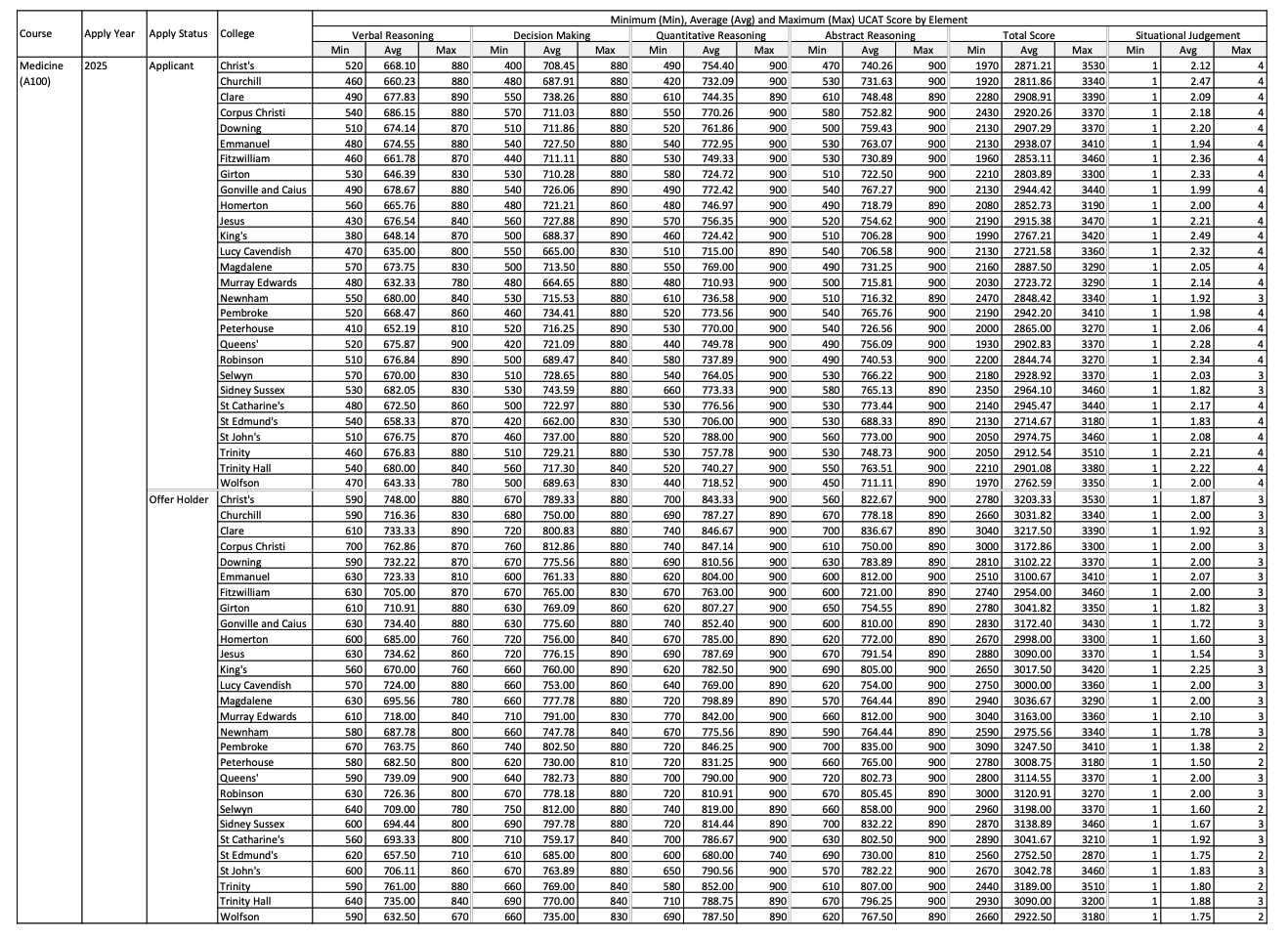
Overall, you’re going to need to achieve a really impressive score to remain competitive for Cambridge Medicine.

City St George’s, University of London
City St George’s, University of London (formerly St George’s) uses a UCAT cut-off: you need at least 500 in each subtest and an overall score above a minimum it sets every year. For 2026 entry, the first year of the three-subtest UCAT, the cut-off was 1880 for home applicants and 1640 for overseas applicants. The 2027 entry cut-off will be published once all interview invitations have been sent, and the university will also consider your Situational Judgement band.

King's College London
King’s College London does not set a minimum UCAT score. Applications are first ranked using UCAT performance, GCSE grades and widening participation indicators, and the Situational Judgement Test is not used for shortlisting. King’s has not yet published scores for the three-subtest UCAT. Its latest figures, for 2024 entry on the old scale out of 3600, show that interviewed applicants averaged 3020 against 2744 for all applicants, so a strong score still makes a real difference.
University of Edinburgh
The University of Edinburgh is one of the most renowned medical schools in Scotland. Its minimum UCAT score for 2027 entry is 1850, but meeting it is only the first step: your UCAT decile then makes up 17.5% of the selection score and your SJT band 7.5%, alongside your academic record (25%) and the Assessment Day (50%). Applicants with Band 4 in the SJT will not be considered.
University of Southampton
The University of Southampton ranks applicants by UCAT score and invites the top candidates to one of its selection days, ranking home and international applicants separately. It does not publish a cut-off, so the score you need depends on that year’s applicants, but a good score is essential to reach the interview stage. Southampton also uses the UCAT to separate applicants whose selection day scores are tied.
Worried About the UCAT? Let The Big Book of Oxbridge Applications Be Your Guide
The UCAT can feel like a big unknown, from how it fits into admissions decisions to what effective preparation actually looks like. If you’re unsure where to start or how to make the most of your study time, you’re not alone.
The Big Book of Oxbridge Applications takes the guesswork out of UCAT prep. The UCAT section of this free book gives you everything you need to understand the test and approach it with confidence. Inside, you’ll find:
- A clear overview of the exam structure and each subtest
- Up-to-date information on test dates and format
- Targeted preparation strategies to help you study efficiently
- Practice questions that reflect the real test
- A free UCAT mock paper to download
What is a high UCAT Score?
Again, it is difficult to pinpoint what makes a ‘high’ UCAT score, as the UCAT requirements of medical schools all differ from each other, and each year the spread of marks achieved by applicants fluctuates.
However, you could say that a high UCAT score in 2026 is 2250 or above (an average of 750+ per subtest), along with a Band 1 in the Situational Judgement Test.
A score of 2250 put you in the top 10% of the 2026 cohort. Combine that with a Band 1, which only 15% of candidates achieved, and you’ll comfortably clear the cut-offs used by most UCAT universities.
Where to apply with a High UCAT score
If you’ve scored highly on the UCAT, you might consider a Medical School with a higher UCAT cut-off score or average offer-holder results. Here are a few examples:
University of Bristol
The University of Bristol does not use the personal statement to select applicants for interview. Once you meet the minimum grades, the decision to interview is based entirely on your UCAT score, without the Situational Judgement Test. For 2026 entry, the threshold to be invited to interview was 2240 for home applicants and 2270 for overseas applicants, just above the score that marked the top 10% of candidates in the 2025 test (2220). Bristol sets a new threshold every year, so it may be different for 2027 entry.
University of Manchester
The University of Manchester sets its UCAT threshold each year once results arrive in November. For 2026 entry, applicants who scored 2060 or more (2250 for overseas applicants, 1960 for widening participation applicants) were automatically invited to interview, and shortlisted applicants averaged 2193. Manchester does not consider applicants with Band 3 or 4 in the Situational Judgement Test.
Newcastle University
Newcastle University puts a lot of weight on the UCAT. For home applicants, the UCAT is worth up to 60 of the 100 points that decide who is interviewed, with the other 40 coming from academic results: 2400 or above earns the full 60 points, and 1810 or below earns 1. International applicants are ranked on their total UCAT score alone. Selectors do not see the personal statement, and applicants with Band 4 in the SJT will not be considered.
University of Glasgow
The University of Glasgow uses the UCAT as its main way of choosing applicants for interview, once they meet the minimum academic requirements. For 2026 entry, the thresholds for interview were 1870 for applicants from Scotland, 1990 for the rest of the UK and 2150 for international and EU applicants. Glasgow does not use the Situational Judgement Test, and it publishes each year’s thresholds only when the cycle is over (September 2027 for 2027 entry).
This is by no means a definitive list of UCAT universities and their requirements, but having an understanding of what you should be aiming for will help you in your preparation.
It is also important to note that the average UCAT scores or UCAT requirements are not a reflection of the quality of the medical school, so don’t assume that the universities with the highest requirements are the best ones for you. Do your research and attend open days to help you decide where you would like to study. The information in this guide is simply to inform you of your chances of gaining an offer with different scores.
What happens if I get a low UCAT Score?
If the UCAT score you achieved isn’t as high as you wanted it to be, don’t be too disappointed. The key is to apply to Medical Schools that place more emphasis on your GCSE and A-level grades and your interviews. Cardiff, for example, has no minimum UCAT score and combines your UCAT decile with your GCSE results, while Queen Mary University of London only requires a score in the 4th decile or above (with SJT Band 1 to 3) before it looks at the rest of your application.
If your UCAT score was closer to average you will find there are plenty of medical schools that have similar average scores for their successful candidate’s results. Many of these medical schools have been known to admit applicants with much lower scores, with some successful candidates scoring well below the average. The key here is to choose universities that de-emphasise the UCAT and ensure that your Personal Statement and Interview techniques are extremely competitive.
We have a full guide on which universities to apply to with a low UCAT score, so check it out if you’re worried about what you can do with a lower UCAT score.
That concludes our guide on UCAT scoring and results. Any medicine applicant should be aiming to do the best that they can, so don’t feel that you need to limit yourself based on the average scores of previous years. Go in with the attitude that you will get a high score and you will be more likely to find success. If you are sitting the test next year, check the UCAT registration dates and deadlines early.
Of course, the most important thing you can do to ensure you get a great score is to effectively prepare for the UCAT. If you’re looking for the best way to prepare for the UCAT, discover our Medicine Programme, which supports you in your journey all the way through to your test date, as well as every other aspect of your application.
Happy with your UCAT Score? What about the rest of your application?
Happy with your UCAT Score? Your interviews are next!
The UCAT is just one part of your Medical School application. A strong application for Medicine also includes nailing your Personal Statement and Interviews. Our Standard Medicine Programme aims to maximise your Admissions Test score, perfect your Personal Statement and develop your Interview skills to get you Interviewing like a pro.
Discover our Standard Medicine Programme by booking a free consultation session or clicking the button below to enrol and triple your chances of success.
The UCAT is just one part of your Medical School application. The last step to getting your offer is your interviews, so consider our Medicine Interview Programme to develop your Interview skills and perform like a pro.
Discover our Medicine Interview Programme by booking a free consultation session or clicking the button below to enrol and triple your chances of success.
Frequently Asked Questions
The highest UCAT score for the first three sections (Verbal Reasoning, Decision Making, and Quantitative Reasoning) is 2700. For the Situational Judgement section, the highest score is Band 1. To achieve this score, you will need a very thorough preparation including strategic practice and knowing all the UCAT-specific exam techniques.
A good UCAT score depends on how the cohort performs each year. For 2026 (2027 entry), a good UCAT score sits around 2050 to 2150 overall (roughly 685 to 715 per subtest), which is about the top 30% to 20% of candidates. The 2026 average was 1918 and the top 10% started at 2250. If you scored in that range and achieved Band 1 or 2 in the Situational Judgement Test, you're in a competitive position for most UK medical schools.
No. Several well-regarded medical schools place more weight on GCSEs, A-Level grades, the personal statement and interview performance than on the UCAT. Cardiff, for example, has no minimum UCAT score, and Queen Mary University of London only requires the 4th decile or above. The key is matching your score to universities whose selection process suits your overall profile rather than assuming a below-average UCAT closes all doors.
It is scored separately and carries real weight. Several universities will not consider applicants who achieve Band 4 in the SJT, however well they scored in the cognitive subtests. Aim for at least Band 2. In 2026, 55% of test takers achieved Band 1 or 2 (down from 60% in 2025), and only 15% reached Band 1, so it is achievable with the right preparation but it isn't a formality.
You receive your results immediately after completing the test, so there is no waiting period for your individual score. What takes longer is understanding where your score sits relative to other applicants. UCAT publishes a preliminary cohort report in mid-September covering roughly half the applicant pool, followed by the full results report at the end of September or early October. That final report is when you can accurately assess how competitive your score is against the full year's cohort.
In 2026, 2000 was above average but not a high score. The average was 1918, and 2000 sits between the 6th decile (1980) and the 7th (2050), so it beat roughly 60% of candidates. It would have cleared some published thresholds for 2026 entry, such as 1880 for home applicants at City St George’s and 1990 for applicants from the rest of the UK at Glasgow, but not those of schools that select mainly on the UCAT, such as Manchester (2060) and Bristol (2240). Thresholds are set again every year.
Yes. In 2026, 2100 sat between the 7th decile (2050) and the 8th (2140), so it beat roughly 70% of candidates. With Band 1 or 2 in the Situational Judgement Test, it makes you a competitive applicant at most medical schools. At schools that rank applicants almost entirely on the UCAT it may still fall short: Bristol’s threshold for interview for 2026 entry was 2240 for home applicants.
The average total score in 2026 was 1918, across 42,359 tests. By subtest, the averages were 602 for Verbal Reasoning, 640 for Decision Making and 675 for Quantitative Reasoning. That is 27 points higher than in 2025, when the average was 1891.
The UCAT Consortium says the dates for the 2027 test will be published by February 2027. In 2026, registration opened on 20 May, testing ran from 13 July to 24 September and results reached universities in early November, so expect a similar timetable. A score from the 2027 test can only be used to apply for 2028 entry. See our guide to UCAT registration dates and deadlines.


