

Welcome to our popular Personal Statement series where we present a successful Personal Statement, and our Oxbridge Tutors provide their feedback on it.
Today, we are looking through an Engineering applicant’s Personal Statement that helped secure a place at Oxford University. The Engineering Course at Oxford is based on a unified course in Engineering Science, which integrates study of the subject across the traditional boundaries of engineering disciplines.
Read on to see how this candidate managed to navigate the many disciplines of Engineering.
Here’s a breakdown of the Personal Statement:
CHARACTERS
3,709
WORDS
617
SUCCESSFUL?
5/5
The universities this candidate applied to were the following:
OXFORD
OFFER
IMPERIAL
OFFER
BRISTOL
OFFER
DURHAM
OFFER
EXETER
OFFER
Oxford Engineering Science Personal Statement (NEW FORMAT)
Why do you want to study this course?
I have always considered myself creative; much of my youth was spent designing and building with my Dad in his workshop. I would read encyclopaedias on cars and watch design-related TV programmes such as BBC’s Robot Wars, analysing the strengths and weaknesses of each robot and thinking about how they could be improved. This background, combined with a genuine enjoyment of mathematics and physics, has given me a desire to read engineering at university.
Reading Marcus du Sautoy’s “The Music of the Primes” and Simon Singh’s “Fermat’s Last Theorem” has shown how individuals have dedicated their lives to solving seemingly simple problems. The main attraction of these books and mathematics more widely, is problem solving, which is also what draws me to engineering.
Reading Steven Johnson’s “Where Good Ideas Come From” discussed the theory that “ideas are generated by crowds where connection is more important than protection” and for me this epitomises the importance of team work and communication within engineering.
Ultimately, I would like to play a role in the future of our rapidly developing world; studying engineering at university will not only give me the skills to do this, but will also stimulate my passion for mathematics and science.
How have your qualifications and studies helped you to prepare for this course or subject?
Solving a wide variety of problems is something I really enjoy; in the most recent UKMT Senior Maths Challenge, I was awarded a gold certificate, also the best score in my year at school.
Studying physics at A-Level has helped me to understand the world, and answered questions I had as a child; why does a satellite stay in orbit? How does gravity work? Why does a clock pendulum keep in time? My favourite aspect of physics is mechanics, complemented by my maths mechanics modules. The application of physics and mechanics to engineering was obvious from the outset; it is a fundamental skill set which bridges the gap between science and invention. I also enjoy studying Further Pure Mathematics, in particular calculus, and am interested in how the solutions of second order differential equations apply to problems in mechanics.
Projects including designing and making a desk lamp, a torch and bench vice grips in GCSE Engineering gave me an initial insight into the discipline. The course gave me hands on experience with equipment typical of an engineering department. Considering the benefits of materials was important too; from an economic, aesthetic, and practical perspective.
What else have you done to prepare outside of education, and why are these experiences useful?
I also secured work experience at a BMW Mini Plant in the ‘Whole Vehicle Analysis’, section. One project involved heating up a Mini’s bonnet to address complaints from customers in hot countries that the bonnet scoop sagged. I used CNC measuring equipment and helped to write up one of a series of reports, resulting in an alloy being added to the scoop so it retained its structure. The week introduced me to engineering in the real world, the importance of quality control and precision and the cost of a company’s mistakes.
Aside from my studies, I have always had a musical interest and am working towards grade 7 piano. I completed work experience at the local ‘Yamaha Homeworld’ music shop specialising in top range digital pianos. I am constantly impressed at how a digital piano can look, feel, and respond exactly like a real piano. I like being part of a team and am a keen rugby and cricket player. Being elected as prefect and head boy has further helped me to work well, and get on with others, as well as improving my public speaking. This has been complemented by taking Grade 8 ‘Speaking in Public’ last year, in which I achieved a distinction. I now feel confident talking in front of large groups and being able to communicate my ideas easily.
Break Free from the Personal Statement Spiral
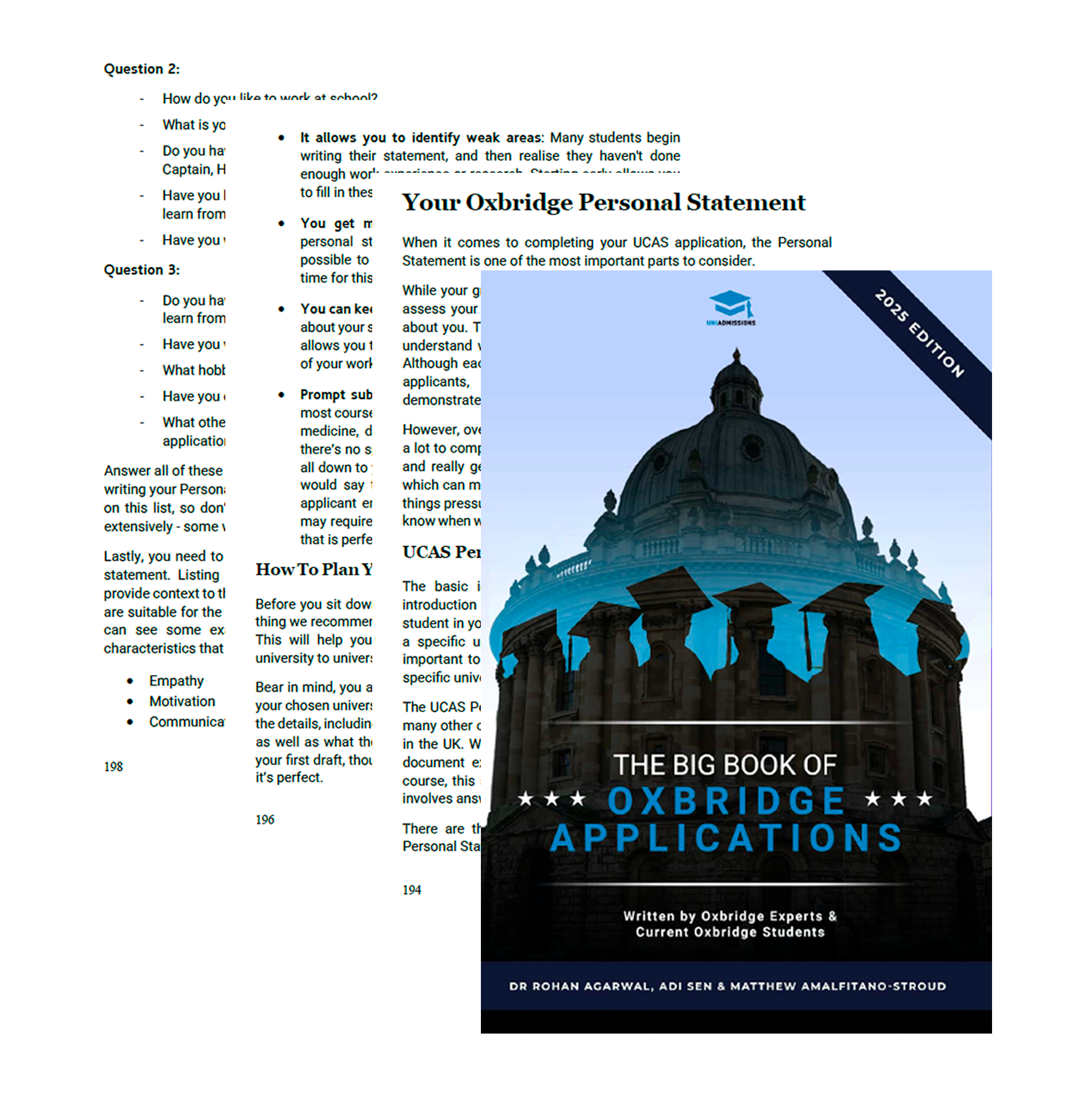
- A method to plan and write a compelling personal statement
- Proven strategies to stand out — even among top applicants
- 28 example Oxbridge Personal Statements
- Additional downloadable resources
Our Tutors' Feedback On This Oxford Engineering Science Personal Statement
Good Points
This is an excellent statement.
The student begins with personal reasons as to why they are interested in engineering, and by the end of the introduction, the reader is left in no doubt that the student is absolutely sure they want to pursue engineering at a higher level. The student successfully describes a range of experiences and interests covering several engineering disciplines and keeps the application general enough to be relevant to a general engineering degree. The statement is well-structured with a clear introduction, main body, and end.
Bad Points
Although the student mentions several experiences/interests covering several engineering disciplines, they fall short of naming a specific engineering discipline that captures their interest.
Whilst this is not a requirement, naming a particular field of engineering as capturing one’s interest above other fields would demonstrate a level of decisiveness to the reader. Many universities do not offer general engineering degrees, and it is possible a student who is applying for engineering at Oxford or Cambridge will also make several applications to universities for specific engineering disciplines.
It is important to keep the statement general enough for applications to general engineering courses but also specific enough for applications to individual engineering disciplines. This would have been possible by stating an interest in a particular engineering discipline.
UniAdmissions Overall Score:
★ ★ ★ ★ ☆
This is an excellent statement, one that is well-written and well-structured. The student’s motivation to study engineering is clear, although the student falls short of naming a specific field of engineering which capture’s their interest above all others.
Because of this one negative, we’re awarding this statement 4/5 stars. However, it’s important to note this rating is based on the overall strength of the statement. Although it had potential to be a little stronger, this had no impact on the number of offers the candidate received.
Enrolling on our Oxbridge Engineering comprehensive Programme will give you access to Personal Statement redrafts.
With our Oxbridge Engineering Premium Programme, your tutor will give you regular actionable feedback with insider tips on how to improve and make your Personal Statement Oxbridge quality for the best chances of success.
Discover our Engineering Programme today to learn how you can enrol and triple your chances of success.
What makes an Oxford Engineering Science statement different?
A strong Oxford Engineering Science personal statement must show more than an interest in designing or building things. Tutors are looking for applicants with a genuine enthusiasm for engineering principles, supported by exceptional strength in mathematics and physics, as these subjects form the foundation of the course.
This means a competitive statement should demonstrate analytical and problem-solving thinking, showing how you approach technical challenges logically and apply mathematical or scientific ideas to understand real-world systems. Rather than focusing only on projects or practical experiences, strong applicants reflect on the engineering concepts behind them and show intellectual engagement with how things work.
Oxford is particularly interested in students who show academic depth, curiosity, and readiness for rigorous scientific study. A successful statement should therefore highlight your motivation for engineering, evidence of mathematical and physical reasoning, and a clear ability to think critically about complex technical problems.
Oxford Engineering Science Personal Statement (OLD FORMAT)
Please note that the personal statement presented earlier in this guide was not originally written in the three-question format currently used by UCAS. Below is the original, unedited version of this statement in the previous free-form style.
—
I have always considered myself creative; much of my youth was spent designing and building with my Dad in his workshop. I would read encyclopaedias on cars and watch design-related TV programmes such as BBC’s Robot Wars, analysing the strengths and weaknesses of each robot and thinking about how they could be improved. This background, combined with a genuine enjoyment of mathematics and physics, has given me a desire to read engineering at university.
Reading Marcus du Sautoy’s “The Music of the Primes” and Simon Singh’s “Fermat’s Last Theorem” has shown how individuals have dedicated their lives to solving seemingly simple problems. The main attraction of these books and mathematics more widely, is problem solving, which is also what draws me to engineering. Solving a wide variety of problems is something I really enjoy; in the most recent UKMT Senior Maths Challenge, I was awarded a gold certificate, also the best score in my year at school.
Studying physics at A-Level has helped me to understand the world, and answered questions I had as a child; why does a satellite stay in orbit? How does gravity work? Why does a clock pendulum keep in time? My favourite aspect of physics is mechanics, complemented by my maths mechanics modules. The application of physics and mechanics to engineering was obvious from the outset; it is a fundamental skill set which bridges the gap between science and invention. I also enjoy studying Further Pure Mathematics, in particular calculus, and am interested in how the solutions of second order differential equations apply to problems in mechanics.
Projects including designing and making a desk lamp, a torch and bench vice grips in GCSE Engineering gave me an initial insight into the discipline. The course gave me hands on experience with equipment typical of an engineering department. Considering the benefits of materials was important too; from an economic, aesthetic, and practical perspective. I also secured work experience at a BMW Mini Plant in the ‘Whole Vehicle Analysis’, section. One project involved heating up a Mini’s bonnet to address complaints from customers in hot countries that the bonnet scoop sagged. I used CNC measuring equipment and helped to write up one of a series of reports, resulting in an alloy being added to the scoop so it retained its structure. The week introduced me to engineering in the real world, the importance of quality control and precision and the cost of a company’s mistakes.
Aside from my studies, I have always had a musical interest and am working towards grade 7 piano. I completed work experience at the local ‘Yamaha Homeworld’ music shop specialising in top range digital pianos. I am constantly impressed at how a digital piano can look, feel, and respond exactly like a real piano. I like being part of a team and am a keen rugby and cricket player. Being elected as prefect and head boy has further helped me to work well, and get on with others, as well as improving my public speaking. This has been complemented by taking Grade 8 ‘Speaking in Public’ last year, in which I achieved a distinction. I now feel confident talking in front of large groups and being able to communicate my ideas easily. Reading Steven Johnson’s “Where Good Ideas Come From” discussed the theory that “ideas are generated by crowds where connection is more important than protection” and for me this epitomises the importance of team work and communication within engineering.
Ultimately, I would like to play a role in the future of our rapidly developing world; studying engineering at university will not only give me the skills to do this, but will also stimulate my passion for mathematics and science.
And there we have it – an Oxford Engineering Personal Statement with feedback from our expert tutors.
Remember, at Oxford, the Admissions Tutors are often the people who will be teaching you for the next few years, so you need to appeal directly to them.
Check out our Free Personal Statement Resources page for even more successful personal statements and expert guides.
For more inspiration, take a look through our other successful Personal Statement analysis articles:
Our expert tutors are on hand to help you craft the perfect Personal Statement for your Oxford Engineering application.
With our Oxbridge Engineering Premium Programme we help you craft the perfect Personal Statement, and teach you how to Interview effectively.
Discover our Engineering Programme by clicking the button below to enrol and triple your chances of success.

