

Welcome to our popular Personal Statement series where we present a successful Personal Statement, and our Oxbridge Tutors provide their feedback on it.
Today, we are looking through an English Language and Literature applicant’s Personal Statement that helped secure them a place at Oxford. The English Language and Literature course at Oxford is one of the broadest degrees in the country, so let’s see how the applicant navigated around this to write a strong Personal Statement.
Here’s a breakdown of the Personal Statement:
CHARACTERS
3,735
WORDS
609
SUCCESSFUL?
4/5
The universities this candidate applied to were the following:
OXFORD
OFFER
DURHAM
REJECTED
EXETER
OFFER
BATH
OFFER
ST ANDREWS
OFFER
Oxford English Language and Literature Personal Statement (NEW FORMAT)
Why do you want to study this course?
George Eliot’s metaphor for imagination- ‘inward light which is the last refinement of Energy … bathing even the ethereal atoms in its ideally illuminated space’- is beautiful. The powerful image supported by the underlying liquid consonants skilfully leads to the action it describes, but it is also the suggestion of particle physics and mass-energy equivalence that interests me about this quotation. In this way, I have gained more from reading ‘Middlemarch’ as I appreciate Eliot’s constant links between science and fiction, and I believe scientific study has generally sharpened my abilities of analysis and concise expression.
I enjoyed Dickens’ ‘Our Mutual Friend’ for its satirical portrayal of superficial London society. His depiction of characters and scenes make the novel humorous and therefore very different to ‘A Tale of Two Cities’. Here, the powerful characterisation emphasises the terrible human suffering and moral corruption, for example his effective personification of ‘La Vengeance’, who encourages the cries of bloodlust from Parisians. I found it easier to empathise with Jude in Hardy’s ‘Jude the Obscure’ than with Dickens’ creations however, since his actions appear futile against the fate which continually works against him. There seems to be no hope in the novel, unlike the eventual triumph of love over death in ‘A Tale of Two Cities’. Just as in ‘Tess of the d’Urbervilles’ and ‘A Pair of Blue Eyes’, love and happiness seem only like a prelude to grief and sorrow linked with the relentless passing of time. I find Donne’s approaches to this theme interesting too: in both his love poems and the Holy Sonnets, Donne uses form to counter and control the passing of time and the prospect of change.
How have your qualifications and studies helped you to prepare for this course or subject?
I have gained more from reading ‘Middlemarch’ as I appreciate Eliot’s constant links between science and fiction, and I believe scientific study has generally sharpened my abilities of analysis and concise expression.
I read Dante’s ‘Inferno’ and several books of Milton’s ‘Paradise Lost’ for a different portrayal of hell and sin to that depicted in ‘Dr Faustus’. I found the torment and suffering described by Dante graphic, whilst the first person narrative drew me closer to the pathos fear and disgust expressed. Milton’s depiction of a mental state is much more powerful in my opinion, and has interesting parallels to Faustus’ state of damnation.
‘Much Ado About Nothing’ reminded me of the surprising similarity between Shakespeare’s comedies and tragedies. Claudio and Hero’s troubled love and Don John’s self-proclaimed villainy seem to mirror the actions of Othello, Desdemona and Iago. Viewing comedy as a structure, ‘Much Ado’ contains the potential tragedy of ‘Othello’, but an added last act resolves all tensions and ends so happily and neatly that it seems to me rather unrealistic.
What else have you done to prepare outside of education, and why are these experiences useful?
I have loved working as a steward at the Globe Theatre; I had the opportunity to see many plays, including a production of Marlowe’s ‘Dr Faustus’. I also saw Shakespeare’s ‘As You Like It’, ‘All’s Well that Ends Well’ and ‘Much Ado About Nothing’ whilst stewarding.
I have participated in many music groups and ensembles at school, having achieved Grade 8 with distinction in both Flute and French Horn. I have worked for two years in my local Cancer Research shop as part of the Gold Duke of Edinburgh award, and also spent a residential week with a charity called Activenture, looking after children of different ages and abilities, for which I received the Young Carer of the Year award. During my gap year, I plan to join my local orchestra and travel for three months around South America, but ultimately I am most excited about the time I will have to read and further explore English literature.
Break Free from the Personal Statement Spiral
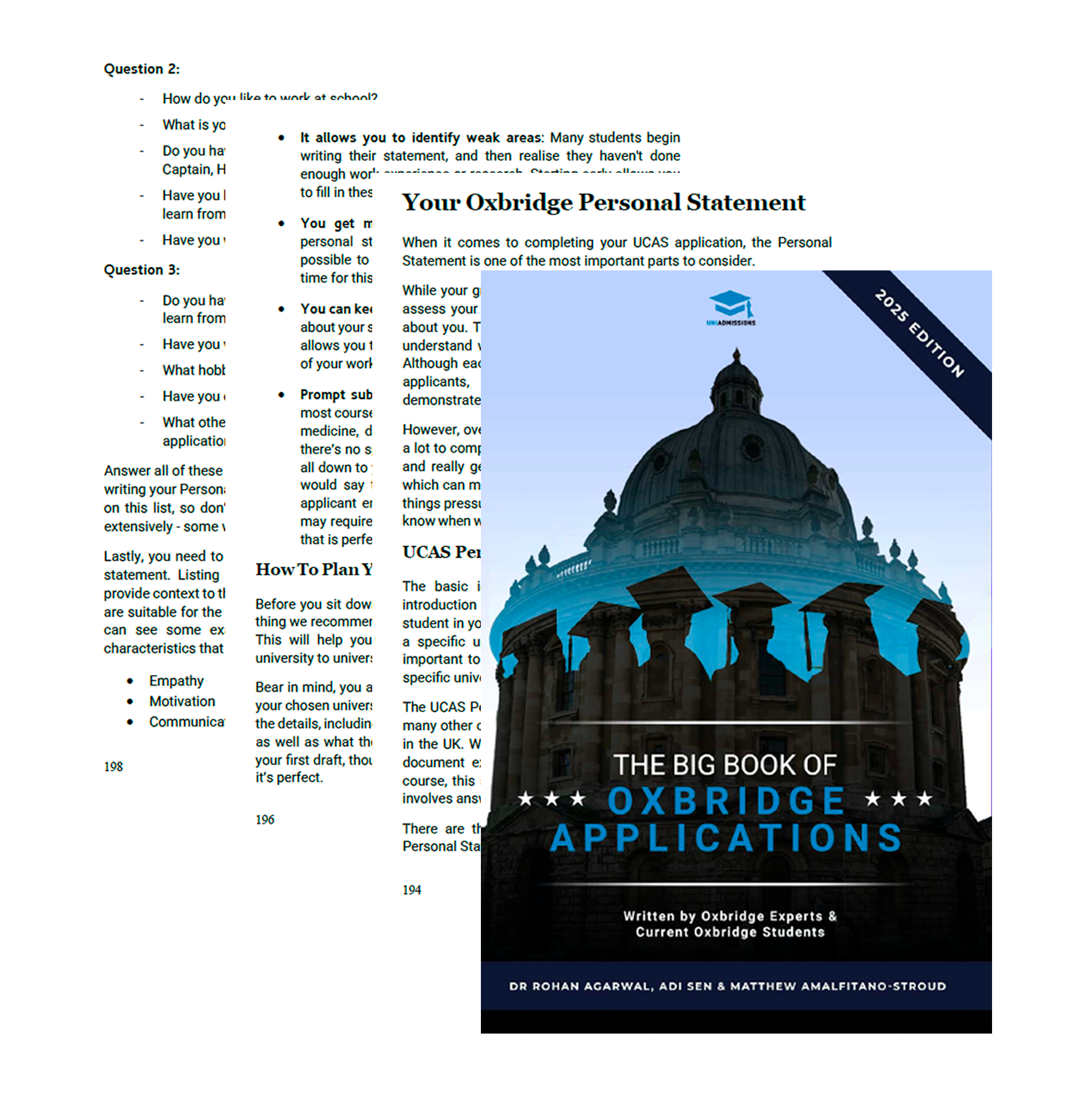
- A method to plan and write a compelling personal statement
- Proven strategies to stand out — even among top applicants
- 28 example Oxbridge Personal Statements
- Additional downloadable resources
Our Tutors' Feedback On This Oxford English Language and Literature Personal Statement
Good Points
The candidate’s wide range of personal interests are clearly demonstrated, and — for the most part — are well-linked to their subject application, giving it further strength. They are able to use independent thought to illustrate how various bits of reading they have done are linked. The list of works they discuss ranges from poetry to plays to Victorian novels; a strong variety of works. They evaluate these across genres and are able to apply critical thought and analysis to them. Throughout their discussions of various texts, the applicant clearly illustrates their enthusiasm for the subject; their writing is energised by positivity and personal engagement with the material.
Bad Points
The candidate could have worked even harder to connect their extra-curricular activities to their application (though their relevance was clear in most instances). The effect of the applicant’s use of independent thought and personal experience was often slightly dulled by their use of highly personal and personalising terms such as ‘beautiful’, or simply ‘I enjoyed’. Though there is perhaps nothing wrong with these evaluations as an initial starting point, the candidate could have pushed further with their readings to interrogate these works further. Though the applicant demonstrates a wide literary foundation, their commentary did at times lapse into plot summary, which is less interesting than their own thought.
UniAdmissions Overall Score:
★ ★ ★ ★ ☆
This candidate’s application reads as both impressive in its depth of knowledge and personal in its illustration of thought and enthusiasm. As such, it reads as a statement that is well-balanced and well-judged; the reader is able to get a good sense of this applicant’s interests on both a personal and academic level. The statement could have made greater use of critical language and could have included fewer instances of value judgments; small alterations which would have given the candidate’s discussions greater academic depth.
Enrolling on our Oxbridge English comprehensive Programme will give you access to Personal Statement redrafts.
Your tutor will give you actionable feedback with insider tips on how to improve and make your Personal Statement Oxbridge quality for the best chances of success.
What Makes An Oxford English Language and Literature Personal Statement Different?
An Oxford English Language and Literature personal statement is more intellectually analytical than a typical English application, with a strong emphasis on wide, engaged, and thoughtful reading. Oxford is less interested in applicants simply expressing a love of books or listing texts they have enjoyed, and more interested in seeing how they think about literature and language in depth. Strong statements often show evidence of critical engagement, close analysis, and independent interpretation, demonstrating not just what an applicant has read, but the ideas, questions, and insights that emerged from that reading.
Successful applicants usually reflect thoughtfully on a small number of literary works, linguistic ideas, or critical questions rather than covering a long list of texts superficially. Oxford values applicants who can analyse language closely, engage with literary ideas in a nuanced way, and show how their thinking has developed through reading, discussion, or independent exploration. Because written work and interviews form an important part of the admissions process, the strongest personal statements often reveal the same qualities Oxford looks for later in selection: analytical precision, intellectual curiosity, originality of thought, and the ability to respond critically to new ideas rather than relying on memorised interpretations.
Unlike some English applications that focus heavily on enthusiasm for reading or creative expression, an Oxford English Language and Literature personal statement is typically more academically reflective and argument-driven. The strongest applicants show that they can think independently about literature and language, make insightful connections between texts and ideas, and engage critically with what they read. A strong statement therefore feels less like a personal reading diary and more like evidence of a thoughtful, analytical mind prepared to study English as a rigorous academic discipline.
Oxford English Personal Statement (OLD FORMAT)
Please note that the personal statement presented earlier in this guide was not originally written in the three-question format currently used by UCAS. Below is the original, unedited version of this statement in the previous free-form style.
—
George Eliot’s metaphor for imagination- ‘inward light which is the last refinement of Energy … bathing even the ethereal atoms in its ideally illuminated space’- is beautiful. The powerful image supported by the underlying liquid consonants skilfully leads to the action it describes, but it is also the suggestion of particle physics and mass-energy equivalence that interests me about this quotation. In this way, I have gained more from reading ‘Middlemarch’ as I appreciate Eliot’s constant links between science and fiction, and I believe scientific study has generally sharpened my abilities of analysis and concise expression.
I have loved working as a steward at the Globe Theatre; I had the opportunity to see many plays, including a production of Marlowe’s ‘Dr Faustus’. I read Dante’s ‘Inferno’ and several books of Milton’s ‘Paradise Lost’ for a different portrayal of hell and sin to that depicted in ‘Dr Faustus’. I found the torment and suffering described by Dante graphic, whilst the first person narrative drew me closer to the pathos fear and disgust expressed. Milton’s depiction of a mental state is much more powerful in my opinion, and has interesting parallels to Faustus’ state of damnation. I also saw Shakespeare’s ‘As You Like It’, ‘All’s Well that Ends Well’ and ‘Much Ado About Nothing’ whilst stewarding. ‘Much Ado About Nothing’ reminded me of the surprising similarity between Shakespeare’s comedies and tragedies. Claudio and Hero’s troubled love and Don John’s self-proclaimed villainy seem to mirror the actions of Othello, Desdemona and Iago. Viewing comedy as a structure, ‘Much Ado’ contains the potential tragedy of ‘Othello’, but an added last act resolves all tensions and ends so happily and neatly that it seems to me rather unrealistic.
I enjoyed Dickens’ ‘Our Mutual Friend’ for its satirical portrayal of superficial London society. His depiction of characters and scenes make the novel humorous and therefore very different to ‘A Tale of Two Cities’. Here, the powerful characterisation emphasises the terrible human suffering and moral corruption, for example his effective personification of ‘La Vengeance’, who encourages the cries of bloodlust from Parisians. I found it easier to empathise with Jude in Hardy’s ‘Jude the Obscure’ than with Dickens’ creations however, since his actions appear futile against the fate which continually works against him. There seems to be no hope in the novel, unlike the eventual triumph of love over death in ‘A Tale of Two Cities’. Just as in ‘Tess of the d’Urbervilles’ and ‘A Pair of Blue Eyes’, love and happiness seem only like a prelude to grief and sorrow linked with the relentless passing of time. I find Donne’s approaches to this theme interesting too: in both his love poems and the Holy Sonnets, Donne uses form to counter and control the passing of time and the prospect of change.
I have participated in many music groups and ensembles at school, having achieved Grade 8 with distinction in both Flute and French Horn. I have worked for two years in my local Cancer Research shop as part of the Gold Duke of Edinburgh award, and also spent a residential week with a charity called Activenture, looking after children of different ages and abilities, for which I received the Young Carer of the Year award. During my gap year, I plan to join my local orchestra and travel for three months around South America, but ultimately I am most excited about the time I will have to read and further explore English literature.
This Personal Statement for English is a great example of a statement done right. The candidate’s interest is clearly shown which is vital to Admissions Tutors.
Remember, at Oxford, these Admissions Tutors are often the people who will be teaching you for the next few years so you need to appeal directly to them.
Go to our Free Personal Statement Resources page for even more successful personal statements and expert guides.
For more inspiration, take a look through our other successful Personal Statement analysis articles:
Our expert tutors are on hand to help you craft the perfect Personal Statement for your Oxford English application.
With our Oxbridge English Premium Programme we help you craft the perfect Personal Statement, produce and submit the best Written Work and teach you how to Interview effectively.
Discover our Oxbridge English Premium Programme by clicking the button below to enrol and triple your chances of success.

