5 things to know
Key Takeaways
- The 2026 interim mean total score is 1970, based on 20,794 tests taken up to 13 September. That's 31 points up on last year's interim figure and 79 above the 2025 final mean of 1891.
- Quantitative Reasoning and Decision Making account for the rise, at 699 and 657 respectively. Verbal Reasoning hasn't moved at all, sitting at 614 for the second year running.
- Every decile boundary is higher than at this point last year. You now need 2300 to reach the 9th decile, up from 2270, with the biggest jumps of 40 points falling between the 4th and 8th deciles.
- The Situational Judgement Test has gone the other way. Only 16% of candidates are in Band 1 so far, down from 25% at this stage in 2025, which makes a Band 1 result harder to get and more valuable if you have one.
- Treat these as preliminary figures. Around 42,800 people are expected to sit the UCAT this year, roughly 1,400 more than last year, and in 2025 the final mean came in 48 points below the interim one.
UCAT FORMAT 2026
Abstract Reasoning was removed from the UCAT in 2025, so the test now has three cognitive subtests (Verbal Reasoning, Decision Making and Quantitative Reasoning) plus the Situational Judgement Test. That means 2026 scores can only be compared fairly with 2025. Anything from 2024 or earlier includes a fourth subtest and isn’t a like-for-like comparison.
The 2026 interim scores have been published by UCAT, how do yours compare?
If you sat the UCAT in July, the wait to see how you did against everyone else has probably felt endless.
Why else might the interim scores matter to you? Many UCAT universities use cut-off scores and some use your decile ranking for selection. For example, the University of Sunderland selects candidates in the top 8 deciles of the cohort, and Liverpool looks at candidates who scored in the top 5.
What are the preliminary UCAT test statistics?
UCAT publishes preliminary results in mid-September each year, before testing has finished, to give a preview of how the final results might look. They’re based on the candidates who have tested so far, which is usually around half the cohort.
The report includes the overall mean score, the mean for each cognitive subtest (not the Situational Judgement Test), decile rankings and the SJT band percentages. The final UCAT results report the same measures.
This year’s data is valid up to 13 September 2026 and is based on 20,794 tests. UCAT expects a further 22,000 candidates to sit the test, and says the figures “should be treated with significant caution”. Use them as a rough guide only.
If those numbers hold, around 42,800 people will sit the UCAT in 2026, compared with 41,354 in 2025. That’s roughly 1,400 more candidates.
When will the final mean scores and deciles be published?
Testing for 2026 runs until 24 September. UCAT says final mean scores, deciles and percentiles will be published “shortly after testing ends”. Now for what you really want to know: the interim results.
UCAT Preliminary Mean Scores 2026
Let’s start by reviewing the mean scores for the subtests, remembering that one section is now missing.
The overall 2026 preliminary mean total scaled score is 1970. At the same point last year it was 1939, so that’s a rise of 31 points. Against the 2025 final mean of 1891, it’s 79 points higher.
Here’s the subtest breakdown:
| UCAT Subtest | |
|---|---|
| Verbal Reasoning | |
| Decision Making | |
| Quantitative Reasoning |
Each subtest is scored between 300 and 900. Here’s how that compares with 2025:
| UCAT Subtest | 2025 Final Score | ||
|---|---|---|---|
| Verbal Reasoning | |||
| Decision Making | |||
| Quantitative Reasoning | |||
| Total Mean Scaled Score |
Verbal Reasoning is exactly where it was at this point last year. Decision Making is up 15 points and Quantitative Reasoning is up 16, so QR is again the subtest with the biggest rise.
Remember, this data is preliminary. In 2025 the interim mean was 1939 and the final mean came in at 1891, a drop of 48 points. Scores have fallen between the interim and final releases in previous years too, so expect the 2026 final figures to be lower than these. If the drop is similar to last year’s, the final mean would land somewhere around 1920. That’s our rough estimate, not a UCAT figure.
Worried About the UCAT? Let The Big Book of Oxbridge Applications Be Your Guide
The UCAT can feel like a big unknown, from how it fits into admissions decisions to what effective preparation actually looks like. If you’re unsure where to start or how to make the most of your study time, you’re not alone.
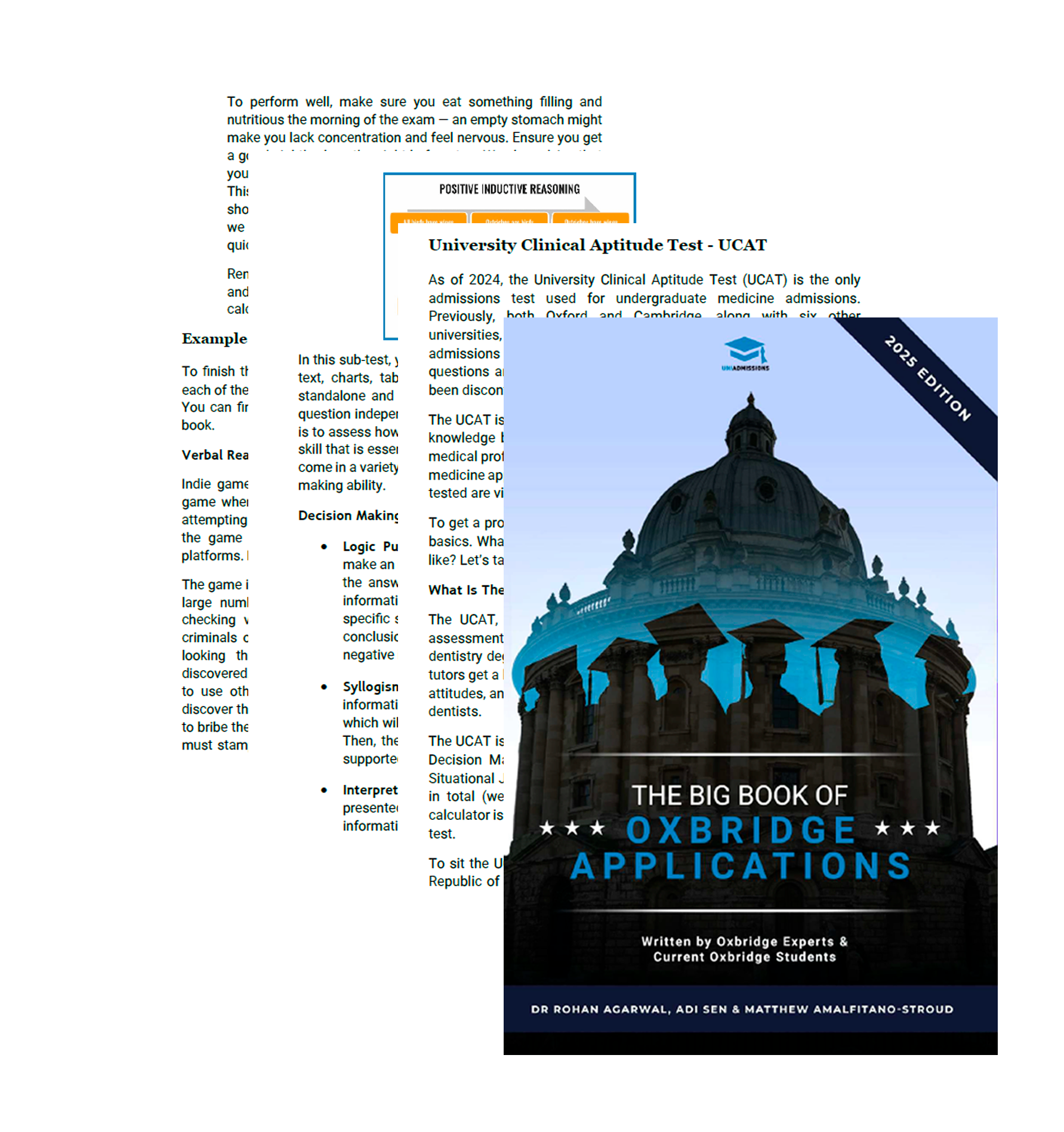
The Big Book of Oxbridge Applications takes the guesswork out of UCAT prep. The UCAT section of this free book gives you everything you need to understand the test and approach it with confidence. Inside, you’ll find:
- A clear overview of the exam structure and each subtest
- Up-to-date information on test dates and format
- Targeted preparation strategies to help you study efficiently
- Practice questions that reflect the real test
- A free UCAT mock paper to download
UCAT Preliminary Decline Ranks 2026
Some universities use decile rankings when deciding who to invite to interview or make offers to. Each decile represents 10% of candidates based on their overall UCAT score. The 1st decile is the score at the 10th percentile (score below it and you’re in the bottom 10% of test takers), the 2nd decile is the score at the 20th percentile, and so on.
Here are the 2026 interim deciles alongside last year’s figures:
Every decile boundary is higher than at the same point last year. The biggest jumps (40 points) sit in the middle of the range, from the 4th to the 8th decile. At the top, you currently need 2300 to reach the 9th decile, up from 2270 at this stage in 2025.
With more candidates sitting the test and interim scores running higher, UCAT cut-offs at some medical schools may rise this year. A strong score will count for more at universities that weight the UCAT heavily.
UCAT Preliminary Situational Judgement Scores 2026
The Situational Judgement Test is scored in bands rather than on the 300 to 900 scale. Here are the interim results for 2026:
And compared with 2025:
The SJT has moved the opposite way to the cognitive scores. Only 16% of candidates are in Band 1 so far, down from 25% at this point last year and 21% in the 2025 final results. Band 3 has grown to 32%.
That makes Band 1 harder to get, and more valuable if you have it. It matters most at medical schools that use the SJT openly, such as Edinburgh, which allocates points to each SJT band. Those points count towards shortlisting for their Assessment Days, and they don’t accept anyone who achieved Band 4.
Conclusion
More people are expected to sit the UCAT this year than last, and interim cognitive scores are higher across the board. Put together, that points to a more competitive year for UCAT medical schools, and you may need a higher score to receive an offer.
The SJT is the exception. Fewer candidates are in Band 1 so far, so a Band 1 result could help you stand out.
Keep in mind that this data is preliminary. Final mean scores have come in lower than the interim figures in previous years, including a 48-point drop in 2025, so be careful when comparing your own score with the numbers above.
Got a low UCAT score? Don’t worry. It’s not too late to get that place.
It’s time for a change of strategy. Whether or not you had been considering taking the UCAT, it’s time to start, because it’s your best chance of getting a place. Luckily, you’ve still got enough time, if you put in hard work and let our tutors help you to succeed.
Discover the UCAT support featured in our Medicine Full-Blue Programme by clicking the button below to enrol and triple your chances of success.