

UK Medical School Rankings for 2026 are now out, so which are the best medical schools in the UK?
With so many different organisations putting together lists of which Medical School is the best in the country, how do you know which ones to look at and believe? And how much importance should you actually place on medical school ranking tables?
We’ve put together this guide to explain the rankings and help you understand what to take into consideration when you’re making your choices. If you’re ready, then let’s get started!
Want to skip to the ranking tables? Press the button’s below:
Who makes the UK medical school rankings?
There are a number of different ranking guides which compile their lists using different measuring factors. The Guardian and The Complete University Guide are two of the most popular organisations that compile lists of the best universities in the UK for lots of courses, though there are also global rankings provided by different organisations like QS Top Universities.
Of course, these aren’t the only league tables around for UK Medical School rankings. A quick Google search can give you a lot more options if you’d like to compare and have multiple tables to back up your decision of which Medical School to apply to. For today though we will be focussing on just two tables.
Learn more about UK University Rankings here
Secure your place to study Medicine at Oxbridge with the help of UniAdmissions and our expert tutors.
We help you craft the perfect Personal Statement, achieve a highly competitive UCAT score and teach you how to Interview effectively – covering all areas of your Oxbridge Medicine application.
Discover our Full-Blue Medicine Programme by clicking the button below to enrol and triple your chances of success.
How Are UK Medical Schools Ranked?
There is no singular way to rank the UK Medical Schools. There are roughly 36 of them in total, all varying in their teaching style, selection process, and education standard.
While many different Medical School ranking tables exist, they do not all agree. This is largely because the rankings are influenced by vague or indefinable aspects, such as the reputation of the university, or the level of student satisfaction for those studying there – both are difficult to accurately measure.
That’s not to say that these ranking tables are completely unreliable, as they still help to give a general sense of how a medical school performed in a given year and how students rated their experience. It’s just important to know that a lot of the metrics covered aren’t supported by extensive data.
It’s also worth noting that even the lowest universities on these lists aren’t too low in quality. The UK is generally known for maintaining a high standard of education, including medical degrees, so the lowest-ranked universities earn their place for being less exceptional or having a couple of noticeable flaws compared to others.
Now we have a bit more context, let’s look at two of the most well-known university ranking tables, starting with The Guardian.
The Guardian Medical School Rankings
To compile their lists of Medical School rankings UK, the Guardian uses these headings to rank the schools:
- Satisfied with course (the overall rating given by final year students)
- Satisfied with teaching (quality of teaching rated by final year students)
- Satisfied with feedback (a rating for the quality of feedback and assessment by final year students)
- Student to staff ratio (the number of students per staff member)
- Spend per student (the amount of money spent on each student excluding academic staff costs)
- Value added score (a comparison of students’ degree results against the entry qualification, which shows how effectively they are taught)
- Career after 15 months (the percentage of graduates who find a job or continue further study within 15 months of graduating)
- Average entry tariff (the typical UCAS score of entrants)
- Continuation (the percentage of first year students who go on to the second year)
They then give each of these categories a score depending on the information they have collected. Finally, all Medical Schools are then given a Guardian Score out of 100, which determines the rank they receive.
Data is collected from a variety of sources, including student satisfaction results from the National Student Survey (NSS) and employability and entry standards data directly from the universities.
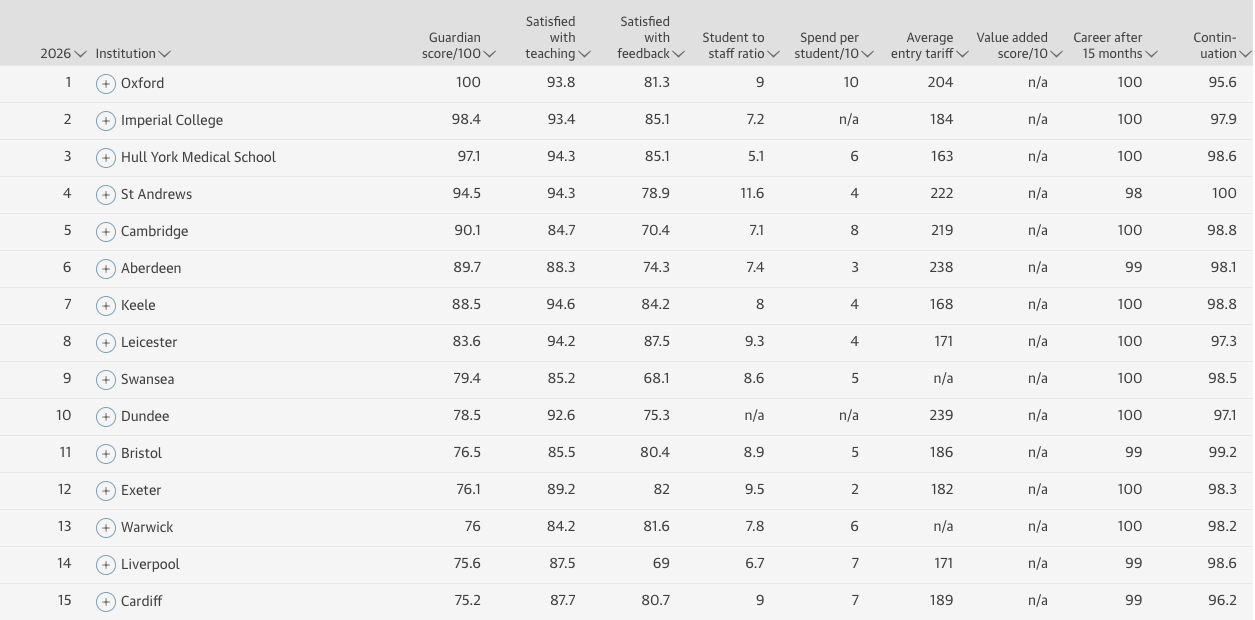
The Guardian Medical School Rankings 2026
Below is The Guardian’s league table in full, displaying the results for 2026 and comparison to 2025’s results:
| Position | University | Previous Position (2025) |
|---|---|---|
| 1 | University of Oxford | 2 (>1) |
| 2 | Imperial College London | 3 (>1) |
| 3 | Hull York Medical School | 5 (>2) |
| 4 | University of St.Andrews | 7 (>3) |
| 5 | University of Cambridge | 4 (<1) |
| 6 | University of Aberdeen | 1 (<5) |
| 7 | Keele University | 8 (>1) |
| 8 | University of Leicester | 10 (>2) |
| 9 | Swansea University | 16 (>7) |
| 10 | University of Dundee | 12 (>2) |
| 11 | University of Bristol | 9 (<2) |
| 12 | University of Exeter | 25 (>13) |
| 13 | University of Warwick | 21 (>8) |
| 14 | University of Liverpool | 27 (>13) |
| 15 | Cardiff University | 15 (=) |
| 16 | University of East Anglia (UEA) | 23 (>7) |
| 17 | University College London (UCL) | 11 (<6) |
| 18 | University of Glasgow | 13 (<5) |
| 19 | Brighton & Sussex Medical School | 19 (=) |
| 20 | Queen’s University Belfast | 19 (<1) |
| 21 | University of Southampton | 22 (>1) |
| 22 (=) | University of Edinburgh | 6 (<16) |
| 22 (=) | University of Leeds | 17 (<5) |
| 24 | University of Sunderland | 18 (<6) |
| 25 | University of Manchester | 26 (>1) |
| 26 | Lancaster University | 28 (>2) |
| 27 | King’s College London | 29 (>2) |
| 28 | University of Nottingham | 36 (>8) |
| 29 | Newcastle University | 14 (<15) |
| 30 | University of Sheffield | 30 (=) |
| 31 | Anglia Ruskin University | 30 (<1) |
| 32 | Queen Mary University of London | 24 (<8) |
| 33 | University of Birmingham | 32 (<1) |
| 34 | University of Plymouth | 34 (=) |
| 35 | Aston University | 38 (>3) |
| 36 | University of Central Lancashire | 35 (<1) |
This year, The Guardian gave the top spot to the University of Oxford with a score of 100. It is followed by Imperial College London, Hull York Medical School, St. Andrews and Cambridge. Aberdeen, which was ranked first in the 2025 table, has dropped to 6th this year. Within the Top 10, only three Russell Group universities appear, which is unusual. But that’s not all:
It is also not common to see Cambridge so low on a UK ranking table, especially for a major subject. However, Cambridge hasn’t ranked 1st for Medicine on the Guardian’s table since 2019 and had previously ranked as low as 6th. In 2024, Oxford ranked even lower than this, finishing in 8th.
The University of Lancashire took the last position in 2026 with a score of 36.4, falling below Aston University, which had ranked in last place the previous year. However, the following medical schools were not featured in this year’s ranking:
- Brunel University London
- Edge Hill University
- Kent & Medway Medical School
- St George's, University of London
- Ulster University
- University of Buckingham
- University of Greater Manchester
Compared to last year’s results, we can see the most dramatic change was for the University of Edinburgh, which fell 16 spots from 6th to 22nd. The biggest improvement was for Liverpool and Exeter, which each rose 13 places on the table.
Worried About the UCAT? Let The Big Book of Oxbridge Applications Be Your Guide
The UCAT can feel like a big unknown, from how it fits into admissions decisions to what effective preparation actually looks like. If you’re unsure where to start or how to make the most of your study time, you’re not alone.
The Big Book of Oxbridge Applications takes the guesswork out of UCAT prep. The UCAT section of this free book gives you everything you need to understand the test and approach it with confidence. Inside, you’ll find:

- A clear overview of the exam structure and each subtest
- Up-to-date information on test dates and format
- Targeted preparation strategies to help you study efficiently
- Practice questions that reflect the real test
The Complete University Guide Medical School Rankings
The second and equally respected university league table is produced by The Complete University Guide. Their Medical School rankings are based on a slightly different set of criteria, although there is a lot of overlap.
To compile their lists of UK Medical School rankings, these are the headings to rank the schools:
- Entry Standards (the average UCAS tariff of students joining the university)
- Student Satisfaction (how satisfied students are with the quality of teaching they receive)
- Research Quality (a measure of the quality of research undertaken in the university)
- Graduate Prospects (a measure of the employability of beyond graduation)
- Overall Score (an overall score that determines the rank of the medical school)
There are also a few other factors taken into consideration that have an impact on the overall score awarded to medical Schools. These aren’t displayed on the main ranking table but are as follows:
- Research intensity (the proportion of staff involved in research)
- Student:staff ratio (the number of students to staff)
- Academic services spend (the spend per student on all academic services)
- Facilities spend (the spend per student on staff and student facilities)
- Good honours (the number of students achieving first or 2:1 degrees)
As with The Guardian, each category has a weighting attached to it, which then feeds into the final “Overall Score” achieved by a university. This overall score is what determines the Medical School’s rank in the UK. Like The Guardian, much of this data is collected from the NSS and the universities.

Find out your percentage chance of getting into Oxford or Cambridge and get a complete report upon completion talking through your strengths and weaknesses.
Complete University Guide Medical School Ranking Table 2027
Below are the top 25 entries Complete University Guide ranking table, displaying the results for 2027 and comparison to 2026’s results:
| 2027 Position | University | Previus Position (2026) |
|---|---|---|
| 1 | University of Cambridge | 1 (=) |
| 2 | University of Oxford | 2 (=) |
| 3 | Imperial College London | 3(=) |
| 4 | Queen’s University Belfast | 4 (=) |
| 5 | University of Glasgow | 6 (>1) |
| 6 | University of Leicester | 12 (>6) |
| 7 | University of Bristol | 8 (>1) |
| 8 | UCL (University College London) | 9 (>1) |
| 9 | Cardiff University | 13 (>4) |
| 10 | University of Exeter | 15 (>5) |
| 11 | University of Dundee | 15 (<4) |
| 12 | Swansea University | 14 (>2) |
| 13 | The University of Edinburgh | 10 (<3) |
| 14 | University of St Andrews | 11 (<3) |
| 15 | University of Manchester | 20 (>5) |
| 16 | Lancaster University | 19 (>3) |
| 17 | King’s College London, University o… | 18 (>1) |
| 18 | Hull York Medical School | 22 (>4) |
| 19 | Queen Mary University of London | 5 (<14) |
| 20 | University of Sheffield | 24 (>4) |
| 21 | Keele University | 23 (>2) |
| 22 | University of East Anglia UEA | 25 (>3) |
| 23 | City St George’s, University of Lon… | 34 (>7) |
| 24 | University of Liverpool | 26 (>2) |
| 25 | Newcastle University | 17 (<8) |
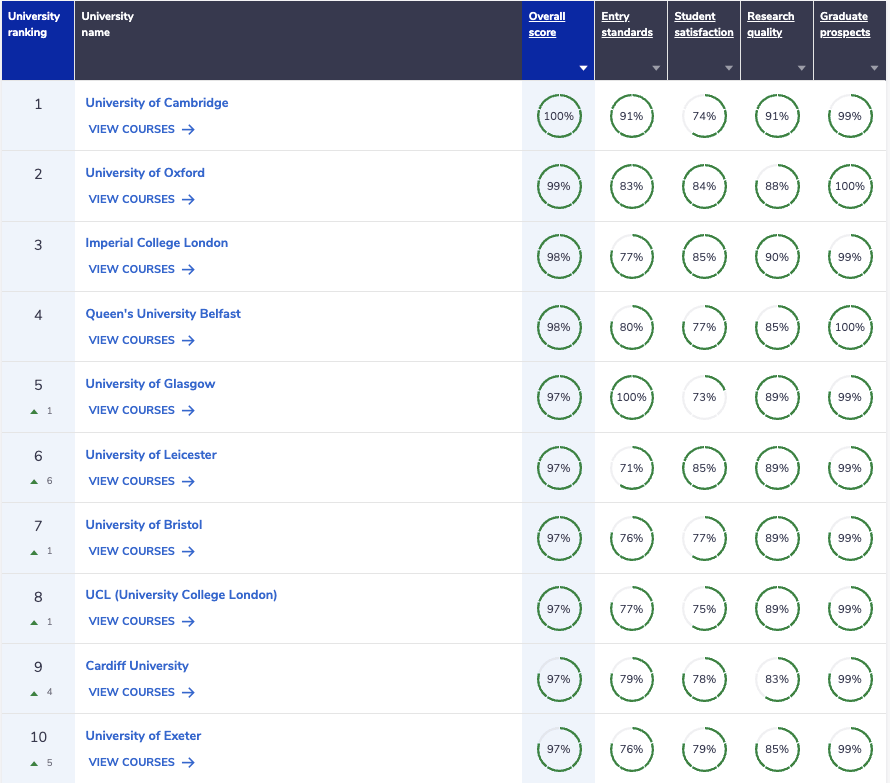
In the CUG 2027 rankings, Cambridge holds the top spot once again, achieving a perfect 100% overall score. Oxford retains second place with 99%, but falls slightly short on Entry Standards and Research Quality metrics — a useful reminder that even a fraction of a percentage point separates two of the world’s elite medical schools. Imperial and Queen’s University Belfast are locked in at 3rd and 4th for the second consecutive year, a sign of genuine, sustained institutional strength rather than a one-year anomaly.
The most eye-catching movement in the 2027 table belongs to the University of Leicester, which climbs six places from 12th to 6th — the biggest upward jump of any school in the top half of the rankings. For applicants, this is worth paying attention to: a school rising sharply in Research Quality (89%) and Graduate Prospects (99%) metrics suggests a programme investing seriously in its academic and clinical infrastructure. Bristol and Cardiff also make meaningful gains, with Bristol up to 7th and Cardiff rising four places to 9th.
However, the most dramatic story in this table is the fall of Queen Mary University of London, which drops 14 places — from 5th to 19th. This is a substantial decline and largely reflects changes in student satisfaction and entry standards data rather than a sudden collapse in quality. Applicants should be careful not to overcorrect here: Queen Mary remains a respected London medical school and the CUG’s methodology can shift schools dramatically on the basis of a single year’s NSS data. Newcastle is also worth noting, sliding eight places to 25th after a strong showing last year.
The table only shows 25 entries. The following medical schools did not feature in this ranking due to insufficient data:
- Bangor University
- Brunel University London
- Plymouth Marjon University
- St Mary's University, Twickenham
- Ulster University
- University of Greater Manchester
- University of South Wales
- University of Surrey
- University of Worcester
It’s also worth noting that Brighton and Sussex — previously ranked together as Brighton & Sussex Medical School — now appear separately in the CUG table for the first time in 2027. How the underlying data has been divided between the two institutions is not yet clear, so treat their individual scores with some caution this cycle.
No single ranking table should determine your application strategy. Cross-referencing the CUG with The Guardian and the Times Higher Education rankings will give you a much more rounded picture, and school-specific factors like course structure, clinical placement locations, and UCAT requirements should carry significant weight alongside any ranking position.
The Best and Worst UK Medical Schools
It needs to be made clear again that these rankings are not definitive in any sense, nor is there a way to calculate the definitive “best” medical school in the UK. While factors such as employment rates and student satisfaction can be measured to a certain degree, each person will have their own preferences as to how they want to study and live at university.
With that being said though, let’s round up the data and see which medical schools ranked highest and lowest between the two tables:
Best Universities For Medicine UK
The highest-ranked medical schools in the UK tend to stay consistent from year to year, although their placements may move around. In 2025, the University of Cambridge and University of Aberdeen took the top spots, with both receiving perfect 100 scores. Of course, the overall score doesn’t mean these universities are literally perfect, but they are consistently high-scoring in many of the metrics that are recorded.
Let’s look at the top five UK medical schools for each list:
Complete University Guide (2027)
- University of Cambridge
- University of Oxford
- Imperial College London
- Queen's University Belfast
- University of Glasgow
The Guardian (2026)
- University of Oxford
- Imperial College London
- Hull York Medical School
- University of St Andrews
- University of Cambridge
The two lists diverge significantly, and understanding why is more useful than simply noting who appears. The CUG weights Research Quality and Entry Standards heavily — which is why Cambridge, Oxford, and Imperial dominate its top five. The Guardian prioritises student satisfaction, teaching quality, and value-added scores — which is why Hull York and St Andrews feature there but not in the CUG’s top five, and why Queen’s Belfast and Glasgow rank highly in the CUG but don’t crack The Guardian’s top ten.
Only three schools appear in both top fives: Cambridge, Oxford, and Imperial. Imperial is also the only London school to feature in either list, making it the strongest-performing London medical school by either measure — a useful data point for applicants choosing between the capital’s options. UCL’s absence from both top fives, despite its global reputation, is a reminder that brand recognition and ranking performance are not the same thing.

Worst Medical Schools UK
Any ranking must have a bottom rank, but in this case, the bottom ranking shouldn’t be taken as a list of medical schools to avoid. Worst is a very strong word to use in this context as none of the universities listed here are bad. They simply placed at the bottom of a highly competitive ranking.
Nonetheless, here are the lowest-ranked medical schools in the UK in ascending order:
Complete University Guide (2027)
- University of Buckingham
- University of Lancashire
- Edge Hill University
- Kent and Medway Medical School
- Aston University, Birmingham
The Guardian (2026)
- University of Lancashire
- Aston University
- University of Plymouth
- University of Birmingham
- Queen Mary University of London
Every medical school in the UK must meet the same GMC accreditation standards, so no school here is genuinely “bad” — these positions reflect relative performance across specific metrics, not the quality of the doctor you’ll graduate as.
The University of Lancashire is the only school to appear at the bottom of both tables. Beyond that, the overlap is minimal: aside from Aston University, the two bottom fives are entirely different — a reflection of how differently the CUG and The Guardian measure performance. Queen Mary’s appearance in The Guardian’s bottom five alongside its 14-place drop in the CUG is the most notable data point this cycle, and worth investigating further if you’re considering applying there.
The practical takeaway: a lower ranking position should prompt questions, not rule a school out. Smaller cohorts, strong primary care placements, or a particular clinical specialty strength won’t show up in these metrics — but they may matter far more to the kind of doctor you want to become.
We know the rankings featured in each table individually, but how do the results looked when considering both tables?
Below, we have created a table that combines the ranking positions for each university from both tables to determine the order based on both opinions. When looking at the combined positions, a lower total equals a higher ranking. For example, Cambridge ranked 1st and 4th in the two tables, so it received a combined ranking of 5, making it the highest-ranked medical school in the UK. Let’s take a look:
UniAdmissions' Combined Medical School Rankings
| Position | University | Combined Ranking Score |
|---|---|---|
| 1 | University of Oxford | 3 |
| 2 (=) | Imperial College London | 6 |
| 2 (=) | University of Cambridge | 6 |
| 4 | University of St.Andrews | 15 |
| 5 | University of Dundee | 17 |
| 6 | University of Bristol | 19 |
| 7 (=) | University of Aberdeen | 20 |
| 7 (=) | University of Leicester | 20 |
| 9 | Swansea University | 23 |
| 10 (=) | Queen’s University Belfast | 24 |
| 10 (=) | University of Glasgow | 24 |
| 12 | Hull York Medical School | 25 |
| 13 | University College London (UCL) | 26 |
| 14 | University of Exeter | 27 |
| 15 | Cardiff University | 29 |
| 16 | Keele University | 30 |
| 17 | University of Edinburgh | 32 |
| 18 | Queen Mary University of London | 37 |
| 19 (=) | University of East Anglia (UEA) | 40 |
| 19 (=) | University of Liverpool | 40 |
| 21 | University of Leeds | 43 |
| 22 (=) | University of Manchester | 45 |
| 22 (=) | Lancaster University | 45 |
| 22 (=) | King’s College London | 45 |
| 25 | Newcastle University | 46 |
| 26 | University of Warwick | 47 |
| 27 | University of Southampton | 50 |
| 28 | University of Sheffield | 54 |
| 29 | University of Sunderland | 59 |
| 30 (=) | University of Birmingham | 61 |
| 30 (=) | University of Nottingham | 61 |
| 32 | University of Plymouth | 65 |
| 33 | Anglia Ruskin University | 67 |
| 34 | Aston University | 72 |
| 35 | University of Lancashire | 75 |
| University of Buckingham | NA (Not ranked by The Guardian | |
| St George’s University of London | NA (Not ranked by The Guardian | |
| Brighton & Sussex Medical School | NA (Ranking Split by CUG) |
From this table, we can see that Oxford was the highest-ranked medical school overall in the UK, despite only ranking first on one table. Oxford, Cambridge and Imperial, which came in joint second, rank high in terms of quality, but the acceptance rates at each university are very low compared to many others. Learn more about this in our Cambridge Acceptance Rates Guide and Oxford Acceptance Rates Guide, or our G5 Medical School Acceptance Rates Guide for insights on more G5 universities.
The University of Lancashire ranks at the bottom of our list with a total score of 75. Several universities didn’t qualify due to exclusions in the ranking tables.
While this list isn’t a more accurate measurement of which medical schools are best, it does help to make the comparison between the two tables a bit easier.
Which Ranking Table Should I Follow?
That depends on what’s most important to you. For example, you may place more importance on ‘spend per student’ or career prospects. The Guardian have created their own way of ranking universities which is largely based on student perspective and The Complete University Guide, on the other hand, puts focus on student satisfaction.
You also need to consider that the ranking of the university as a whole is also based on the quality of research being produced by the postgraduate Masters and PhD students, which has little to do with the experience of a Medical undergraduate.
It can be easy to get very carried away with all these different ratings and rankings of the best Medical Schools in the UK. While it is true that these subtle differences may affect your experience at university, you should keep in mind that all of these Medical Schools are highly rated universities with excellent rankings across the board.
However, it is crucial to remember that no matter which Medical School you attend, you will graduate with the future of a fully respected career which is boundless in its opportunities. So don’t get too worried if you don’t end up being able to go to the medical schools at the very top of the list.
Ultimately, it’s a matter of what you are looking for in a University when it comes to how you choose which Medical School you want to apply to.
Oxbridge Medicine is incredibly competitive and it helps to have an edge. Our expert support will help you receive your dream offer.
With hours of guided study (including One-To-One Tuition, Mock Interviews, Intensive Courses and Comprehensive Materials), our expert Full-Blue Medicine Programme truly gives you an advantage that can make the difference between an offer and rejection.
Discover our Full-Blue Medicine Programme by clicking the button below to enrol and triple your chances of success.


