

Welcome to our popular Personal Statement series where we present a successful Personal Statement, and our Oxbridge Tutors provide their feedback on it.
Today, we are looking through a Classics applicant’s Personal Statement that helped secure a place at Oxford University. The Classics Course at Oxford involves extensive study of ancient languages, with a view to studying texts in the original.
Read on to see how this candidate managed to navigate the many disciplines and perspectives of Classics.
Here’s a breakdown of the Personal Statement:
CHARACTERS
3,290
WORDS
540
SUCCESSFUL?
5/5
The universities this candidate applied to were the following:
OXFORD
OFFER
EDINBURGH
OFFER
KENT
OFFER
EXETER
OFFER
MANCHESTER
OFFER
Enrolling on our Oxbridge Classics comprehensive Programme will give you access to Personal Statement redrafts.
Your tutor will give you actionable feedback with insider tips on how to improve and make your Personal Statement Oxbridge quality for the best chances of success.
Oxford Classics Personal Statement
1. Why do you want to study this course or subject?
Listening to operas like Handel’s Acis and Galatea, or looking at paintings like Raphael’s exquisite Triumph of Galatea, I am always reminded of Ovid’s brilliant manipulation of sources in producing stories now well ingrained in our culture – in this case transplanting the terrifying Cyclops of Odyssey 9 into a comic love triangle from Theocritus. In the Iliad, by contrast, Homer tells a deeply profound story of the cost of war, in which the humanity and inhumanity of war, presented through the sympathetic voice of the poet and the scope of the action respectively, are drawn together throughout the poem, culminating in the meeting of two tragic figures, Achilles and Priam, in Book 24. For me, however, the most moving part of the Iliad is Hector’s speech to Andromache in Book 6 when he imagines her being enslaved, because it combines the shame-driven bravery of the heroic code with an acute sense of conflicting duties, alien to most of the other characters in the poem. It is this variety in Classical literature, especially in the rich traditions of epic and mythology, that most appeals to me about Classics. In reading Classics at university I am particularly looking forward to studying more Greek tragedy, since I so enjoyed reading King Lear and Endgame at English AS-Level and the Antigone at Bryanston.
The infectious curiosity of Herodotus, the witty cynicism of Tacitus: Ancient History offers the whole range of authorial perspectives, but what struck me the most last year when I studied Ancient History for the first time was the fact that one need look no further than Plutarch’s Lives to find the whole range of personalities still found in today’s politics.
2. How have your qualifications and studies helped you to prepare for this course or subject?
An idea particularly resonant in modern politics, from Neil Kinnock to Joe Biden, is that of the ‘novus homo’, and my interest in Cicero, through studying his works at AS-Level, led me to write an article for Omnibus in which I argued that Cicero intended to publish not only the seventy-nine epistulae commendaticiae of ad Familiares 13, as suggested by Ludwig Gurlitt, but also some of the letters to Atticus.
In my Extended Project dissertation I investigated the issues surrounding the UK’s euthanasia legislation. In researching this subject I studied the views of Immanuel Kant and Jeremy Bentham, but also the opinions of more recent philosophers such as Peter Singer. I was especially impressed by Joseph Fletcher’s essay, The Cognitive Criterion of Personhood, because his clear and logical argument for defining a ‘person’, especially the criterion of one’s sense of the future, was the foundation for my argument concerning the value and sanctity of human life.
3. What skills and experience have you got that show you are suited to this course?
Outside the classroom I like to be involved in a lot of music, mostly singing – in which my favourite genre is Baroque oratorio – cello, and harpsichord. I recently performed in Mendelssohn’s Octet at the Cadogan Hall, and having won first prize in London’s Spring Grove Chamber Music Festival with my string quartet we are spending the money on making a CD of some of our recent repertoire. My other pursuits include some amateur journalism and representing my school in public speaking, while at home I particularly enjoy reading the books of P. G. Wodehouse and watching the 1950s films of Federico Fellini and Ingmar Bergman.
For more inspiration, take a look through our other successful Personal Statement analysis articles:
Break Free from the Personal Statement Spiral
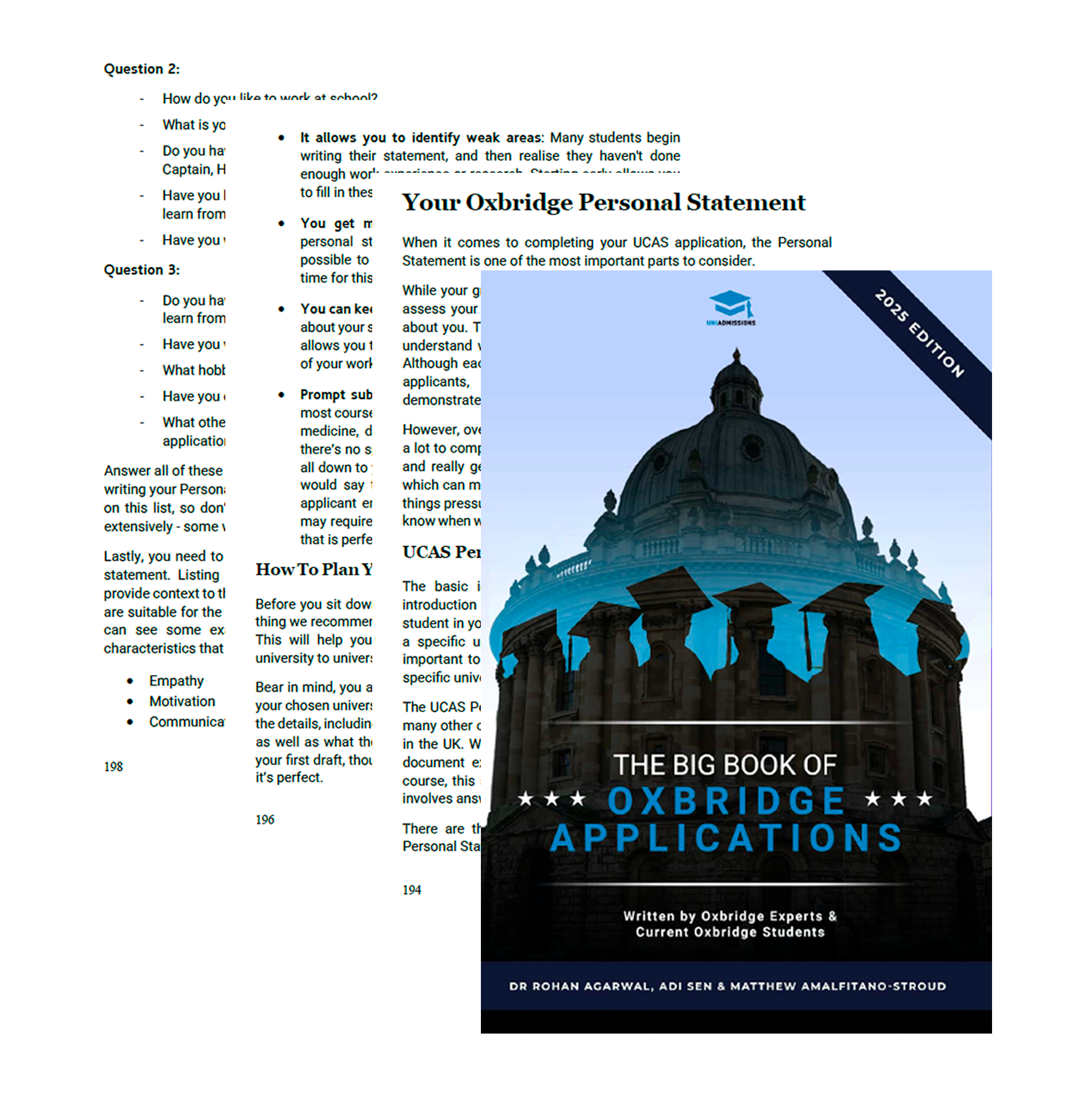
- A method to plan and write a compelling personal statement
- Proven strategies to stand out — even among top applicants
- 28 example Oxbridge Personal Statements
- Additional downloadable resources
Access "The Oxbridge Application Vault"
- 300+ page ebook for Oxbridge Applicants
- 25 page ebook for Personal Statement
- 2h+ online course to succeed in any exam
- Online Oxbridge Success Calculator
- 12 page ebook about UniAdmissions

Good Points Of The Oxford Classics Personal Statement
The student clearly engages with the subject and is eager to demonstrate the knowledge they have already built in their studies. Importantly, attention is given to both classical literature and ancient history, showing that the student has well-rounded interests in their chosen subject. The student is able to talk competently about a number of classical sources and figures, but also is able to make links with current affairs, which works well. Mentioning the article that the student wrote was a strong inclusion because it shows the student took initiative and undertook an academic style activity, moving beyond what is required of them in their studies.
Bad Points Of The Oxford Classics Personal Statement
The student takes some time to begin to talk about their own personal interests in Classics. The phrasing for the first half of the introductory paragraph is, for the most part, quite abstract and factual. Writing in this way can present difficulties in getting your personality across. The paragraph about the student’s extra-curricular activities would be better if the activities given attention to were linked to Classics in some way. While a wealth of extra-curricular activities may demonstrate that the student is capable of balancing their interests and their studies, it would be more impressive to show a commitment to Classics, in this instance, through these activities. Wider reading in a particular area of Classics the student finds interesting would be more relevant than who they enjoy reading or the types of film they enjoy.
UniAdmissions Overall Score:
★ ★ ★ ☆ ☆
This personal statement is well written and demonstrates the student’s wealth of knowledge about Classics from the outset. At times, it sadly lacks in personality, the student talks happily about facts and concepts but does not sustain a noticeable passion throughout- resulting in a personal statement that seems at times overly factual. While by no means a bad personal statement, it would benefit from getting across at every opportunity the view that the student has a real passion for this subject and engages with it at every opportunity. The student should be the focus, not the subject.
What Makes An Oxford Classics Personal Statement Different?
While there’s no set standard for Classics personal statements, most applicants will cover similar topics, such as their coursework, field trips and potentially relevant work experience. However, Oxford isn’t as interested in these areas, and statements featuring just these topics won’t stand out. So, what can you do to make your statement different?
Firstly, while these typical experiences are important to cover, you need to explore them in depth rather than just providing surface level descriptions. Reflection is the key to a successful personal statement, which means exploring what you have learnt, how this knowledge has helped you develop your skills and how it changed your perception of Classics. This provides evidence of your genuine dedication to the subject.
However, beyond the experiences you’ve had, it’s also important to evidence your super-curricular engagement with the subject, including wider reading and research projects. While this may not seem like the most interesting topic to discuss, it is exactly what Oxford is looking for in applicants, especially in Classics. A huge part of studying at Oxford is the ability to work independently and guide your own learning beyond the classroom. As such, displaying a high level of curiosity in your statement will highlight that you have what it takes to succeed in the course.
Oxford aren’t looking for the applicants with the most impressive experiences – they are looking for the applicants that make the most of their time and resources to truly engage with their subject. This is what you need to prove in your writing.
It’s important to consider that this Personal Statement was not originally written in the three question format currently used by UCAS. Below is the original, unedited version of this statement in the previous free-form style.
Oxford Classics Personal Statement (OLD FORMAT)
Listening to operas like Handel’s Acis and Galatea, or looking at paintings like Raphael’s exquisite Triumph of Galatea, I am always reminded of Ovid’s brilliant manipulation of sources in producing stories now well ingrained in our culture – in this case transplanting the terrifying Cyclops of Odyssey 9 into a comic love triangle from Theocritus. In the Iliad, by contrast, Homer tells a deeply profound story of the cost of war, in which the humanity and inhumanity of war, presented through the sympathetic voice of the poet and the scope of the action respectively, are drawn together throughout the poem, culminating in the meeting of two tragic figures, Achilles and Priam, in Book 24. For me, however, the most moving part of the Iliad is Hector’s speech to Andromache in Book 6 when he imagines her being enslaved, because it combines the shame-driven bravery of the heroic code with an acute sense of conflicting duties, alien to most of the other characters in the poem. It is this variety in Classical literature, especially in the rich traditions of epic and mythology, that most appeals to me about Classics. In reading Classics at university I am particularly looking forward to studying more Greek tragedy, since I so enjoyed reading King Lear and Endgame at English AS-Level and the Antigone at Bryanston.
The infectious curiosity of Herodotus, the witty cynicism of Tacitus: Ancient History offers the whole range of authorial perspectives, but what struck me the most last year when I studied Ancient History for the first time was the fact that one need look no further than Plutarch’s Lives to find the whole range of personalities still found in today’s politics. An idea particularly resonant in modern politics, from Neil Kinnock to Joe Biden, is that of the ‘novus homo’, and my interest in Cicero, through studying his works at AS-Level, led me to write an article for Omnibus in which I argued that Cicero intended to publish not only the seventy-nine epistulae commendaticiae of ad Familiares 13, as suggested by Ludwig Gurlitt, but also some of the letters to Atticus.
In my Extended Project dissertation I investigated the issues surrounding the UK’s euthanasia legislation. In researching this subject I studied the views of Immanuel Kant and Jeremy Bentham, but also the opinions of more recent philosophers such as Peter Singer. I was especially impressed by Joseph Fletcher’s essay, The Cognitive Criterion of Personhood, because his clear and logical argument for defining a ‘person’, especially the criterion of one’s sense of the future, was the foundation for my argument concerning the value and sanctity of human life.
Outside the classroom I like to be involved in a lot of music, mostly singing – in which my favourite genre is Baroque oratorio – cello, and harpsichord. I recently performed in Mendelssohn’s Octet at the Cadogan Hall, and having won first prize in London’s Spring Grove Chamber Music Festival with my string quartet we are spending the money on making a CD of some of our recent repertoire. My other pursuits include some amateur journalism and representing my school in public speaking, while at home I particularly enjoy reading the books of P. G. Wodehouse and watching the 1950s films of Federico Fellini and Ingmar Bergman.
This Personal Statement for Classics is a good example of a well-written Statement that demonstrates a wealth of knowledge and interest, vital to Admissions Tutors.
Remember, at Oxford, these Admissions Tutors are often the people who will be teaching you for the next few years, so you need to appeal directly to them.
You can find more successful personal statements and our expert guides on our Free Personal Statement Resources page.
Our expert tutors are on hand to help you craft the perfect Personal Statement for your Oxford Classics application.
With our Oxbridge Classics Full-Blue Programme, we help you craft the perfect Personal Statement and teach you how to Interview effectively.
Discover our Oxbridge Classics Full-Blue Programme by clicking the button below to enrol and triple your chances of success.

