

Welcome to our popular Personal Statement series where we present a successful Personal Statement, and our Oxbridge Tutors provide their feedback on it.
Today, we are looking through a Classics applicant’s Personal Statement that helped secure a place at Cambridge University. The Classics Course at Cambridge combines many disciplines and perspectives in the study of Greek and Roman Antiquity.
Read on to see how this candidate managed to navigate the many disciplines and perspectives of Classics.
Here’s a breakdown of the Personal Statement:
CHARACTERS
3,941
WORDS
673
SUCCESSFUL?
5/5
The universities this candidate applied to were the following:
CAMBRIDGE
OFFER
DURHAM
OFFER
BRISTOL
OFFER
EXETER
OFFER
MANCHESTER
OFFER
Enrolling on our Oxbridge Classics comprehensive Programme will give you access to Personal Statement redrafts.
Your tutor will give you actionable feedback with insider tips on how to improve and make your Personal Statement Oxbridge quality for the best chances of success.
Cambridge Classics Personal Statement
1. Why do you want to study this course or subject?
I first became intrigued by the classical world whilst learning about the Romans in primary school. Since then an inspirational Latin teacher, trips to classical sites and the writings of Homer have cemented my fascination with this subject. Having studied Latin GCSE and AS level, as well as AS Classical Civilisation, I have come to appreciate the rich cultural depth of the ancient world and its profound influence upon society today as the origin of so many of the fundamental aspects of our daily lives, from democracy and English language through to the justice system. It is for these reasons that I wish to study Classics at degree level.
Having taken trips to Pompeii and Greece I found the opportunity to see parts of the ancient world in the flesh, such as the Parthenon, awe inspiring. It was an experience which made the ancient world seem far more real to me and gave me a sense of the scale and significance of the ancient sites which cannot be gained from photographs or drawings so I hope to visit more in the future. I relish the opportunity to study Classics at the highest level and especially look forward to working with both experts in the field and other students who share my passionate interest.
2. How have your qualifications and studies helped you to prepare for this course or subject?
As part of my Latin AS course I found the structure of Latin and its legacy in terms of modern European languages fascinating. This led me to research the derivations of the English language as part of my Academic Research Course project with a specific focus on Latin and Greek influences and I found that Latin influence on English especially is huge both in terms of vocabulary and idiom. Studying The Iliad in translation for the AS Classical Civilisation course has stimulated my interest in ancient literature, quickly appreciating its striking sophistication and lucidity, prompting me to read The Odyssey. This epic, for me, particularly raised the question of the nature of morality in ancient Greece as the portrayal of Odysseus is as a pious and kind man, yet his indiscriminate slaughter of the suitors and servants at the end would seem to conflict with this. Having seen certain short passages in the original Greek I have come to further appreciate the subtle word play of Homer such as the section in which Odysseus outmanoeuvres the Cyclops by saying that his name is ‘nobody’ which is yet more impressive when seen in the Greek as the translation cannot fully convey the use of double meaning.
In addition to my AS subjects I have attended a weekly Ancient Greek class and completed the Bryanston Greek summer school course. I feel this has given me a good grounding in ancient Greek that I can build on this year in preparation for a Classics degree. I also found the AS Philosophy course most absorbing and through this have gained a detailed understanding of some ancient philosophy, such as Plato, which is an area of classics I am keen to study further. This led me to read Aristotle’s Nicomachean Ethics, which I found to be strikingly convincing and relevant to the modern world considering its age. I particularly found the concept of virtues and the ‘Golden mean’ a compelling argument for how we should make moral decisions as the idea of moderating our behaviour between two extremes is an intuitive one. The Maths AS course has developed my skills of logical thought, a discipline which is proving useful in other subjects when analysis is required for essays or translation.
3. What skills and experience have you got that show you are suited to this course?
I am also involved with running the college Classics society which is helping to develop my organisational and presentation skills. Music is also a great interest of mine and over the course of the last year I have taught myself to play the guitar proficiently and I am also a very competent drummer, having taken lessons for several years. Both these pursuits, but in particular teaching myself the guitar, have developed skills of perseverance and self-motivation, which are of great use to any academic study.
For more inspiration, take a look through our other successful Personal Statement analysis articles:
Break Free from the Personal Statement Spiral
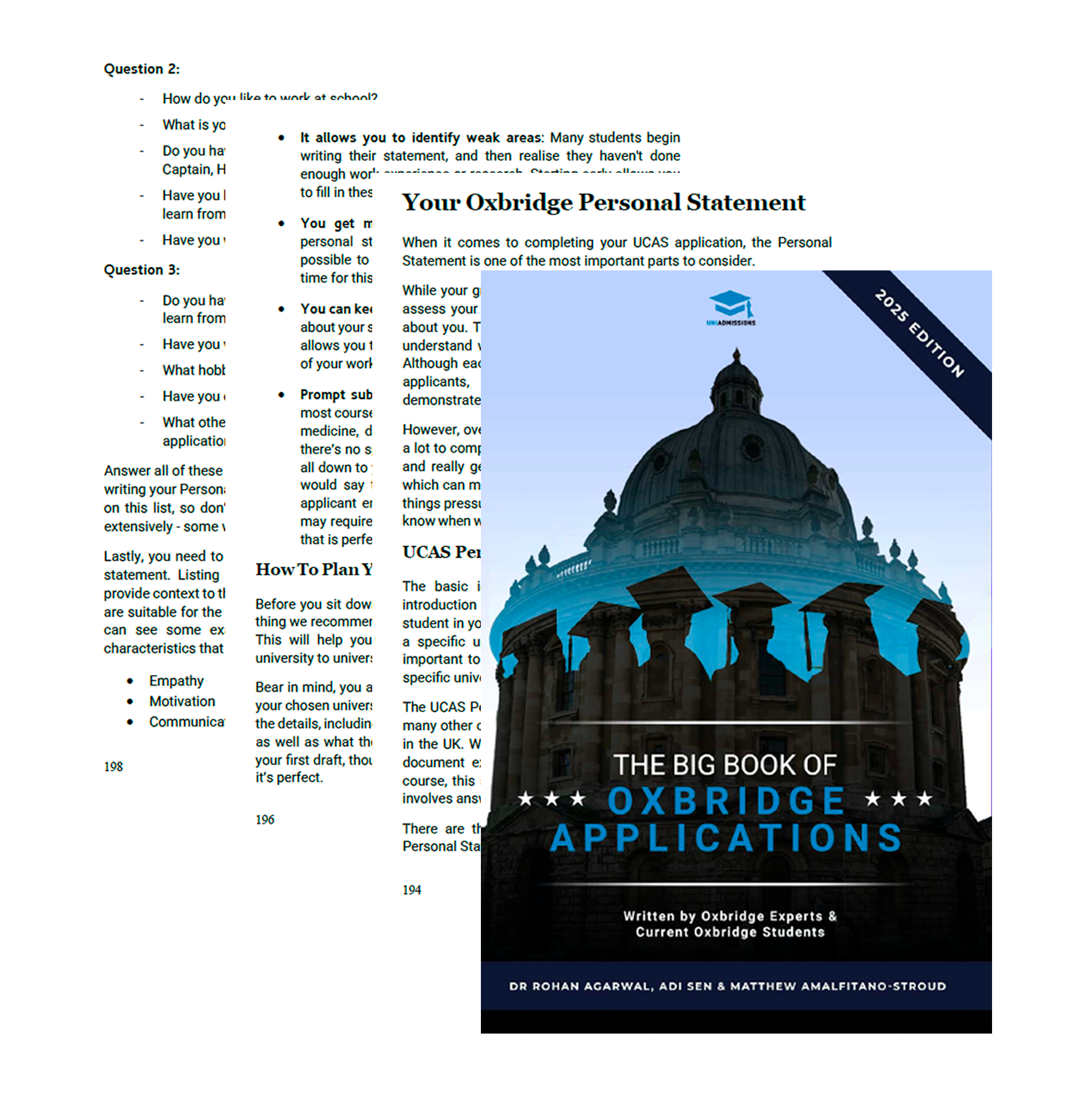
- A method to plan and write a compelling personal statement
- Proven strategies to stand out — even among top applicants
- 28 example Oxbridge Personal Statements
- Additional downloadable resources
Access "The Oxbridge Application Vault"
- 300+ page ebook for Oxbridge Applicants
- 25 page ebook for Personal Statement
- 2h+ online course to succeed in any exam
- Online Oxbridge Success Calculator
- 12 page ebook about UniAdmissions

Good Points Of The Cambridge Classics Personal Statement
The personal statement is very strong, with no obvious errors. The student’s strength in particular here is their ability to make classics relevant in all of their listed academic interests. This is done notably well in the paragraph about A-Level Philosophy, which the student used as a springboard to undergo their own research. Indeed the Academic Research Project was another well-chosen inclusion, as independent research work is more closely in line with the style of working at university, and the student seems comfortable working in this way. The ending lines work well in underlining that the student is eager and excited to begin this course.
Bad Points Of The Cambridge Classics Personal Statement
The opening line is somewhat of a personal statement cliché. Talk of developing these interests fully at such a young age is, more often than not, unconvincing. Structurally, the balance of the statement seems to be weighted towards language or literature aspects, with societal dimensions coming later. Ensuring that all aspects of the course are covered from the outset, or as soon as is practical, will help to give the impression the student is a good fit for the course as a whole, rather than only being interested in smaller aspects. In terms of engagement with ancient texts, The Odyssey (as with The Iliad and The Aeneid) is fairly standard, and usually on the Classics A-Level Syllabus. Given that the majority of students applying to study Classics at university will be studying it at A-Level, going off syllabus to more niche texts might set the student apart from the crowd. The grammar is, at points, questionable, indicating the statement required closer proofreading prior to being submitted.
UniAdmissions Overall Score:
★ ★ ★ ★ ☆
This personal statement is strong stylistically, but there is room for potential improvement. The content may come across as fairly standard, particularly in terms of the ancient literature the student has read (at least up until the section on Philosophy). The current content is all unproblematic, but to stand out from the crowd, the students should talk about more independent work they have done beyond what is required of them in school.
What Makes A Cambridge Classics Personal Statement Different?
While there’s no set standard for Classics personal statements, most applicants will cover similar topics, such as their coursework, field trips and potentially relevant work experience. However, Cambridge isn’t as interested in these areas, and statements featuring just these topics won’t stand out. So, what can you do to make your statement different?
Firstly, while these typical experiences are important to cover, you need to explore them in depth rather than just providing surface level descriptions. Reflection is the key to a successful personal statement, which means exploring what you have learnt, how this knowledge has helped you develop your skills and how it changed your perception of Classics. This provides evidence of your genuine dedication to the subject.
However, beyond the experiences you’ve had, it’s also important to evidence your super-curricular engagement with the subject, including wider reading and research projects. While this may not seem like the most interesting topic to discuss, it is exactly what Cambridge is looking for in applicants, especially in Classics. A huge part of studying at Cambridge is the ability to work independently and guide your own learning beyond the classroom. As such, displaying a high level of curiosity in your statement will highlight that you have what it takes to succeed in the course.
Cambridge aren’t looking for the applicants with the most impressive experiences – they are looking for the applicants that make the most of their time and resources to truly engage with their subject. This is what you need to prove in your writing.
It’s important to consider that this Personal Statement was not originally written in the three question format currently used by UCAS. Below is the original, unedited version of this statement in the previous free-form style.
Cambridge Classics Personal Statement (OLD FORMAT)
I first became intrigued by the classical world whilst learning about the Romans in primary school. Since then an inspirational Latin teacher, trips to classical sites and the writings of Homer have cemented my fascination with this subject. Having studied Latin GCSE and AS level, as well as AS Classical Civilisation, I have come to appreciate the rich cultural depth of the ancient world and its profound influence upon society today as the origin of so many of the fundamental aspects of our daily lives, from democracy and English language through to the justice system. It is for these reasons that I wish to study Classics at degree level.
As part of my Latin AS course I found the structure of Latin and its legacy in terms of modern European languages fascinating. This led me to research the derivations of the English language as part of my Academic Research Course project with a specific focus on Latin and Greek influences and I found that Latin influence on English especially is huge both in terms of vocabulary and idiom. Studying The Iliad in translation for the AS Classical Civilisation course has stimulated my interest in ancient literature, quickly appreciating its striking sophistication and lucidity, prompting me to read The Odyssey. This epic, for me, particularly raised the question of the nature of morality in ancient Greece as the portrayal of Odysseus is as a pious and kind man, yet his indiscriminate slaughter of the suitors and servants at the end would seem to conflict with this. Having seen certain short passages in the original Greek I have come to further appreciate the subtle word play of Homer such as the section in which Odysseus outmanoeuvres the Cyclops by saying that his name is ‘nobody’ which is yet more impressive when seen in the Greek as the translation cannot fully convey the use of double meaning.
In addition to my AS subjects I have attended a weekly Ancient Greek class and completed the Bryanston Greek summer school course. I feel this has given me a good grounding in ancient Greek that I can build on this year in preparation for a Classics degree. I am also involved with running the college Classics society which is helping to develop my organisational and presentation skills.
Having taken trips to Pompeii and Greece I found the opportunity to see parts of the ancient world in the flesh, such as the Parthenon, awe inspiring. It was an experience which made the ancient world seem far more real to me and gave me a sense of the scale and significance of the ancient sites which cannot be gained from photographs or drawings so I hope to visit more in the future.
I also found the AS Philosophy course most absorbing and through this have gained a detailed understanding of some ancient philosophy, such as Plato, which is an area of classics I am keen to study further. This led me to read Aristotle’s Nicomachean Ethics, which I found to be strikingly convincing and relevant to the modern world considering its age. I particularly found the concept of virtues and the ‘Golden mean’ a compelling argument for how we should make moral decisions as the idea of moderating our behaviour between two extremes is an intuitive one. The Maths AS course has developed my skills of logical thought, a discipline which is proving useful in other subjects when analysis is required for essays or translation.
Music is also a great interest of mine and over the course of the last year I have taught myself to play the guitar proficiently and I am also a very competent drummer, having taken lessons for several years. Both these pursuits, but in particular teaching myself the guitar, have developed skills of perseverance and self-motivation, which are of great use to any academic study.
I relish the opportunity to study Classics at the highest level and especially look forward to working with both experts in the field and other students who share my passionate interest.
This Personal Statement for Classics is a good example of a well-rounded Statement whilst demonstrating academic interests, vital to Admissions Tutors.
Remember, at Cambridge, these Admissions Tutors are often the people who will be teaching you for the next few years, so you need to appeal directly to them.
You can find more successful personal statements and our expert guides on our Free Personal Statement Resources page.
Our expert tutors are on hand to help you craft the perfect Personal Statement for your Cambridge Classics application.
With our Oxbridge Classics Full-Blue Programme, we help you craft the perfect Personal Statement, perform strongly on the Written Assessment and teach you how to Interview effectively.
Discover our Oxbridge Classics Full-Blue Programme by clicking the button below to enrol and triple your chances of success.

