

Welcome to our popular Personal Statement series where we present a successful Personal Statement, and our Oxbridge Tutors provide their feedback on it.
Today, we are looking through a Medicine applicant’s Personal Statement that helped secure a place at Cambridge University. The Medicine Course at Cambridge aims to educate students to become compassionate, thoughtful, skilled members – and leaders – of the medical profession.
Read on to see how this candidate wrote a Personal Statement that demonstrates the qualities to work in a medical profession.
Here’s a breakdown of the Personal Statement:
CHARACTERS
3,956
WORDS
641
SUCCESSFUL?
1/4
The universities this candidate applied to were the following:
CAMBRIDGE
OFFER
IMPERIAL COLLEGE
INTERVIEW + REJECTED
CARDIFF
INTERVIEW + REJECTED
BRISTOL
REJECTED
Cambridge Medicine Personal Statement (NEW FORMAT)
Why do you want to study this course?
I realise that medicine may not always have positive outcomes, having witnessed two deaths at a young age. However, the inevitable fallibility of the human body has driven my desire to acquire a better understanding of the complicated processes and mechanisms of our body. I am captivated by the prospect of lifelong learning; the rapid and ceaseless pace of change in medicine means that there is a vast amount of knowledge in an astonishing number of fields.
Work experience and volunteering have intensified my desire to pursue the profession; it gave me the chance to observe doctors diagnosing problems and establishing possible routes of treatment; I found the use of monoclonal antibodies in kidney transplantation fascinating. A doctor needs to be skilled, dexterous and creative. Medicine is a scientific discipline that requires a profound understanding of the physiology of the body, but the application of medicine can be an art, especially when communications between the doctor and the patient can influence the outcome of the treatment. I admire the flexibility of doctors; an inpatient needs to be approached with sensitivity and reassurance, whereas an acute admission patient would benefit more from hands-on assessments.
I believe I possess the ability, devotion, diligence and determination required for this course that demands a holistic understanding of both the sciences and the arts. I will relish the challenges on an academic and personal level and I look forward to following this vocation in the future.
How have your qualifications and studies helped you to prepare for this course or subject?
My Nuffield Bursary project was based on finding potential medical treatments for sepsis by working on the molecular genetics of bacteria-infected cells. Using theory to interpret laboratory experiments allowed me to show how an enzyme was involved in the inflammatory response mechanism.
My skills of organisation and time management were recognised by the Individual Achievement Award for my role as Finance Director in the Young Enterprise team. I used my leadership skills to assign team members to tasks to which their talents were best suited and demonstrated effective communication and teamwork to meet the deadlines.
I took part in the British Mathematical Olympiad after receiving the Gold and Best in School prize for the Senior Maths challenge last year. Regular participation in the Individual and Team Maths Challenge enhanced my lateral thinking.
The numerous awards I have won such as Best Results at GCSE and Bronze in the Physics Olympiad not only show my ability in a range of subjects but also my commitment to my academic career. As a subject mentor, I developed my ability to break down problems, explaining them in a logical, analytical yet simpler way. I cherished the opportunity to work with the younger pupils; enabling them to grasp new concepts, and I believe that discussing ideas, problems or case studies with colleagues will be even more rewarding.
What else have you done to prepare outside of education, and why are these experiences useful?
I have been volunteering at Derriford Hospital since 2010. The most valuable part is taking time to converse with the patients to alleviate their stress and appreciate their concerns, demonstrating my understanding of the importance of listening. I appreciate that the quality of life is more important than the quantity of years, as a recent death at the ward made me realise that despite all the technological advances and our increasing understanding of the human body, there is a limit to what we can achieve.
A keen pianist, I have been playing for 14 years. At the age of 12, I became the pianist for the Children’s Amateur Theatre Society. Perseverance was essential as I was learning numerous songs each week showing commitment, resilience and attention to detail, which are transferable skills applicable to medicine. Playing in front of 300 people regularly helped me to build my confidence and taught me to stay calm under pressure. Playing the piano is a hobby that I love and I will continue to pursue it to balance my academic life.
Break Free from the Personal Statement Spiral
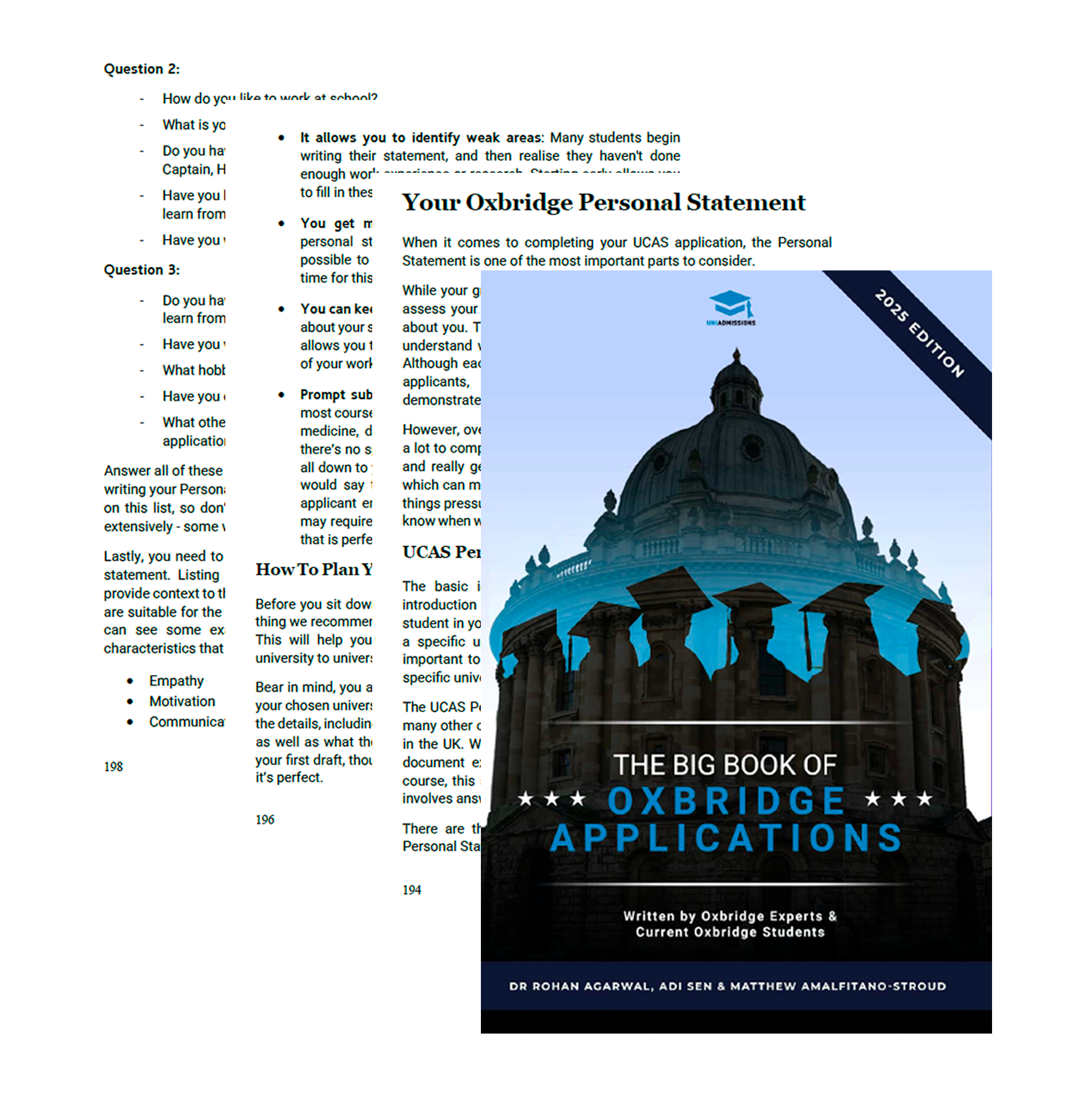
- A method to plan and write a compelling personal statement
- Proven strategies to stand out — even among top applicants
- 28 example Oxbridge Personal Statements
- Additional downloadable resources
Our Tutors' Feedback On This Cambridge Medicine Personal Statement
Good Points
A well-written statement that guides the reader from one point to the next, delivering good insight into personal development and the motivations to becoming a doctor. The student shows that they have a very diverse background, both academically as well as work experience. One of the strongest parts of the statements is that the student recognises the limitations of medicine and acknowledges the challenges in delivering medical care under those limitations. The student is also able to demonstrate experiences made in non-medical fields and how they contributed to their personal development. This is important as some of the skills necessary to becoming a good doctor are transferable from other professions.
Bad Points
The student provides extensive detail on awards and prizes won. This part is somewhat unnecessary as it does not add anything to the quality of the statement itself. Most, if not all students applying for medicine will have a history of academic excellence, therefore, listing awards and achievements is less relevant. This space could be better used to provide more insight into lessons learned from work experience.
UniAdmissions Overall Score:
★ ★ ★ ★ ☆
A strong statement with a lot of information on the student’s development and academic achievements. The statement succeeds at raising interest in the student and providing an overview of the individual’s development. There are a few minor weaknesses that could be optimised in order to improve the overall strength of the statement even further.
Enrolling on our Oxbridge Medicine comprehensive Programme will give you access to Personal Statement redrafts.
Your tutor will give you actionable feedback with insider tips on how to improve and make your Personal Statement Oxbridge quality for the best chances of success.
Discover our Oxbridge Medicine Programme by clicking the button below to enrol and triple your chances of success.
What Makes A Cambridge Medicine Personal Statement Different?
A Cambridge Medicine personal statement is more academically focused than many other medical school applications. Cambridge explicitly states that personal statements help identify applicants with the strongest academic potential, so the emphasis is less on simply proving that you want to be a doctor and more on showing how you think, learn, and engage with medicine as an academic discipline. Strong statements often demonstrate intellectual curiosity, scientific reasoning, and thoughtful reflection on subject exploration beyond the classroom, rather than relying heavily on generic motivation or broad lists of experiences.
Cambridge also places particular weight on evidence of scientific interest and analytical thinking. Medical applicants are expected to show curiosity about the science behind medicine, the ability to engage with complex ideas, and the capacity to reflect critically on what they have learned from reading, supercurricular activities, work experience, or observation. Rather than describing experiences at face value, successful applicants usually explain how those experiences deepened their understanding of medicine, developed their thinking, or led them to explore further academic questions.
Unlike some other universities, Cambridge advises applicants not to spend too much space on unrelated extracurricular activities or generic personal motivations. The statement should remain academically detailed throughout, with most of the focus on subject engagement, evidence of learning, and intellectual reflection. For Medicine specifically, Cambridge’s broader admissions criteria also highlight qualities such as scientific problem-solving, communication, ethical awareness, emotional maturity, and realistic understanding of the profession, so the strongest personal statements tend to combine academic depth with thoughtful insight into what studying and practising medicine truly involves.
Cambridge Medicine Personal Statement (OLD FORMAT)
Please note that the personal statement presented earlier in this guide was not originally written in the three-question format currently used by UCAS. Below is the original, unedited version of this statement in the previous free-form style.
—
I realise that medicine may not always have positive outcomes, having witnessed two deaths at a young age. However, the inevitable fallibility of the human body has driven my desire to acquire a better understanding of the complicated processes and mechanisms of our body. I am captivated by the prospect of lifelong learning; the rapid and ceaseless pace of change in medicine means that there is a vast amount of knowledge in an astonishing number of fields.
Work experience and volunteering have intensified my desire to pursue the profession; it gave me the chance to observe doctors diagnosing problems and establishing possible routes of treatment; I found the use of monoclonal antibodies in kidney transplantation fascinating. A doctor needs to be skilled, dexterous and creative. Medicine is a scientific discipline that requires a profound understanding of the physiology of the body, but the application of medicine can be an art, especially when communications between the doctor and the patient can influence the outcome of the treatment. I admire the flexibility of doctors; an inpatient needs to be approached with sensitivity and reassurance, whereas an acute admission patient would benefit more from hands-on assessments. I have been volunteering at Derriford Hospital since 2010. The most valuable part is taking time to converse with the patients to alleviate their stress and appreciate their concerns, demonstrating my understanding of the importance of listening. I appreciate that the quality of life is more important than the quantity of years, as a recent death at the ward made me realise that despite all the technological advances and our increasing understanding of the human body, there is a limit to what we can achieve.
My Nuffield Bursary project was based on finding potential medical treatments for sepsis by working on the molecular genetics of bacteria-infected cells. Using theory to interpret laboratory experiments allowed me to show how an enzyme was involved in the inflammatory response mechanism. My skills of organisation and time management were recognised by the Individual Achievement Award for my role as Finance Director in the Young Enterprise team. I used my leadership skills to assign team members to tasks to which their talents were best suited and demonstrated effective communication and teamwork to meet the deadlines. I took part in the British Mathematical Olympiad after receiving the Gold and Best in School prize for the Senior Maths challenge last year. Regular participation in the Individual and Team Maths Challenge enhanced my lateral thinking. The numerous awards I have won such as Best Results at GCSE and Bronze in the Physics Olympiad not only show my ability in a range of subjects but also my commitment to my academic career. As a subject mentor, I developed my ability to break down problems, explaining them in a logical, analytical yet simpler way. I cherished the opportunity to work with the younger pupils; enabling them to grasp new concepts, and I believe that discussing ideas, problems or case studies with colleagues will be even more rewarding.
A keen pianist, I have been playing for 14 years. At the age of 12, I became the pianist for the Children’s Amateur Theatre Society. Perseverance was essential as I was learning numerous songs each week showing commitment, resilience and attention to detail, which are transferable skills applicable to medicine. Playing in front of 300 people regularly helped me to build my confidence and taught me to stay calm under pressure. Playing the piano is a hobby that I love and I will continue to pursue it to balance my academic life.
I believe I possess the ability, devotion, diligence and determination required for this course that demands a holistic understanding of both the sciences and the arts. I will relish the challenges on an academic and personal level and I look forward to following this vocation in the future.
And there we have it – a Cambridge Medicine Personal Statement with feedback from our expert tutors.
Remember, at Cambridge, the Admissions Tutors are often the people who will be teaching you for the next few years, so you need to appeal directly to them.
Our Free Personal Statement Resources page is filled with even more successful personal statements and expert guides. If you are applying for medicine, our Successful Personal Statement For Medicine At Oxford University guide is a helpful supplementary read.
For more inspiration, take a look through our other successful Personal Statement analysis articles:
Our expert tutors are on hand to help you craft the perfect Personal Statement for your Cambridge Medicine application.
With our Oxbridge Medicine Premium Programme we help you craft the perfect Personal Statement, achieve a highly competitive UCAT score and teach you how to Interview effectively.
Discover our Oxbridge Medicine Full-Blue Programme to enrol and triple your chances of success.


