

Getting into Oxbridge is genuinely competitive. Most applicants arrive with strong predicted grades, a thoughtful personal statement, and a teacher who thinks the world of them. But when everyone looks good on paper, do the things that used to feel like advantages stop being advantages?
What actually tips the balance is rarely another qualification or a longer list of achievements. More often, it comes down to something harder to manufacture: a genuine sense that this applicant thinks about their subject when nobody’s asked them to. That they picked up a book because they were curious, followed an idea beyond the school syllabus, and can talk about it with conviction. Admissions tutors call this genuine intellectual curiosity. And the thing that demonstrates it is super curricular activity.
This guide covers everything you need to know. What super curricular activities actually are, how they differ from extracurriculars, which ones are worth your time by subject, and how to make sure they come across in your application.
If you only have time to read one section, read this:
Most Oxbridge applicants have good grades. The ones who get offers have usually spent two or three years reading around their subject, attending lectures, entering competitions, and building the kind of independent perspective that survives a tutorial. Start in Year 10 or 11 if you can. Pick one or two things that genuinely interest you in your subject and go deep rather than collecting activities. When it comes to your personal statement, do not list what you have done — explain what it made you think. That is the difference between an application that qualifies and one that gets you an interview.
Looking for subject-specific super curricular activities? Choose from the subjects below:
What Are Super Curricular Activities?
Super curricular activities are academically focused pursuits that deepen your engagement with a subject beyond what is taught in the classroom. The word “super” here means above or beyond, not simply additional. These are not things you do instead of your schoolwork or alongside it for balance. They are things you do because you are genuinely interested in your subject and want to understand it at a higher level.
In practice, super curricular activity might look like reading academic books and journal articles related to your chosen course, attending university open lectures, completing online courses from leading institutions, entering subject-specific competitions, or engaging with the kind of debates and ideas that your A-level syllabus never quite reaches. The common thread is subject depth. Everything connects back to what you want to study.
This matters because UK university applications, particularly to Oxford and Cambridge, ask you to demonstrate not just that you have studied your subject but that you have thought about it independently. A student who has read widely, engaged critically, and developed their own perspective on key ideas in their field is a fundamentally different candidate to one who has simply performed well in class. Super curricular activity is how that difference becomes visible.
Super Curricular vs Extracurricular: What Is the Difference?
Super Curricular Activities
- Academic engagement with your chosen subject beyond the syllabus
- Demonstrates intellectual curiosity and subject passion
- Examples include academic reading, subject competitions, online university courses, open lectures, relevant work experience, summer schools
- Evidence you think about your subject when no one has asked you to
Extracurricular Activities
- Activities outside the classroom unrelated to your subject
- Demonstrates character, resilience, and wider contribution
- Examples include sport, music, drama, volunteering, Duke of Edinburgh, positions of responsibility
- Evidence you are a well-rounded person who contributes beyond academics
This is one of the most common points of confusion for applicants, and it is worth getting clear on before you start planning your preparation.
Extracurricular activities are everything you do outside the classroom that is not directly related to your academic subject. Sport, music, drama, volunteering, the Duke of Edinburgh Award, positions of responsibility at school. These things have real value. They speak to your character, your resilience, and your ability to contribute to a community. Most universities are happy to see them mentioned, and for some courses they carry genuine weight.
Super curricular activities are different in kind, not just in degree. They are specifically about your subject. Reading a philosophy text because you are applying to read Philosophy at Oxford is super curricular. Captaining the football team is extracurricular. Both matter, but they are doing different jobs in your application, and confusing one for the other is a mistake that costs applicants more than they realise.
This distinction matters particularly at Oxbridge because of how the personal statement is used. Admissions tutors at Oxford and Cambridge read personal statements not as a general character assessment but as preparation for interview which resembles an academic discussion with a subject expert. They are identifying threads to pull on, ideas to probe, positions to challenge. A personal statement built around extracurricular achievements gives them very little to work with academically. One built around genuine intellectual engagement with the subject gives them exactly what they need.
Access "The Big Book Of Oxbridge Applications" For FREE
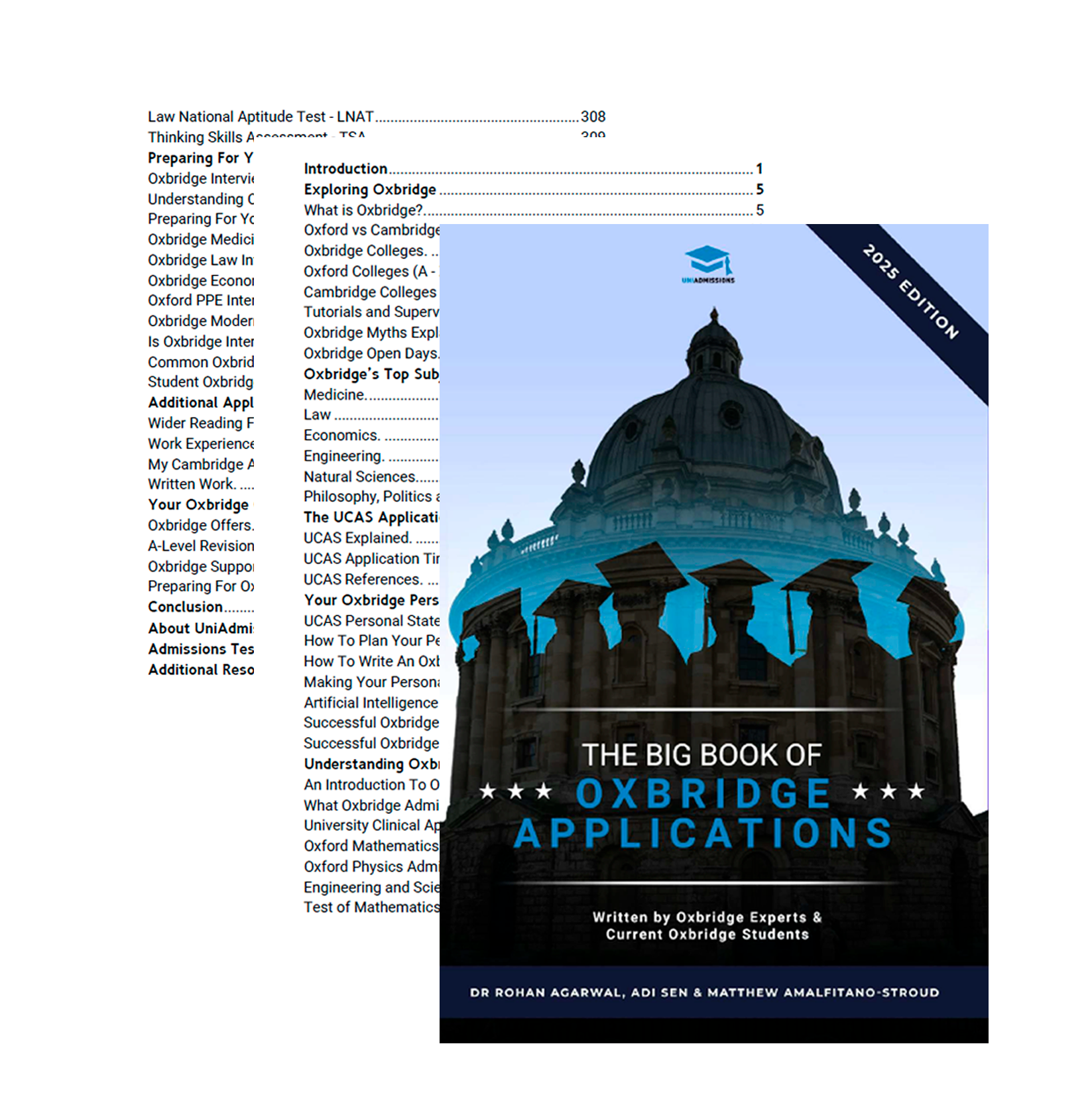
- Over 40 admissions test practice questions
- 28 example Oxbridge Personal Statements
- Interviews with Oxbridge students and graduates
- Additional downloadable resources
Why Super Curricular Activities Matter for University Applications
To understand why super curricular activities carry so much weight, it helps to understand what admissions tutors at selective UK universities are actually trying to do. They are not looking for the most well-rounded student or the busiest one. They are looking for the student most likely to thrive in a high-pressure academic environment where independent thinking is expected from day one.
At Oxford and Cambridge, that environment is the tutorial and supervision system. You will meet your tutor weekly, sometimes in a group of two, sometimes alone, and you will be expected to defend the arguments in your essay, respond to challenges you have not prepared for, and engage with ideas on the spot. The admissions process is designed, in large part, to identify students who can do that. Super curricular activity is the clearest evidence available that you are one of them.
When an Oxbridge admissions tutor reads your personal statement, they are not just checking that you have done interesting things. They are assessing the quality of your intellectual engagement. A candidate who references a specific argument from a book they read independently, explains what they found compelling about it, and then offers a counterpoint is demonstrating the kind of thinking that tutorials demand. That kind of reflection does not come from skimming a reading list the week before the UCAS deadline. It comes from sustained, genuine engagement with your subject over time.
There is also a practical dimension that many applicants underestimate. Oxford and Cambridge interviews are not a test of what you know. They are a test of how you think. Tutors will often introduce material you have never seen before and ask you to reason through it in real time. But they will also draw directly on your personal statement. If you have mentioned a book, expect to be asked what you made of the argument in chapter three. If you have described an enthusiasm for a particular debate within your field, expect to be asked to take a side and defend it. Super curricular activity is not just preparation for the application. It is preparation for the interview itself.
Why Oxbridge Places So Much Weight on Super Curricular Activities
Oxford and Cambridge are explicit about what they are looking for, in a way that many applicants do not fully appreciate. Oxford’s admissions guidance describes a passion for the subject that extends well beyond the school curriculum. Cambridge goes further, publishing subject-specific super curricular suggestions for prospective applicants and describing them as an opportunity to demonstrate the kind of independent intellectual engagement the university expects.
This reflects the genuine demands of undergraduate study at both institutions. A first-year student at Oxford or Cambridge is expected to read and think at a level that would constitute postgraduate work at many other universities. The gap between A-level and first-year Oxbridge is significant, and admissions tutors are acutely aware of it. Super curricular preparation is one of the few reliable signals that a candidate is ready to make that jump.
It is also worth understanding the numbers. The Oxford acceptance rate sits at around 14%, and the Cambridge acceptance rate is similar. The vast majority of applicants who are rejected are not academically weak. Many have the grades, the predicted results, and the ability to succeed. What they have not demonstrated is the intellectual independence that distinguishes a promising student from one who is genuinely ready for Oxbridge. Super curricular activity is where that demonstration happens.
For a comprehensive overview of the full application process, our guide on how to get into Oxbridge is a good place to start.
Ready to Build an Oxbridge-Level Academic Profile?
Super curricular preparation is most effective with expert guidance alongside it. UniAdmissions’ Oxbridge Full-Blue Programmes are designed to help you develop the intellectual depth admissions tutors are looking for and show it clearly in your application.
Do Russell Group Universities Care About Super Curricular Activities?
Yes, though the weight placed on them varies considerably by institution and course. At the most competitive end of the Russell Group, particularly for Medicine, Law, and Economics at universities such as Imperial, UCL, and LSE, strong super curricular engagement is increasingly expected rather than merely appreciated. These universities receive far more applications from academically qualified candidates than they have places, and super curriculars is one of the few tools available to distinguish between them.
For less heavily oversubscribed courses, a compelling extracurricular profile may carry more relative weight. But the general principle holds across the Russell Group: any university that takes the personal statement seriously is, to some degree, assessing the quality of your independent intellectual engagement with your subject. Super curricular activity is what gives you something substantive to write about. For a sense of how competitive individual institutions are, our guide to Russell Group acceptance rates is worth consulting.
Super Curricular Activities: Examples and Ideas
There is no official approved list of super curricular activities, and that is genuinely good news. It means there is room to pursue what actually interests you rather than performing enthusiasm for things that do not. That said, certain types of activity tend to carry more weight than others in the admissions process, and it is worth understanding why.
Academic Reading
Reading is the most fundamental form of super curricular engagement and the most universally applicable. Academic books written for an intellectually serious general audience, subject-specific journals, long-form essays, and well-researched journalism can all deepen your understanding and give you material to reflect on. The key is not volume but quality of engagement. Reading one book carefully, forming a view on its argument, and being able to articulate where you agree and where you push back is worth considerably more than skimming ten.
Online Learning
Online learning has become a genuinely valuable part of super curricular preparation. Platforms such as Coursera, edX, and FutureLearn host courses from Oxford, Cambridge, MIT, Yale, and other leading institutions, many of them free. Completing a relevant course and being able to speak concretely about what you learned and what questions it raised demonstrates both initiative and intellectual seriousness.
University Open Lectures and Public Talks
University open lectures and public talks are significantly underused by school-age applicants. Many Russell Group and G5 universities publish lecture recordings online, and attending in person, where geography allows, puts you in an environment where you can ask questions and engage with academics directly. Some departments run specific outreach events for sixth formers, which are worth seeking out well in advance.
Summer Schools
Summer schools, whether residential or online, offer intensive academic engagement in a university environment. Many individual universities run programmes designed specifically for Year 11 to 13 students. Beyond the academic content, they provide experience of learning at university level, which is itself useful preparation.
Subject Competitions
Subject competitions provide structured academic challenge beyond A-level and are well regarded by admissions tutors, particularly in STEM subjects. The UK Mathematics Trust competitions, the Biology, Chemistry, and Physics Olympiads, and the UK Linguistics Olympiad all fall into this category. For humanities and social science students, essay competitions run by universities and independent organisations serve a similar purpose and have the added benefit of forcing you to construct a sustained argument in writing.
Relevant Work Experience
Relevant work experience or shadowing can also function as super curricular activity when it connects meaningfully to the academic content of your course. This is particularly true in Medicine, where clinical exposure is expected, and in Law, where court visits or time at a solicitor’s practice can shape your understanding of the discipline in ways that are directly relevant to what admissions tutors want to see.
How to Find Super Curricular Opportunities
The best super curricular opportunities are more accessible than most students realise, and many of them are free. University departmental websites frequently publish reading lists for prospective applicants. Many departments run open days, taster lectures, and online events specifically for sixth formers, which can be found through university outreach pages. The Brilliant Club places PhD researchers in schools to deliver university-style tutorials and is particularly valuable for students whose schools have limited access to this kind of academic challenge. The UNIQ programme at Oxford and the Sutton Trust programmes at Cambridge offer residential access for students from underrepresented backgrounds.
For wider reading guidance that applies across subjects, our article on how to start wider reading for Oxbridge is a useful companion to this one.
When should you start super curricular activities?
The honest answer is earlier than most students think. The ideal starting point is Year 10 or Year 11, well before university applications are anywhere near the horizon. Not because admissions tutors will ask for a dated record of everything you have read, but because genuine intellectual engagement takes time to develop. You cannot manufacture two years of curiosity in the six weeks before your UCAS deadline.
Starting early also means you have room to change direction. Many students who begin reading around their subject in Year 10 discover that what they thought they wanted to study is not quite right, or find an angle within it that genuinely excites them. That process of exploration is itself valuable, and it produces the kind of specific, considered perspective that stands out in a personal statement.
For students in Year 12 or 13 reading this, it is not too late. A focused six to twelve months of serious engagement can still produce strong material. But the emphasis has to shift from breadth to depth. Rather than trying to cover everything, pick two or three things, read them carefully, form a view, and be ready to defend it. That is more useful than a longer list assembled under pressure.
The timeline below shows how different types of super curricular activity map across Years 10 to 13, and when each one is worth prioritising.
Super Curricular Activities by Subject
The most effective super curricular preparation is subject-specific. What impresses a Medicine admissions tutor is quite different from what impresses a tutor interviewing for History or Engineering. The following sections outline what carries genuine weight for the most competitive courses, based on what those disciplines actually demand at university level.
Super Curricular Activities for Medicine
Medicine is among the most demanding applications in the UK system, and the super curricular bar is correspondingly high. Clinical work experience or shadowing is effectively non-negotiable: admissions tutors want evidence that you have engaged with the realities of patient care and understand what the profession actually involves, not just what it looks like from the outside. This is not about accumulating hours. It is about being able to reflect on what you observed and what it taught you about medicine as a discipline.
Beyond clinical exposure, reading around the scientific and ethical dimensions of medicine is important. Admissions interviews at Oxford and Cambridge Medical Schools regularly draw on candidates’ wider reading, and tutors are adept at identifying the difference between someone who has genuinely engaged with a text and someone who has listed it for effect. Books that bridge the clinical and the human tend to generate the richest material for both personal statements and interviews. Our list of must-read books for medical students is a good place to start.
Staying current with medical research and healthcare policy adds another dimension. The BMJ and The Lancet both publish accessible content alongside peer-reviewed research, and being able to discuss a current debate in public health or medical ethics demonstrates the kind of engagement that tutors at leading medical schools are looking for.
Super Curricular Activities for Law
Most Law applicants arrive without any formal legal education or law work experience, which means the super curricular work is doing a significant job in demonstrating that you understand what you are applying to study. Reading about landmark cases and the reasoning behind judicial decisions, engaging with the philosophical foundations of law, and following current legal debates in the news are all ways of showing that your interest in the subject is genuine and informed.
Court visits deserve a special mention. They are free, open to the public, and one of the most direct forms of super curricular engagement available to Law applicants. Sitting in on a hearing, even briefly, gives you first-hand experience of legal argument in practice and something concrete and original to write about. Mooting competitions, where available, develop the kind of precise, structured argumentation that Law tutorials demand. Our Law reading list for Oxbridge covers the key texts worth working through before you apply.
Super Curricular Activities for Economics and PPE
Economics and PPE applicants are expected to arrive with more than a passing interest in current affairs. Admissions tutors want to see that you can engage critically with economic arguments, understand the assumptions underlying different schools of thought, and have at least some familiarity with the foundational texts in the discipline. Being able to discuss a current macroeconomic debate or evaluate a piece of policy with some rigour is the kind of thing that distinguishes candidates at interview.
The Financial Times and The Economist provide a useful diet of current analysis. Academic blogs such as the IGM Forum, which publishes the views of leading economists on policy questions, give a sense of how professionals in the field actually disagree. For more structured preparation, our Economics reading list for Oxbridge sets out the books and resources most relevant to competitive applications while our Economics Work Experience guide explains how to find and make the most of relevant experience opportunities.
Super Curricular Activities for History
History applicants should be reading beyond their A-level set texts as a matter of course, but the quality of that reading matters more than the quantity. The goal is to develop a genuine sense of historiography: an understanding of how historical interpretations are constructed, contested, and revised over time. Choosing a period or theme that genuinely interests you and reading deeply around it, including historians who disagree with each other, will serve you better at interview than attempting to cover everything superficially.
Visiting archives, museums, and sites of historical significance can also constitute meaningful super curricular engagement, but only when approached analytically. What did the primary sources suggest that the secondary literature does not? What struck you about the gap between the historical narrative and the material evidence? Writing about these encounters, even informally, helps you process what you have seen and builds the reflective habit that History tutorials reward.
Super Curricular Activities for English Literature
For English applicants, reading widely is the starting point rather than the distinguishing factor. Most strong candidates have read a lot. What separates the exceptional ones is how they read. Engaging with literary criticism, developing familiarity with the theoretical frameworks that shape how texts are interpreted, and building the capacity to argue for a reading rather than simply describe one are the qualities that admissions tutors in English are looking for.
Reading across periods, forms, and traditions matters too. An applicant whose reading is limited to contemporary literary fiction is at a disadvantage relative to one who has engaged seriously with poetry, drama, and pre-twentieth century literature. Attending theatre and being able to discuss dramatic texts as performed works rather than just scripts is another dimension worth developing, particularly for applicants to courses where drama features prominently.
Super Curricular Activities for Computer Science and Mathematics
For Maths and Computer Science applicants, super curricular preparation tends to be more problem-focused than reading-focused, though the two are not mutually exclusive. The UKMT competitions, culminating in the Senior Mathematical Challenge and beyond, provide structured challenge well above A-level and are widely recognised by admissions tutors. STEP papers, used by Cambridge as part of the admissions process for Mathematics, are also worth engaging with early. Online platforms such as Project Euler and Brilliant.org offer further mathematical challenge for those working toward Oxbridge-level preparation.
Reading about the history and philosophy of mathematics, the theoretical foundations of computation, or the ideas behind cryptography and complexity theory can add real depth to an application and give you material to discuss at interview beyond problem-solving. Admissions tutors in these subjects are often as interested in how you think about the nature of mathematical reasoning as they are in technical facility alone.
Super Curricular Activities for Natural Sciences
Natural Sciences at Cambridge and the individual science courses at Oxford both expect applicants who engage with their subject significantly above A-level. Reading academic science writing, following current research in your area of interest, and being familiar with the key open questions in the field are all expected. Journals such as Nature and New Scientist publish accessible content that bridges the popular and the technical and are worth reading regularly.
The subject Olympiads, in Chemistry, Biology, and Physics, are particularly well regarded and provide concrete evidence of ability beyond the standard curriculum. For applicants with a genuine interest in the broader intellectual landscape of their subject, books exploring the philosophy, history, or social context of scientific discovery can enrich your application considerably and open up more interesting interview conversations.
Super Curricular Activities for Engineering
Engineering applicants need to demonstrate both technical depth and a genuine understanding of how engineering connects to real problems in the world. Reading about the areas of engineering, the design principles behind significant structures or technologies, and the ethical dimensions of the built environment gives your application context that pure technical ability cannot. Admissions tutors in Engineering are looking for students who think about why as well as how.
Practical projects, whether building, coding, or designing, can serve as strong super curricular evidence when you can reflect on them analytically. What were the constraints? What did you have to compromise on and why? What would you do differently? This kind of reflective engagement is exactly what Engineering tutorials develop, and demonstrating it before you arrive signals genuine readiness. Our Engineering reading list for Oxbridge covers the key texts and resources for serious applicants.
Get Subject-Specific Oxbridge Guidance
Whether you are applying for Medicine, Law, PPE, Natural Sciences, or others, our Oxbridge specialists can help you identify the right super curricular activities for your course and how to present them effectively.
How to Talk About Super Curricular Activities in Your Application
Building a strong body of super curricular experience is one thing. Communicating it effectively in a UCAS personal statement is another, and this is where many otherwise strong applicants lose ground.
The personal statement gives you 4,000 characters, which is less space than it sounds. The instinct of many students is to use it as a list: the books they have read, the courses they have completed, the competitions they have entered. Admissions tutors find this approach thin, and for good reason. Naming things is not the same as demonstrating engagement with them. A tutor reading a personal statement that says “I read X and found it fascinating” has learned almost nothing about how that applicant thinks. One that says “X challenged my assumption that Y, which made me reconsider Z” has learned a great deal.
What tutors want to see is reflection: what you found interesting, why it shifted or challenged your thinking, and what questions it left unresolved. The new UCAS personal statement format, introduced for the 2026 entry cycle, is structured around explicit prompts that ask applicants to explain their interest in their subject and demonstrate their preparation for it. This makes the ability to write reflectively about super curricular engagement more important than ever, because the format itself is designed to draw it out.
A useful test is to ask whether your personal statement could have been written by any student who did the same activities, or only by you. The former is a list. The latter is a genuine account of intellectual development. Specificity and honest reflection are more persuasive than comprehensiveness, and admissions tutors are experienced enough to tell the difference.
At interview, super curricular activity becomes the foundation for live intellectual discussion. Tutors will follow threads from your personal statement, push back on positions you have taken, and introduce new material to see how you respond. The candidates who perform best are rarely the ones who have memorised the most. They are the ones who have thought hard enough about their subject to engage confidently with the unexpected. That kind of intellectual confidence is built through sustained super curricular engagement, not acquired in the weeks before the interview.
One final point. Authenticity matters considerably more than applicants sometimes expect. Admissions tutors at Oxbridge read hundreds of personal statements each cycle and interview dozens of candidates per place. They can tell the difference between a student who has genuinely engaged with an idea and one who has included a book title because they were told it would help. Pursue what actually interests you. The application is easier to write, and the interview is easier to navigate, when you are speaking from genuine engagement rather than strategic performance.
Turn Your Preparation Into a Compelling Application
The gap between a good application and a successful one is often how clearly a candidate can articulate their intellectual journey. UniAdmissions’ Oxbridge programmes help you develop that depth and present it with confidence.
Frequently Asked Questions (FAQ)
Any academically focused pursuit that deepens your engagement with your chosen subject beyond the school curriculum. This includes independent reading, online courses, subject competitions, university open lectures, relevant work experience, and summer schools. The key distinction is that it connects directly to what you want to study, rather than being a general interest or hobby.
There is no target number. Quality and depth of engagement matter far more than quantity. A candidate who has read three or four books carefully, can discuss them critically, and has attended a relevant lecture series is in a stronger position than one who has completed twenty online courses without retaining much from any of them. Focus on building genuine understanding rather than an impressive-looking list.
The earlier the better, though it is never too late. Ideally, you would begin engaging with your subject seriously in Year 10 or 11, well before you start writing your personal statement. This gives you time to read widely, change your mind about things, and develop real opinions. Students who start in the summer before Year 13 can still make meaningful progress, but they are working against the clock.
No. Some of the most valuable super curricular engagement, reading, attending lectures, thinking carefully about a problem, leaves no official record at all. What matters is whether you can speak and write about it with genuine depth. Certificates and completion records from online courses can provide useful structure to your preparation, but they are not a requirement and carry no special weight on their own.
Not at Oxbridge. Both universities apply grades as a threshold, and applicants who fall below standard offer conditions are rarely considered regardless of how strong the rest of their application is. At other Russell Group universities, like KCL for example, there is slightly more contextual flexibility, but super curricular engagement is intended to complement a strong academic record, not substitute for one.
Tutors are generally aware that access to paid programmes is unequal, and most are more interested in the quality of your thinking than in where you developed it. A student who attended a prestigious summer school but cannot engage critically with what they learned is considerably less impressive than one who read independently and has genuinely interesting things to say. Legitimate university-affiliated programmes do carry some weight, but only when the intellectual engagement is evident.
The academic expectations are the same regardless of where you are applying from. International students should focus on the same fundamentals: reading widely in their subject, engaging with relevant academic debates, and building the intellectual independence that Oxbridge values. One practical difference is that access to UK-specific opportunities, such as court visits for Law or NHS-based work experience for Medicine, may be harder to arrange from abroad. Admissions tutors are generally aware of this, and equivalent engagement in a different context is understood and accepted.

