

5 things to know
Key Takeaways
- Cambridge tops the Complete University Guide 2027. Oxford leads The Guardian 2027 and Times Higher Education 2026, and Imperial is the highest-ranked Russell Group university in QS 2027.
- Tables often disagree because they gather data differently, look at different metrics and score them in their own way.
- A lower-ranked university could still be a great choice. It may climb in future years or do well in the subject rankings that matter to you.
- Location, campus and atmosphere will probably shape your time at university more than any ranking table will.
- You'll spend three or more years there, so don't base your decision too heavily on a single year's rankings.
If you’re struggling to decide which universities to apply to, you’re not alone. Each year, thousands of applicants must choose just five of the 100+ university options available to them.
You likely want to attend the best possible university. In most cases, it will probably be a Russell Group University, which are generally considered the best universities in the UK. More than that, some Russell Group universities rank among the best in the world! But what exactly does that mean?
In this guide, we’ll explore what university rankings are, how Russell Group universities perform across various league tables, and how important these rankings should be in your decision-making process.
Winners – Overview
Complete Uni Guide:
University of Cambridge
The Guardian:
University of Oxford
Times Higher Education:
University of Oxford
QS Top Universities:
Imperial College London
Want to learn more about university ranking tables? Carry on reading below! Want to skip to the results from a specific ranking table? Select one of the options here:
What Are University Rankings?
Before we start, we should clarify what a university ranking table actually is.
A university ranking table is, simply put, a list of universities that have been ordered from best to worst based on a scoring system. While this sounds simple, it’s made more complicated by the fact that there is no one official university ranking in the UK or the world.
Instead, multiple organisations compile their own ranking tables, usually utilising different scoring standards from one another. These socring systems are based on a wide variety of metrics, including student satisfaction, graduate success and more. For example, there are the metrics used for The Guardian’s university ranking table.
Guardian score/100 – rating of excellence based on a combination of the other factors.
Satisfied with the course – the rating of the overall quality of the course, given by final-year students in the latest National Students Survey (NSS) given as a percentage.
Satisfied with the teaching – the rating of the quality of teaching on the course given by final-year students in the latest NSS.
Satisfied with feedback – the rating of the feedback and assessment, given by final-year students in the latest NSS.
Student to staff ratio – number of students per member of teaching staff.
Spend-per student/10 – money spent on each student, excluding academic staff costs, given as a rating out of ten.
Average entry tariff – typical UCAS scores of young entrants to the department.
Value-added score/10 – this score compares students’ degree results with their entry qualifications, to show how effectively they are taught – given as a score out of ten.
Career after 15 months – percentage of graduates who find graduate-level jobs, or are in further study at professional or higher education level, within 15 months of graduation.
Continuation – percentage of first-year students continuing to second-year.
Despite other ranking tables using similar metrics, they will often deliver different results on the final table. This is usually caused by slight differences in the data-gathering processes, changes in the metrics considered and different ways of interpreting and scoring the data collected.
These differences can sometimes be minor, such as a university shifting one of two places between lists, but can sometimes see the same university appear in vastly different spots on different lists in the same year. This is more common in subject-specific university rankings rather than general ones.- you can learn more about the rankings for the UK’s top courses in our collection of university rankings guides.
These rankings are updated each year based on the latest data, so the placements of universities aren’t set in stone.
Who Creates University Rankings?
As stated, there isn’t a single body responsible for ranking universities. In the UK, there are various ranking bodies, the two most popular of which being Complete University Guide and The Guardian. However, these two only rank UK universities. There are also organisations that provide global university rankings. These include Times Higher Education and QS Top Universities.
Are University Rankings Important?
Given what we understand about university rankings, you may be wondering how important these rankings actually are. On the one hand, if a university is consistently ranking highly on different lists, this means it must be a great university and one you should apply for.
On the other hand, a university that ranks lower may still be a great choice, as it may rank higher in future years or perform well in subject-specific rankings. Seeing a seemingly objective ranking of universities can put you in the mindset of only applying to those in the top spots, but this isn’t helpful for your application.
University rankings can be beneficial in guiding your application but basing all of your decisions on them can cause problems down the line. Here are multiple things to consider when using ranking tables:
University rankings are great for compiling and interpreting data in a digestible form, but they don’t consider the more human elements of your university choice. The location, campus and overall atmosphere of a university will likely have a bigger impact on your university experience than the statistics provided by a ranking table, so it’s important to base decisions on your own personal preferences as well as quantifiable data. You aren’t going to perform as well at a university that you don’t like!
So, to answer the question “Are University Rankings Important?”, they can be when you’re starting your university search but should be considered in moderation when compared to other important factors about universities. A top-ranking university may not be the best choice for you and vice-versa, so be sure to keep your options open.
Learn more about UK University Rankings here
Boost your university application and get your place with UniAdmissions
Russell Group universities receive hundreds of thousands of applications each year, so it can be tough to make yours stand out. At UniAdmissions, we’ve developed programmes to support applicants for Oxford, Cambridge, Imperial and more through their full applications, including admissions tests and interviews.
Discover our Full-Blue Programmes below and find out how you can enrol and triple your chances of success.
Complete University Guide Russell Group University Ranking Table (2025-2027)
University of Cambridge
COMPLETE UNIVERSITY GUIDE WINNER

Now that we understand what university rankings are, let’s see where each Russell Group university ranked in these tables, starting with Complete University Guide’s UK rankings. Need a refresher on which universities are in the Russell Group? We have a dedicated Russell Group guide that explains everything you need to know.
As you can see there are a variety of consistencies and differences between the results from different in every league table. This illustrates that a university’s ranking isn’t a definitive statement of its quality, as its placement can easily drop or rise between years. You’ll be at your chosen university for at least three years, so it’s likely that, even if you get admitted into the “top” university of your year, it may not stay that way for you’re whole course.
| University | 2027 Ranking | 2026 Ranking | 2025 Ranking |
|---|---|---|---|
| University of Birmingham | 12 | 14 | 14 |
| University of Bristol | 17 | 15 | 16 |
| University of Cambridge | 1 | 1 | 1 |
| Cardiff University | 27 | 22 | 21 |
| Durham University | 6 | 5 | 8 |
| University of Edinburgh | 19 | 18 | 12 |
| University of Exeter | 11 | 11 | 15 |
| University of Glasgow | 29 | 31 | 26 |
| Imperial College London | 5 | 6 | 6 |
| King’s College London | 16 | 19 | 24 |
| University of Leeds | 18 | 21 | 22 |
| University of Liverpool | 22 | 23 | 24 |
| London School of Economics (LSE) | 3 | 3 | 3 |
| University of Manchester | 24 | 28 | 19 |
| Newcastle University | 35 | 19 | 30 |
| University of Nottingham | 26 | 26 | 28 |
| University of Oxford | 2 | 2 | 2 |
| Queen Mary University of London | 40 | 41 | 50 |
| Queen’s University Belfast | 23 | 24 | 27 |
| University of Sheffield | 13 | 16 | 20 |
| University of Southampton | 15 | 17 | 17 |
| University College London (UCL) | 13 | 13 | 9 |
| University of Warwick | 7 | 9 | 11 |
| University of York | 20 | 12 | 17 |
Topping the rankings for Complete University Guide (CUG) is the University of Cambridge, which isn’t a surprise. As you’ll see on the other tables, the top spot in the UK is usually taken by either Oxford or Cambridge.
Beyond that, though, the Russell Group makes up the majority of the Top 10 but doesn’t take up every slot. Almost all G5 universities (except UCL) appear here, alongside Durham University and the University of Warwick, but there are four spots taken by non-Russell Group universities. These are University of St Andrews, Loughborough University, University of Bath, and Lancaster University.
The lowest-ranking Russell Group university is Queen Mary University of London, ranking 40th out of 130 (an increase from 41st in the previous-year table). Although it teaches a broad range of subjects, the university is primarily known for its medical school, which was what it was originally established as. This means that, in other fields, it may not be as highly regarded.
For reference, Queen Mary ranked 4th in CUG’s Medicine ranking for the same year, one position higher than last year, indicating that it is actually a well-regarded medical school. The second-lowest-rated Russell Group university was the Newcastle University, which ranked 35th.

The Guardian Russell Group University Ranking Table (2025-2027)
University of Oxford
THE GUARDIAN WINNER

Next, we have The Guardian’s rankings, another UK-based ranking table. Although it’s ranking the same universities, you’ll see a variety of differences in the placements of them here:
| University | 2027 Ranking | 2026 Ranking | 2025 Ranking |
|---|---|---|---|
| University of Birmingham | 14 | 28 | 36 |
| University of Bristol | 12 | 15 | 16 |
| University of Cambridge | 2 | 3 | 3 |
| Cardiff University | 43 | 37 | 46 |
| Durham University | 6 | 5 | 6 |
| University of Edinburgh | 11 | 13 | 15 |
| University of Exeter | 16 | 17 | 18 |
| University of Glasgow | 21 | 24 | 14 |
| Imperial College London | 5 | 6 | 5 |
| King’s College London | 19 | 21 | 28 |
| University of Leeds | 26 | 28 | 37 |
| University of Liverpool | 30 | 21 | 27 |
| London School of Economics (LSE) | 3 | 4 | 4 |
| University of Manchester | 20 | 36 | 31 |
| Newcastle University | 82 | 81 | 63 |
| University of Nottingham | 51 | 50 | 62 |
| University of Oxford | 1 | 1 | 1 |
| Queen Mary University of London | 54 | 72 | 74 |
| Queen’s University Belfast | 43 | 45 | 43 |
| University of Sheffield | 15 | 16 | 20 |
| University of Southampton | 18 | 20 | 22 |
| University College London (UCL) | 13 | 10 | 9 |
| University of Warwick | 7 | 7 | 8 |
| University of York | 46 | 38 | 25 |
New 2027 rankings show that the University of Oxford has held onto the top spot for another year, but the headline change is Cambridge climbing to 2nd, reclaiming the place it lost to the University of St Andrews last year. LSE nudges up to 3rd and Imperial to 5th, while Durham slips one to 6th and Warwick holds steady at 7th. The one real casualty at the top is UCL, which falls from 10th to 13th, meaning the Russell Group now has six universities in the top 10 rather than seven.
Further down the table, though, the year has mostly gone the Russell Group’s way. Fifteen of the 24 universities have moved up, seven have dropped, and two have stayed exactly where they were. The biggest climbers are Queen Mary University of London, up 18 places from 72nd to 54th, the University of Manchester, up 16 from 36th to 20th, and the University of Birmingham, up 14 from 28th to 14th. Birmingham’s run is the one to watch: 36th in 2025, 28th in 2026, 14th now.
Not everyone has had a good year. The University of Liverpool has fallen nine places to 30th, the University of York is down eight to 46th, and Cardiff University drops six to 43rd. And while the picture has improved overall, three universities still sit at 50 or below: the University of Nottingham at 51st, Queen Mary at 54th, and Newcastle University at 82nd, one place lower than last year and a fair way off the 63rd it managed in 2025.
We already have some idea of why Newcastle struggles on general rankings like this one (it places 24th on The Guardian’s Medicine table), and it remains the clear outlier. But the wider trend has reversed from last year: where Russell Group universities were noticeably more scattered in 2026, most of them have clawed back ground in 2027.

Times Higher Education Russell Group University Ranking Table (2025-2026)
University of Oxford
TIMES HIGHER EDUCATION WINNER
We’ve seen two of the most popular UK rankings tables, where Russell Group universities are likely to rank highly. Now it’s time to see how these universities compare to the top universities from other parts of the world. We can do this through global rankings, including Time Higher Education (THE):
| University | 2026 Ranking | 2025 Ranking |
|---|---|---|
| University of Birmingham | 93 | 101 |
| University of Bristol | 78 | 81 |
| University of Cambridge | 5 | 5 |
| Cardiff University | 201-250 | 190 |
| Durham University | 172 | 174 |
| University of Edinburgh | 29 | 30 |
| University of Exeter | 172 | 177 |
| University of Glasgow | 87 | 87 |
| Imperial College London | 9 | 8 |
| King’s College London | 36 | 38 |
| University of Leeds | 123 | 12 |
| University of Liverpool | 160 | 160 |
| London School of Economics (LSE) | 50 | 46 |
| University of Manchester | 53 | 51 |
| Newcastle University | 157 | 168 |
| University of Nottingham | 136 | 130 |
| University of Oxford | 1 | 1 |
| Queen Mary University of London | 141 | 135 |
| Queen’s University Belfast | 201-250 | 201-205 |
| University of Sheffield | 98 | 105 |
| University of Southampton | 115 | 97 |
| University College London (UCL) | 22 | 22 |
| University of Warwick | 106 | 106 |
| University of York | 146 | 147 |
Impressively, the University of Oxford has ranked 1st out of all other universities in the world on this list. Most of the Top 10 is populated by American Ivy League universities, with just Cambridge and Imperial College London joining Oxford as UK representation.
Other universities that appear in the top 50 include UCL, King’s College London, the University of Edinburgh and the London School of Economics. Some of the high-ranking universities in the UK tables, like Warwick and Durham, didn’t fare as well in this table, appearing at 106 and 172, respectively. This indicates that the global rankings value different things compared to the UK rankings, as these universities outperformed many of the more successful Russell Group universities on this table.
Singling out the lowest-performing university is harder to do on this list, though. Due to how many universities are being ranked, universities are lumped into groups of 50 after the 200th position. There are two universities that fall into the 201 – 250 range; Cardiff University and Queen’s University Belfast. While we don’t have the exact positions for these two universities, we can see that Cardiff is listed above Belfast, which may indicate that it ranked higher.
Bear in mind that this table ranked a total of 2,857 universities in 2025. Even with the lowest university ranking as low as 250th, that still puts all of the Russell Group universities in the top 10% across the whole world, indicating that attending any of them will provide a great education. Again, the rankings become less important when you look at it from this perspective, so be sure to consider what you want out of your university experience rather than just the ranks that each university received.

QS Top Universities Russell Group University Ranking Table (2025-2027)
Imperial
QS WORLD UNIVERSITY WINNER

The final ranking table from 2027 that we’ll look at is from QS Top Universities. This is another global ranking table, so let’s see how the Russell Group fared:
| University | 2027 Ranking | 2026 Ranking | 2025 Ranking |
|---|---|---|---|
| University of Birmingham | 68 | 76 | 80 |
| University of Bristol | 57 | 51 | 54 |
| University of Cambridge | 6 | 6 | 5 |
| Cardiff University | 179 | 181 | 186 |
| Durham University | 85 | 94 | 89 |
| University of Edinburgh | 35 | 34 | 27 |
| University of Exeter | 136 | 155 | 169 |
| University of Glasgow | 80 | 79 | 78 |
| Imperial College London | 2 | 2 | 2 |
| King’s College London | 37 | 31 | 40 |
| University of Leeds | 77 | 86 | 82 |
| University of Liverpool | 139 | 147 | 165 |
| London School of Economics (LSE) | 62 | 56 | 50 |
| University of Manchester | 40 | 35 | 34 |
| Newcastle University | 149 | 137 | 129 |
| University of Nottingham | 97 | 97 | 108 |
| University of Oxford | 4 | 4 | 3 |
| Queen Mary University of London | 103 | 110 | 120 |
| Queen’s University Belfast | 174 | 199 | 206 |
| University of Sheffield | 82 | 92 | 105 |
| University of Southampton | 111 | 87 | 80 |
| University College London (UCL) | 8 | 9 | 9 |
| University of Warwick | 68 | 74 | 69 |
| University of York | 158 | 169 | 184 |
In this table, we can see that Imperial College London outperformed both Oxford and Cambridge, coming in second place behind the Massachusetts Institute of Technology (MIT). Oxford placed 4th, while Cambridge was behind by two places, an interesting result when compared to the other tables.
In general, we can see that Russell Group universities performed in this global ranking table compared THE. All of the members were ranked within the Top 200 universities, with Belfast being the lowest placed at 199. However, there are substantially fewer universities ranked here (just 1,503). There is also a smaller proportion of university-ranked outside of the Top 100.
There are more ranking tables available than the ones we’ve discussed, but these four provide a good idea of what a standard ranking will look like for Russell Group universities.

Access "The Big Book Of Oxbridge Applications" For FREE
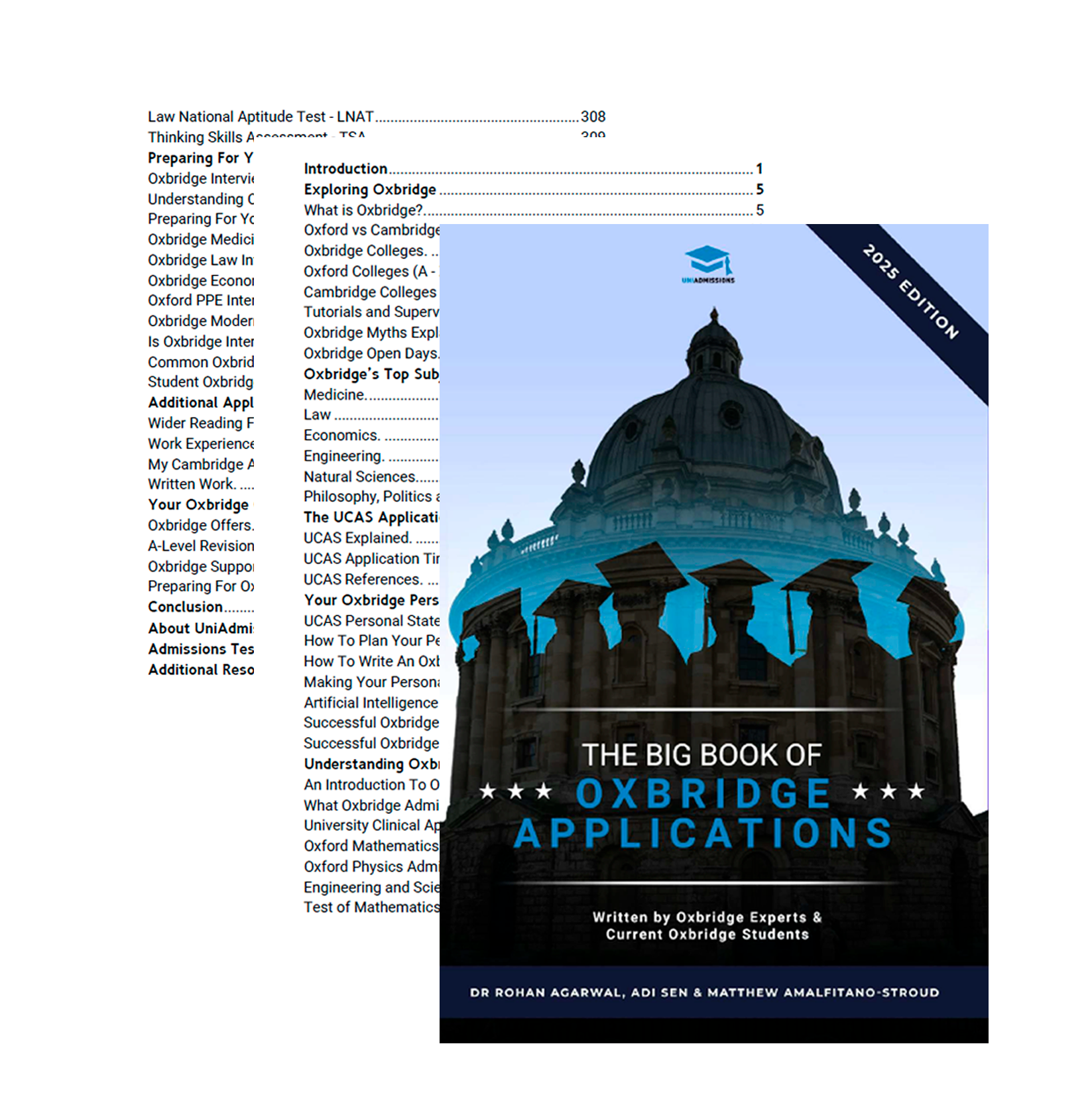
- Over 40 admissions test practice questions
- 28 example Oxbridge Personal Statements
- Interviews with Oxbridge students and graduates
- Additional downloadable resources
Average Russell Group University Rankings
Before we finish this guide, let’s look at the average rankings for each university in 2026. These averages are calculated for UK Rankings, World Rankings and all rankings:
| University | Average UK Ranking (2026) | Average World Ranking (2026) | Average Overall Ranking |
|---|---|---|---|
| University of Birmingham | 21.00 | 84.50 | 52.75 |
| University of Bristol | 15.00 | 64.50 | 39.75 |
| University of Cambridge | 2.00 | 5.50 | 3.75 |
| Cardiff University | 29.50 | NA | 80.00 |
| Durham University | 5.00 | 133.00 | 69.00 |
| University of Edinburgh | 15.50 | 31.50 | 23.50 |
| University of Exeter | 14.00 | 163.50 | 88.75 |
| University of Glasgow | 27.50 | 83.00 | 55.25 |
| Imperial College London | 6.00 | 5.50 | 5.75 |
| King’s College London | 20.00 | 33.50 | 26.75 |
| University of Leeds | 24.50 | 104.50 | 64.50 |
| University of Liverpool | 22.00 | 153.50 | 87.75 |
| London School of Economics (LSE) | 3.50 | 53.00 | 28.25 |
| University of Manchester | 32.00 | 44.00 | 38.00 |
| Newcastle University | 56.00 | 147.00 | 101.50 |
| University of Nottingham | 38.00 | 116.50 | 77.25 |
| University of Oxford | 1.50 | 2.50 | 2.00 |
| Queen Mary University of London | 56.50 | 125.50 | 91.00 |
| Queen’s University Belfast | 34.50 | NA | 89.33 |
| University of Sheffield | 16.00 | 95.00 | 55.50 |
| University of Southampton | 18.50 | 101.00 | 59.75 |
| University College London (UCL) | 11.50 | 15.50 | 13.50 |
| University of Warwick | 8.00 | 90.00 | 49.00 |
| University of York | 25.00 | 158.00 | 91.50 |
As we can see, Oxford has the highest average ranking across all categories, while the University of Exeter was ranked the lowest worldwide. Overall, Newcastle had the lowest average ranking. These could then be considered the worst Russell Group universities, and Oxford the best. However, remember that rankings are just one consideration within the university application process.
Oxford and Cambridge may be ranked highest, but they’re also extremely competitive, which may not be best for you. Queen Mary may have ranked lower, but you may prefer attending a university with a stronger focus on medicine. Your choice comes down to personal preference more than anything else.

That concludes our guide to Russell Group university rankings. We hope this guide has helped you understand how rankings can be useful in choosing your university and how Russell Group universities are seen within the education industry. These rankings update each year, so be sure to check back when the new tables are released by each organisation.
We’ve discussed how the top-ranking universities tend to be the most competitive, but that doesn’t mean it’s impossible to get in. With the right preparation plan and effective resources and support, you can greatly improve your chances of getting into your chosen university.
It can be hard to access everything you need in one place, but enrolling on a UniAdmissions Full-Blue Programme will more than triple your chances of success in your application to Oxford, Cambridge and other Russell Group universities. Through one-to-one tutoring, extensive resources and a personalised curriculum, you’ll have everything you need to perfect your whole application. If you’d like to learn more about how you can access this support, book a free consultation with our admissions team today!
Boost your Russell Group university application and get your place with UniAdmissions
Russell Group universities receive hundreds of thousands of applications each year, so it can be tough to make yours stand out. At UniAdmissions, we’ve developed programmes to support applicants for Oxford, Cambridge, Imperial and more through their full applications, including admissions tests and interviews.
Discover our Full-Blue Programmes below and find out how you can enrol and triple your chances of success.
Frequently Asked Questions
Oxford consistently comes out on top. Cambridge and Imperial College London follow closely behind.
Generally yes, but there's more variation than most applicants expect. In UK tables, every Russell Group university tends to sit within the top 50. Globally, the picture spreads out considerably. Some members rank outside the top 150 on the QS and THE tables, so being Russell Group doesn't guarantee a top position, particularly in subject areas outside a university's core strengths.
It matters more than most people realise. The same university can appear in very different positions depending on which table you consult. Newcastle, for instance, ranks 30th in the 2026 Complete University Guide but 63rd in The Guardian's table for the same year. Each ranking weights its metrics differently, so always cross-reference at least two or three tables and look at subject-specific rankings where possible.
Not necessarily, and this is one of the most common mistakes applicants make. The highest-ranked universities are also the most competitive, with the lowest acceptance rates. A university ranked 20th overall might rank in the top five for your specific subject. Queen Mary is a good example, ranking 56th overall but 5th for Medicine by the Complete University Guide. Subject-level rankings will tell you far more than the general table.
The very top tends to be stable. Oxford and Cambridge rarely move far. Further down the table, shifts of ten or more places between years are not uncommon, particularly on global ranking tables where methodology differences are more pronounced. The practical takeaway is that you'll spend three or more years at your chosen university, so basing your decision heavily on a single year's rankings is not recommended.

