

5 things to know
Key Takeaways
- The average UCAT score in 2026 was 1918. That's the final mean total score across 42,359 tests, up 27 points on 2025's 1891. The number of tests also rose, from 41,354 in 2025.
- Quantitative Reasoning and Decision Making drove the rise. The 2026 subtest means were 602 for Verbal Reasoning (no change from 2025), 640 for Decision Making (up 12) and 675 for Quantitative Reasoning (up 14).
- You needed 2250 to reach the top 10% in 2026. The 9th decile rose from 2220 in 2025 to 2250, and the median (5th decile) moved from 1880 to 1920. Every decile boundary was higher than last year.
- Band 1 in the SJT got harder to achieve. Only 15% of candidates reached Band 1 in 2026, down from 21% in 2025, and 55% reached Band 1 or 2, down from 60%.
- A good UCAT score in 2026 is around 2050 to 2150, and a high score is 2250+. That's our view based on the deciles: 2050 to 2150 puts you roughly in the top 30% to 20% of candidates, and 2250+ puts you in the top 10%.
The UCAT (University Clinical Aptitude Test) was taken by more than 42,000 Medicine and Dentistry applicants in 2026 – but what is a good UCAT score to aim for?
With such strong competition for a limited number of places at Medical and Dental schools, it’s no wonder that all students want to find out whether they had a good UCAT score compared to the rest of the year’s cohort.
Unfortunately, there’s no definitive answer for what counts as a good UCAT score. Although there are suggested cut-offs, there is no such thing as a “score you need to get into X Medical School” as the UCAT forms only one component of the application and your Personal Statement, A-level grades, GCSE and Interview performance all need to be strong too.
That said, we can take a look at the mark distributions of the previous years to give you an idea of where a UCAT score stands within your cohort year. This article will do just this, as well as explore the UCAT requirements of some of the top medical schools and where you may wish to apply with the mark you get. Let’s dive in.
UCAT Results 2026
Testing for 2026 has now finished, so we have the final results for every UCAT test taker this year. A total of 42,359 UCAT tests were completed in 2026, around 1,000 more than in 2025 (41,354) and the highest total in the table below.
Here are the mean scores for each subtest of the UCAT in 2026:
UCAT 2026 Mean Score
1918
UCAT Verbal Reasoning 2026 Mean Score
602
UCAT Decision Making 2026 Mean Score
640
UCAT Quantitiative Reasoning 2026 Mean Score
675
2026 is only the second year of the three-subtest UCAT, so 2025 is the only fair comparison. Overall, candidates scored 27 points higher on average, with Quantitative Reasoning and Decision Making behind the whole increase. Verbal Reasoning didn’t move at all.
The final figures came in well below the interim ones. In mid-September, with about half the cohort tested, the mean was 1970. It finished at 1918, a drop of 52 points, which is similar to the 48-point drop between the interim and final results in 2025. If you compared your score against the interim figures, it’s worth checking again against the final ones below.
Meanwhile, the 2026 Situation Judgement results are as follows:
UCAT 2026 SJT Band 1
15%
UCAT 2026 SJT Band 2
40%
UCAT 2026 SJT Band 3
34%
UCAT 2026 SJT Band 4
11%
The SJT moved in the opposite direction to the cognitive subtests. Fewer candidates reached Band 1 (15% vs 21%), and 55% achieved Band 1 or 2, compared with 60% in 2025. Band 3 grew from 29% to 34%. That makes a Band 1 more valuable this year, and a Band 2 is still better than what 45% of candidates achieved.
How is the UCAT scored?
As you may already know, the UCAT consists of four sections:
The three cognitive subtests (Verbal Reasoning, Decision Making and Quantitative Reasoning) are scored in the same way. Your raw marks in each one are converted to a scaled score between 300 and 900. These three scores are added together to give your total UCAT score, which ranges from 900 to 2700. This total is sometimes divided by three to give an average score on the 300 to 900 scale. The Situational Judgement Test is scored separately, in Bands 1 to 4.
The test previously included an additional subtest – Abstract Reasoning – but this has since been removed. This subtest was scored on a scale of 300 – 900 and was included in the final overall score. Therefore, it’s important to take into account that results from previous years of the UCAT could be as high as 3600. This is no longer the case as of 2025.
When Do UCAT Results Come Out?
Applicants get their UCAT results straight after completing their test, so you won’t have to wait long to see how you did. However, many applicants will also want to see their score compared to other test-takers.
UCAT publishes two reports for each testing period. The first is a preliminary (or interim) score report, which provides the mean scores of roughly half the applicant pool. These are typically released in mid-September and can be useful for estimating the final results of the cohort. You can review 2026’s interim results in our dedicated guide.
The final results for the test are published soon after the final testing day, normally at the end of September or early October. These detail the same mean scores and decile ranks as the interim scores, but they account for every test taker that year, giving the definitive review of the results.
Applicants can use the mean scores and decile ranks to understand how they performed compared to other students and get a better view of how competitive their application is, so it’s a good idea to look at these results.
In 2026, the average score per cognitive subtest was roughly 639 (a 1918 total), and 80% of candidates scored between 1590 and 2250 overall, or about 530 to 750 per subtest. Average scores vary between sections, though. Here are the average scores for each section over recent years:
Average UCAT Scores
| Verbal Reasoning | |||||||
| Decision Making | |||||||
| Quantitative Reasoning | |||||||
| Abstract Reasoning | NA | NA | |||||
| Total | |||||||
| Total UCAT Tests Sat |
However, the Situational Judgement Test is marked differently because the answers can be close to being right, but not exactly correct, and still get you some marks. Each candidate’s average score places them in either Band 1 (best), Band 2, Band 3, or Band 4 (worst). The data from the UCAT Consortium lists the average UCAT scores for applicants. Here are the scores for recent years.
Average SJT UCAT Scores
| 2027 Entry | 2026 Entry | 2025 Entry | 2024 Entry | 2023 Entry | 2022 Entry | 2021 Entry | |
|---|---|---|---|---|---|---|---|
| Band 1 | 15% | 21% | 13% | 25% | 20% | 14% | 30% |
| Band 2 | 40% | 39% | 36% | 39% | 36% | 36% | 36% |
| Band 3 | 34% | 29% | 38% | 26% | 31% | 33% | 24% |
| Band 4 | 11% | 10% | 13% | 9% | 14% | 16% | 9% |
Each candidate is assigned a Band from 1 to 4, with 1 being the best score. Ideally, you should aim to get a Band 1 or 2 to put yourself in a good position. Some universities have a cut-off band for the SJT so will not accept candidates with a Band 4 score in the SJT.
UCAT Decile Rankings 2026
UCAT deciles split all test takers into groups of 10%. Each score shown is the threshold for that decile, so an applicant who scored 2250 or above in 2026 was in the 9th decile, meaning they scored higher than 90% of test takers. Here are the deciles for 2026, with 2025 for comparison:
| Decile Rank | Score (2026) | Verbal Reasoning | Decision Making | Quantitative Reasoning |
|---|---|---|---|---|
| 1st | 1590 | 500 | 520 | 530 |
| 2nd | 1700 | 540 | 560 | 580 |
| 3rd | 1780 | 560 | 590 | 600 |
| 4th | 1850 | 580 | 620 | 640 |
| 5th | 1920 | 600 | 640 | 670 |
| 6th | 1980 | 620 | 670 | 700 |
| 7th | 2050 | 640 | 690 | 730 |
| 8th | 2140 | 670 | 710 | 780 |
| 9th | 2250 | 710 | 760 | 820 |
Every overall decile boundary is higher than in 2025. The biggest jumps (40 points) are at the 5th, 7th and 8th deciles, so the middle and upper-middle of the cohort is where scores have shifted most. At the top, the 9th decile rose by 30 points, from 2220 to 2250.
Looking at the subtests, the Verbal Reasoning deciles are identical to 2025 apart from the 9th (700 to 710). Decision Making is up by 10 to 20 points from the 4th decile upwards, and Quantitative Reasoning is up at almost every decile, with the 8th decile jumping 30 points from 750 to 780.
In practice, a score that put you in the 8th decile last year (2100) would only just clear the 7th decile in 2026.
UCAT Score Conversions 2026
So we know that UCAT scores fall on a scale of 300 – 900, but, of course, you aren’t going to be answering 900 questions in each section! As previously mentioned, your raw marks in each subtest will be converted into a UCAT score within that scale. The number of questions in each subtest is as follows:
- Verbal Reasoning - 44 Questions
- Decision Making - 35 Questions
- Quantitative Reasoning - 36 Questions
- Situational Judgement - 69 Questions
The official conversion calculation used by UCAT is unfortunately not publically available and potentially changes from year to year. UCAT states that it is impossible to make direct comparisons between scores from two different subtests due to the different amounts of questions, so each one has its own score conversion calculation.
Also, remember that Situational Judgement is marked using a completely different system, although raw marks are still the initial measure of performance before conversion.
UniAdmissions have a 74% medicine application success rate – our students are 6x more likely to gain their place than the average candidate.
Got the right UCAT Score? Now it’s time to prepare for your medical school interviews.
With UniAdmissions’ UCAT Tuition Programme, you will be supported with a fully developed curriculum that takes you through all aspects of the UCAT, with one-to-one support from an expert UCAT tutor who scored in the top 10%. You will also have access to a whole suite of expert resources, live courses and much more.
Discover our UCAT Tuition Programme today by booking a free consultation session or clicking the button below.
With UniAdmissions’ Medicine Interview Programme, you will be supported with a fully developed curriculum that takes you through everything you need to know about panel interviews or MMIs. With one-to-one support from an expert medicine tutor who got their offer, live courses and access to a whole suite of expert resources, you’ll have everything you need to impress your interviews.
Discover our Medicine Interview Programme today by booking a free consultation session or clicking the button below.
What is a good UCAT Score?
Firstly, a good UCAT score is different to a ‘high’ UCAT score. Secondly, good UCAT scores vary between years depending on how the cohort performs.
For 2026, the average score was 1918 (around 639 per subtest), 27 points higher than in 2025. Based on the 2026 deciles, we’d suggest that a good score was around 2050 to 2150 overall (roughly 685 to 715 per subtest). That puts you somewhere between the 7th decile (2050) and just above the 8th (2140), or roughly in the top 30% to 20% of candidates.
Bear in mind that this bar has moved. Last year we suggested 2000 to 2100 was a good score. In 2026, 2000 only just clears the 6th decile (1980), so it’s above average but not much more than that.
Mean scores have now risen two years running on the new format, so a good score could be higher again in 2027. For the SJT, we still recommend aiming for at least Band 2. With only 15% of candidates reaching Band 1 this year, a Band 1 will really help you stand out.
Where to apply with a good UCAT score
Remember that each university uses UCAT scores differently, so the best way to make the most of your score is to apply to the Medical Schools that place the right level of emphasis on the UCAT that suits your performance. Here are some examples of medical schools that require good UCAT scores.
University of Cambridge
As an Oxbridge university, Cambridge is seen as one of the top medical schools in the world. The university previously used the BMAT for its medicine admissions but has now moved to the UCAT. With an average acceptance rate of 15% each year, this course is reserved for applicants with strong applications, which include a high UCAT score.
Below are the average UCAT scores of applicants and offer holders within the 2025 entry cycle:
| Subtest | Average UCAT Score by Apply Status and Domicile | |||
|---|---|---|---|---|
| UK Applicant | UK Offer Holder | International Applicant | International Offer Holder | |
| Verbal Reasoning | 670.53 | 716.91 | 665.30 | 733.57 |
| Decision Making | 719.91 | 770.22 | 700.54 | 791.79 |
| Quantitative Reasoning | 758.36 | 804.21 | 746.17 | 851.79 |
| Total Score | 2148.7 | 2291.34 | 2112.01 | 2377.15 |
| Situational Judgement (Bands) | 2.05 | 1.86 | 2.36 | 1.79 |
As we can see, the average applicants scored between 665 and 758 across the three different subtests, with overall scores of 2149 and 2112. These are already fairly high scores, but these get even higher when looking at the scores for successful applicants. The highest of these was for Quantitative Reasoning, which saw average scores of 804 and 852. This suggests that at least a handful of applicants scored near-perfect scores in this subtest.
In fact, we know that many applicants did actually score full marks in this subtest, based on the college data provided by Cambridge:
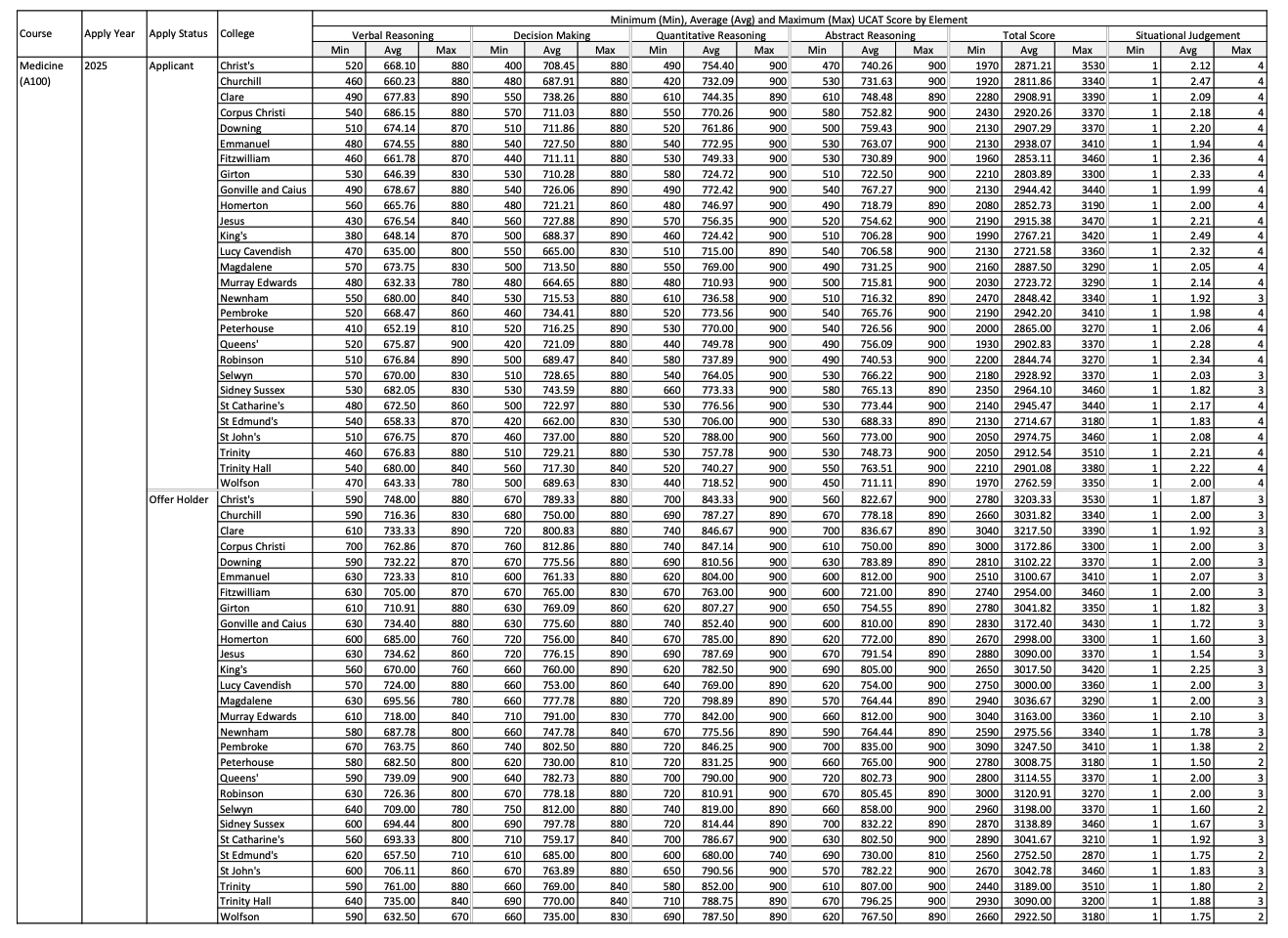
Overall, you’re going to need to achieve a really impressive score to remain competitive for Cambridge Medicine.

St George's University
St. Georges University in London is a medical school that operates fairly high cut-off scores in its application process, meaning applicants must achieve a certain score in order to be considered. In 2024, this score was 2690 (673) while the previous year was 2630 (658). In 2024 (for 2025 entry), the average score achieved by all applicants was 2675 (669), which is definitely on the higher end of the UCAT percentiles.

King's College London
King’s College London is one of the most famous universities in the UK’s capital, so it’s no surprise that they have high standards for applicants of one of their most competitive courses. During the 2021 admissions cycle, shortlisted applicants scored an average of 2788 (697), with 2774 (694) being the previous year’s average. However, KCL doesn’t operate cut-off scores so you aren’t required to reach a certain score to officially be considered.
University of Edinburgh
The University of Edinburgh is one of the most renowned medical schools in Scotland, and its UCAT requirements prove that they are very selective with its offers. For 2026 Entry, they operated a UCAT cut-off score of 1650 (550), which isn’t very high. However, the average scores for successful applicants from the previous year greatly surpass this score, with applicants scoring an average of 2516 (629) in 2024. Therefore, it is clear that passing the threshold may not be enough to get you an offer at Edinburgh. Applicants who achieve Band 4 in the SJT will also not be considered.
University of Southampton
The University of Southampton uses the UCAT as the main consideration when shortlisting applicants, meaning a good score is important to get an interview. Though they don’t use a cut-off score anymore, results from previous years have indicated that they have high standards for the UCAT. In the 2022 admissions cycle, the lowest UCAT score invited to interview was 2580 (645), meaning all shortlisted applicants for that year scored above average.
Worried About the UCAT? Let The Big Book of Oxbridge Applications Be Your Guide
The UCAT can feel like a big unknown, from how it fits into admissions decisions to what effective preparation actually looks like. If you’re unsure where to start or how to make the most of your study time, you’re not alone.
The Big Book of Oxbridge Applications takes the guesswork out of UCAT prep. The UCAT section of this free book gives you everything you need to understand the test and approach it with confidence. Inside, you’ll find:
- A clear overview of the exam structure and each subtest
- Up-to-date information on test dates and format
- Targeted preparation strategies to help you study efficiently
- Practice questions that reflect the real test
- A free UCAT mock paper to download
What is a high UCAT Score?
Again, it is difficult to pinpoint what makes a ‘high’ UCAT score, as the UCAT requirements of medical schools all differ from each other, and each year the spread of marks achieved by applicants fluctuates.
However, you could say that a high UCAT score in 2026 is 2250 or above (an average of 750+ per subtest), along with a Band 1 in the Situational Judgement Test.
A score of 2250 put you in the top 10% of the 2026 cohort. Combine that with a Band 1, which only 15% of candidates achieved, and you’ll comfortably clear the cut-offs used by most UCAT universities.
Where to apply with a High UCAT score
If you’ve scored highly on the UCAT, you might consider a Medical School with a higher UCAT cut-off score or average offer-holder results. Here are a few examples:
University of Bristol
The University of Bristol no longer uses the Personal Statement as a selection factor for the Interviews and now mainly focuses on the UCAT. For 2025 Entry, Bristol actually implemented a cut-off score of 3010 (753) for home applicants and 3080 (770) for international students. This means that only applicants who achieved this score were interviewed.
University of Manchester
The University of Manchester consistently enforces high cut-off scores in its application process, with applicants for 2025 Entry being required to score 2710 (678). The mean score for shortlisted applicants in 2024 was 2904 (726), meaning a high score was required to stand a good chance of success. This trend is likely to continue in the future as medicine becomes more competitive. Applicants also need to achieve a Band 1 or 2 in the Situational Judgement test to be interviewed.
Newcastle University
Newcastle University is generally regarded as the university that takes the UCAT most into account. They rank the applicants who qualify to enter entirely on their UCAT scores, and then select the top of these. You will need to be in the top 15% – 20% of those sitting the test to be considered, so you likely need a score of over 700 on average! The cut-off score for 2023 Entry was 2820 (705), with averages from previous shortlisted cohorts reaching 2943 (736). Applicants will also be disqualified if they achieve Band 4 in the SJT.
University of Glasgow
The University of Glasgow exceeds other Scottish universities when it comes to UCAT results. The theshold scores for 2024 entry applicants were 2450 (613) for Scottish applicants, 2500 (625) for other UK applicants and 2800 (700) for international applicants. This is made even more important by the fact that the UCAT is the universities primary method of shortlisting applicants (after they have met the minimum academic requirements).
This is by no means a definitive list of UCAT universities and their requirements, but having an understanding of what you should be aiming for will help you in your preparation.
It is also important to note that the average UCAT scores or UCAT requirements are not a reflection of the quality of the medical school, so don’t assume that the universities with the highest requirements are the best ones for you. Do your research and attend open days to help you decide where you would like to study. The information in this guide is simply to inform you of your chances of gaining an offer with different scores.
What happens if I get a low UCAT Score?
If the UCAT score you achieved isn’t as high as you wanted it to be, don’t be too disappointed. The key is to apply to Medical Schools that place more emphasis on GCSE and A-level grades, Interviews and your Personal Statements such as Queen Mary University of London and Cardiff.
If your UCAT score was closer to average you will find there are plenty of medical schools that have similar average scores for their successful candidate’s results. Many of these medical schools have been known to admit applicants with much lower scores, with some successful candidates scoring below 2000. The key here is to choose universities that de-emphasise the UCAT and ensure that your Personal Statement and Interview techniques are extremely competitive.
We have a full guide dedicated to this topic, so check it out if you’re worried about what you can do with a lower UCAT score.
That concludes our guide on UCAT scoring and results. Any medicine applicant should be aiming to do the best that they can, so don’t feel that you need to limit yourself based on the average scores of previous years. Go in with the attitude that you will get a high score and you will be more likely to find success.
Of course, the most important thing you can do to ensure you get a great score is to effectively prepare for the UCAT. If you’re looking for the best way to prepare for the UCAT, discover our Medicine Programme, which supports you in your journey all the way through to your test date, as well as every other aspect of your application.
Happy with your UCAT Score? What about the rest of your application?
Happy with your UCAT Score? Your interviews are next!
The UCAT is just one part of your Medical School application. A strong application for Medicine also includes nailing your Personal Statement and Interviews. Our Standard Medicine Programme aims to maximise your Admissions Test score, perfect your Personal Statement and develop your Interview skills to get you Interviewing like a pro.
Discover our Standard Medicine Programme by booking a free consultation session or clicking the button below to enrol and triple your chances of success.
The UCAT is just one part of your Medical School application. The last step to getting your offer is your interviews, so consider our Medicine Interview Programme to develop your Interview skills and perform like a pro.
Discover our Medicine Interview Programme by booking a free consultation session or clicking the button below to enrol and triple your chances of success.
Frequently Asked Questions
The highest UCAT score for the first three sections (Verbal Reasoning, Decision Making, and Quantitative Reasoning) is 2700. For the Situational Judgement section, the highest score is Band 1. To achieve this score, you will need a very thorough preparation including strategic practice and knowing all the UCAT-specific exam techniques.
A good UCAT score depends on how the cohort performs each year. For 2026 (2027 entry), a good UCAT score sits around 2050 to 2150 overall (roughly 685 to 715 per subtest), which is about the top 30% to 20% of candidates. The 2026 average was 1918 and the top 10% started at 2250. If you scored in that range and achieved Band 1 or 2 in the Situational Judgement Test, you're in a competitive position for most UK medical schools.
No. Several well-regarded medical schools place more weight on GCSEs, A-Level grades, the personal statement and interview performance than on the UCAT. Queen Mary University of London and Cardiff are examples where a lower UCAT score is less likely to rule you out. The key is matching your score to universities whose selection process suits your overall profile rather than assuming a below-average UCAT closes all doors.
It is scored separately and carries real weight. Several universities will not consider applicants who achieve Band 4 in the SJT, however well they scored in the cognitive subtests. Aim for at least Band 2. In 2026, 55% of test takers achieved Band 1 or 2 (down from 60% in 2025), and only 15% reached Band 1, so it is achievable with the right preparation but it isn't a formality.
You receive your results immediately after completing the test, so there is no waiting period for your individual score. What takes longer is understanding where your score sits relative to other applicants. UCAT publishes a preliminary cohort report in mid-September covering roughly half the applicant pool, followed by the full results report at the end of September or early October. That final report is when you can accurately assess how competitive your score is against the full year's cohort.


