

Writing a successful Personal Statement can feel overwhelming, especially with the introduction of the new UCAS format from 2026. That is why we created this free Personal Statement cheat sheet: a practical guide designed to help students structure their answers effectively, avoid common mistakes and understand what top universities are really looking for.
Your Personal Statement is your chance to show the universities you apply to who you really are. The rest of the application is faceless statistics – the Personal Statement gives the admissions tutor the opportunity to look beyond those statistics and focus on the real you, the person they may spend at least three years teaching their subject to.
We have created the perfect resource to get you started on your Personal Statement journey. This easy-to-use Personal Statement cheat sheet will tell you everything you need to know to start crafting the perfect Personal Statement.
Get expert support on crafting the perfect Personal Statement
Students enrolled on UniAdmissions’ Full-Blue Programmes get access to Personal Statement redrafts. Your tutor will give you actionable feedback with insider tips on how to improve your statement for the best chances of success.
The New UCAS Personal Statement Format
From 2026 onwards, UCAS has replaced the traditional Personal Statement with three structured questions. While the format has changed, the expectations from competitive universities remain largely the same.
The Three New Personal Statement Questions
Applicants now answer:
- Why do you want to study this course or subject?
- How have your qualifications and studies helped you prepare for this course or subject?
- What else have you done outside education to prepare, and why are these experiences useful?
The new structure is intended to make the process clearer. However, applicants to highly competitive universities will still need to focus on demonstrating academic depth and independent thinking throughout their responses.
Personal Statement Word and Character Limit Guide
Your UCAS Personal Statement has a maximum overall limit of 4,000 characters, including spaces. It also has a minimum limit of 350 characters per answer.
A strong approach is to weight your content based on academic value should be:
- Question 1 (Why this course?) – ~35–40% of your space
This should be your most intellectually focused section. Prioritise subject motivation, ideas, and academic curiosity. Avoid filler or generic passion statements. - Question 2 (Academic preparation) – ~35–40% of your space
Match Q1 in importance. Use this to evidence your readiness through supercurriculars, wider reading, and academic reflection — not just listing activities. - Question 3 (Wider experiences) – ~20–30% of your space
Keep this tight and selective. Only include experiences that clearly demonstrate transferable skills relevant to your course.
Personal Statement Dos and Don’ts
DOs
- Focus on academic engagement and reflection
- Analyse what you learned from experiences
- Use specific examples and evidence
- Demonstrate independent thinking
- Prioritise quality over quantity
DON’Ts
- List achievements without reflection
- Use generic clichés
- Overfocus on unrelated extracurriculars
- Spend too long on introductions
- Write what you think universities “want to hear”
How This Cheat Sheet Helps With the New Format
This cheat sheet will help you to avoid repetition between answers, weak academic reflection, generic explanations, and poor balance between sections.
Break Free from the Personal Statement Spiral
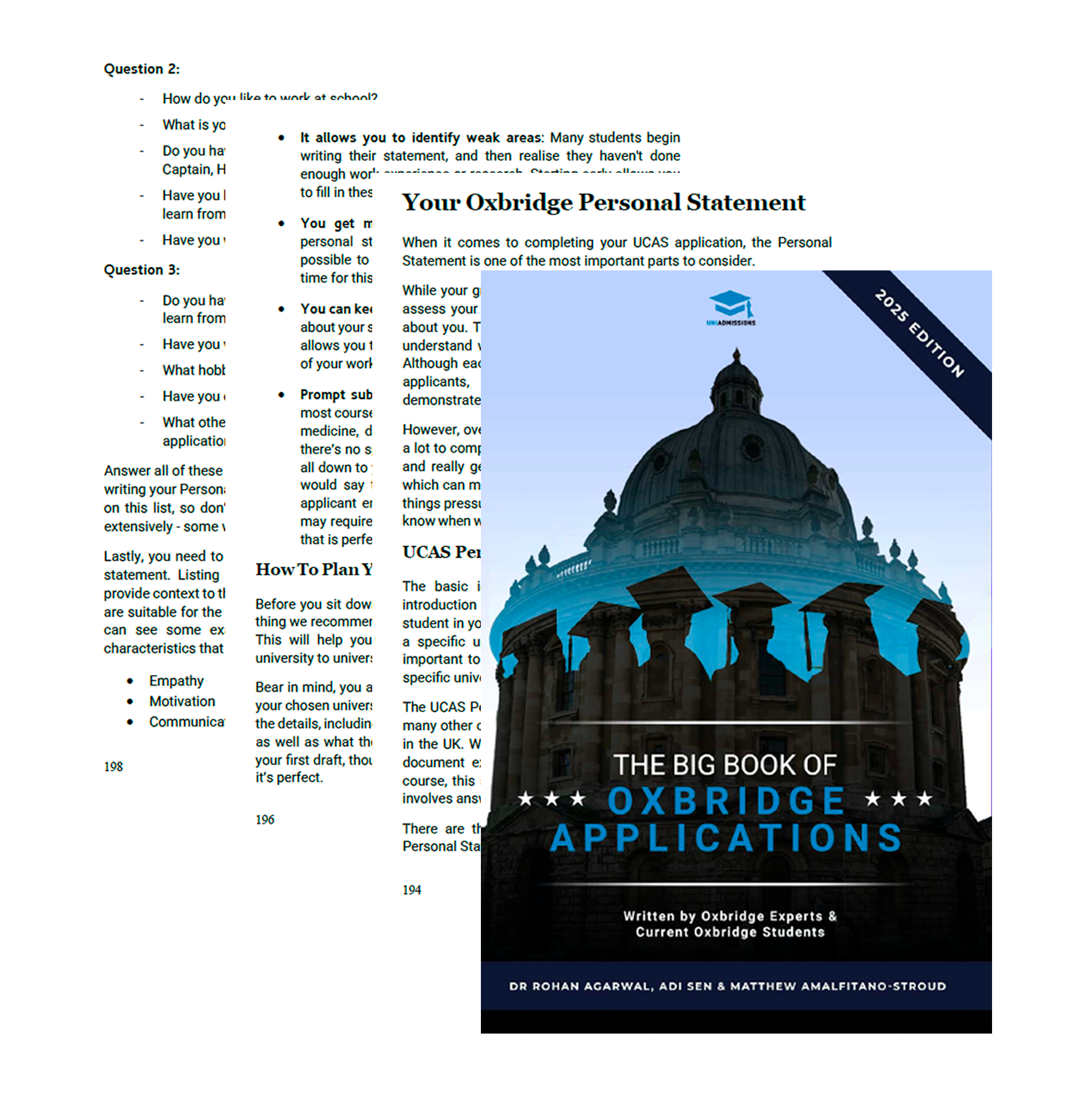
- A method to plan and write a compelling personal statement
- Proven strategies to stand out — even among top applicants
- 28 example Oxbridge Personal Statements
- Additional downloadable resources
Your UCAS Personal Statement Cheat Sheet
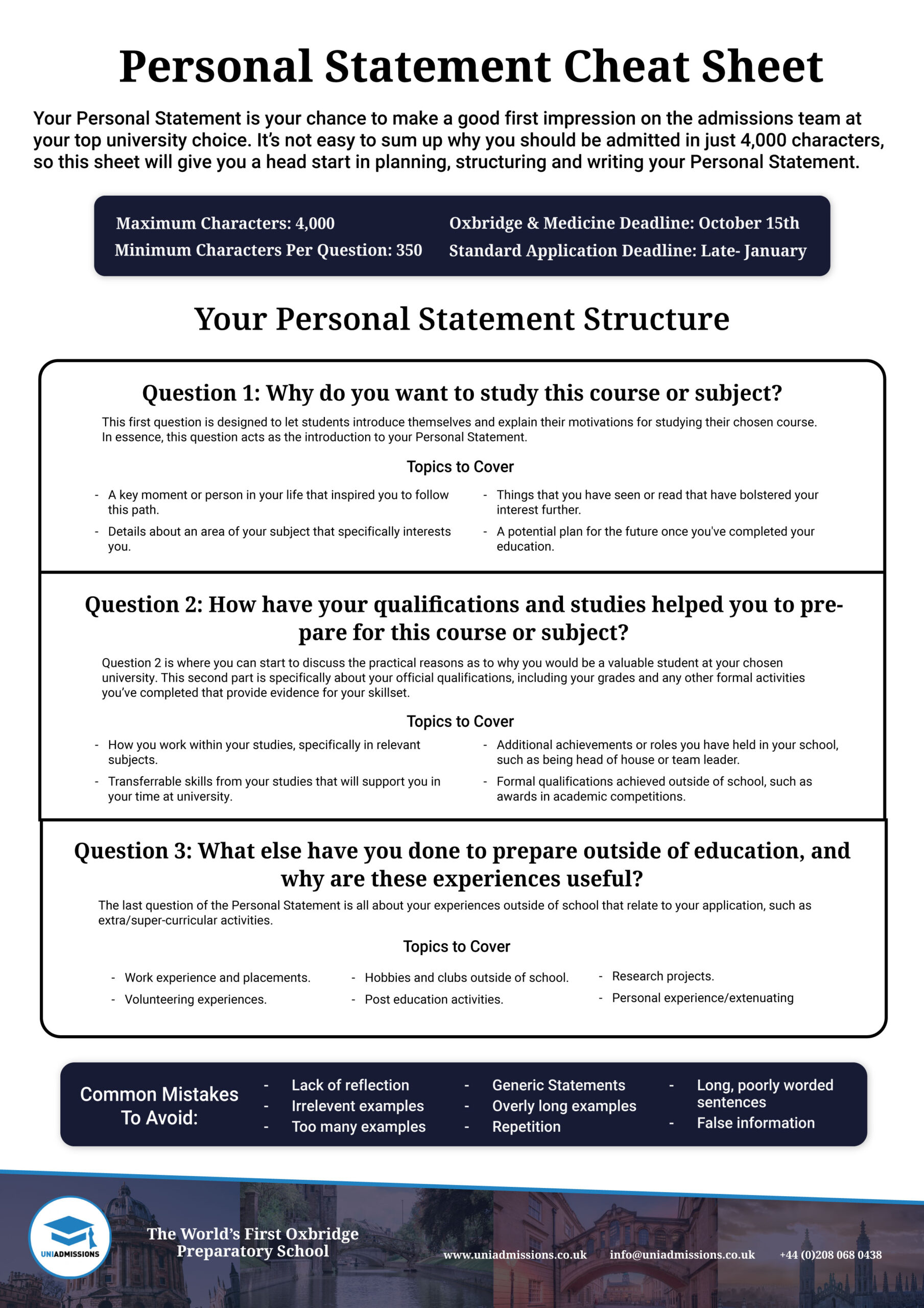
If you’re looking for inspiration from Oxbridge applicants, take a look through our successful Personal Statement examples:
Looking for Personal Statement support to strengthen your application?
Students enrolled on our comprehensive application support Programmes will get access to Personal Statement redrafts. Your tutor will give you actionable feedback with insider tips on how to improve your statement for the best chances of success.
With UniAdmissions, you can triple your chances of success. Want to find out how? Press the button below to discover out Full-Blue Programmes.
Frequently Asked Questions
Yes. While UCAS has introduced three structured questions, universities still use your responses to assess academic potential, subject motivation, and readiness for study. For competitive courses, especially at Oxford and Cambridge, the Personal Statement remains a key differentiator between strong applicants.
There is no strict formula, but a strong approach is to prioritise academic content. Typically, Question 1 (subject motivation) and Question 2 (academic preparation) should carry the most weight, with Question 3 used more selectively to highlight relevant wider experiences and transferable skills.
Oxbridge admissions tutors look for intellectual curiosity, academic depth, and evidence of independent thinking. Strong statements go beyond listing achievements and instead analyse ideas, demonstrate subject engagement, and show how your thinking has developed through supercurricular learning.
Avoid generic statements, unreflective activity lists, and overused clichés such as “I have always been passionate about…” Focus instead on specific academic engagement, critical reflection, and clear links between your experiences and your chosen course.
The UCAS Personal Statement is capped at 4,000 characters (including spaces) across all three questions, with a minimum of 350 characters per answer. This limit stays the same under the new 2026 format, but it is now shared between the three structured sections.

