

Welcome to our popular Personal Statement series where we present a successful Personal Statement, and our Oxbridge Tutors provide their feedback on it.
Today, we are looking through a Natural Science applicant’s Personal Statement that helped secure a place at Cambridge University. The Natural Science Course at Cambridge is a unique and demanding course focused on blurring the boundaries between the different fields of science.
Read on to see how this candidate wrote a Personal Statement that helped secure their place on a reputable degree.
NEW PERSONAL STATEMENT FORMAT
As of 2025, UCAS Personal Statements will be presented with a new three-question format. Be aware that the Personal Statement featured in this guide was written in the previous free-form format. Despite this, the example will still be beneficial to read as the content included remains the same as what you should aim to write in your own work.
When reading this example, think about which question each paragraph answers. To learn more about the Personal Statement changes, read our dedicated guide to the new Personal Statements here.
Here’s a breakdown of the Personal Statement:
CHARACTERS
3,978
WORDS
643
SUCCESSFUL?
5/5
The universities this candidate applied to were the following:
CAMBRIDGE
OFFER
DURHAM
OFFER
IMPERIAL
OFFER
ST ANDREWS
OFFER
EDINBURGH
OFFER
Enrolling on our Cambridge Natural Science comprehensive Programme will give you access to Personal Statement redrafts.
Your tutor will give you actionable feedback with insider tips on how to improve and make your Personal Statement Oxbridge quality for the best chances of success.
Cambridge Natural Sciences (Physical) Personal Statement
Question 1: Why do you want to study this course or subject?
The more I discover about physics, the less I realise that I know, and the keener I am to further explore unfamiliar topics at university. Studying areas such as special relativity and quantum mechanics have made me question concepts I took as given, such as the nature and manipulation of time and the degree of certainty to which we can truly know anything.
My particular interest in physics was sparked when I read an article on quantum physics, and was introduced to a simple description of the fundamental constituents of matter. This led me to read further about particle physics. I particularly enjoyed Brian Greene’s The Elegant Universe, which gave me a brief insight into the intricacies of string theory, and The Feynman Lectures on Physics, from which I learnt new mechanics and probability theory. I watch lectures on the MIT website, read New Scientist and am a junior member of the IoP to further my knowledge of new scientific developments.
I am a hardworking and intellectually curious student and am excited by the prospect of developing my mathematical skills and studying physics at a more advanced level at university.
Question 2: How have your qualifications and studies helped you to prepare for this course or subject?
I have also competed in national challenges to develop my thinking skills further, achieving bronze in the Physics Olympiad, silver in the Cambridge Chemistry Challenge and gold in the Senior Maths Challenge. Additionally, this year I won the school leavers’ physics prize.
I recently took part in an extended-essay competition at school, producing an independently researched piece of work on the superluminal neutrinos apparently found in 2011. I focused on the impossibility of faster-than-light travel according to special relativity, and the implications for time travel the discovery would have had if the measurements had been correct. This gave me the chance to explore further a subject I was interested in but had not studied at school. I researched my essay by reading scientific journals and textbooks, and speaking to scientists I met at physics events.
Question 3: What else have you done to prepare outside of formal education, and why are these experiences useful?
I enjoyed visiting CERN last year and learning more about the experiments conducted there.
Last summer I attended a residential Headstart physics course at the University of Leicester, and spent three days at the Debate Chamber physics school. I enjoyed performing undergraduate experiments, and was particularly interested by the lectures on recent developments in nanotechnology and the ways in which nanoparticles could be used to destroy cancerous cells in the body. I also had a tantalising glimpse of some of the complex mathematics behind General Relativity, and would love to study this intricate topic in more detail. These experiences confirmed my love of physics as well as increasing my appreciation of more complicated subjects not covered by my A Level courses. Furthermore, they helped to develop my skills in processing new information and quickly adapting to unfamiliar concepts.
I will shortly begin a paid internship at Hildebrand Technology Ltd, where I will be using mathematical modelling of real life situations for statistical analysis. This will be an opportunity to apply mathematical techniques I have learnt in school to more complex problems. This placement, along with self-studying university textbooks and extra further maths modules, will ensure that I maintain and expand my maths skills and scientific knowledge during my gap year.
In my final year I was captain of the school Boat Club. I have rowed in the top senior boat since I was 15, and in 2013 I won silver at National Schools and gold at Schools Head. This sport has involved intensive training, which demands self-discipline and commitment. I love music, and take part in many close harmony groups and choirs, as well as taking grades in musical theatre, singing and piano. My music and sport, along with lifeguarding and weekly volunteering at a local primary school, have allowed me to develop my time management skills and use the time I have for work efficiently and productively.
For more inspiration, take a look through our other successful Personal Statement analysis articles:
Break Free from the Personal Statement Spiral
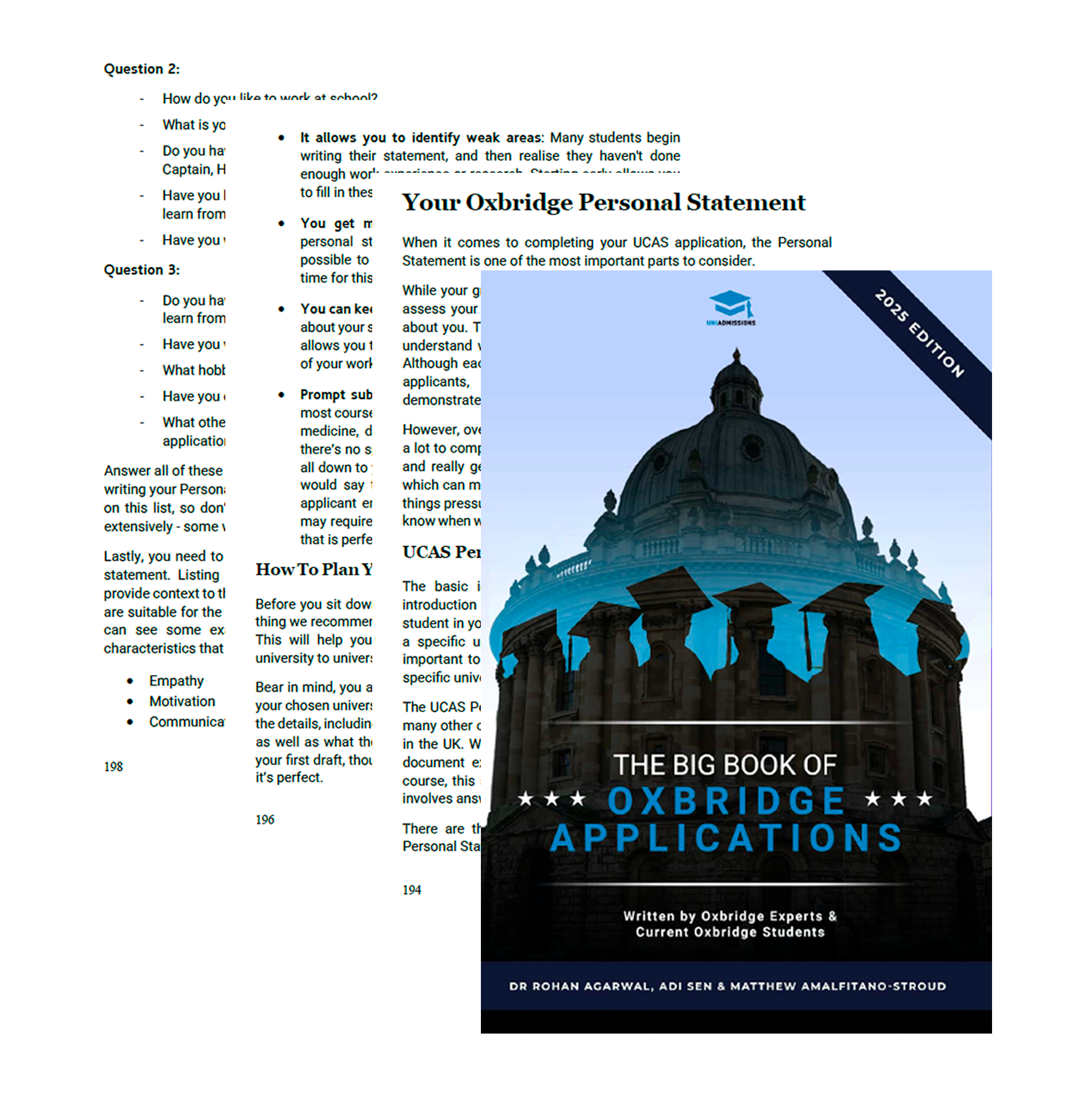
- A method to plan and write a compelling personal statement
- Proven strategies to stand out — even among top applicants
- 28 example Oxbridge Personal Statements
- Additional downloadable resources
Access "The Oxbridge Application Vault"
- 300+ page ebook for Oxbridge Applicants
- 25 page ebook for Personal Statement
- 2h+ online course to succeed in any exam
- Online Oxbridge Success Calculator
- 12 page ebook about UniAdmissions

Good Points Of The Personal Statement
This is a very good statement. The statement is well structured, and the student’s motivation to study physics is clear. All points are explained clearly, and experiences expanded on. The student uses examples beyond their A-level studies to explain their desire to study physics, which comes across very well to the reader.
Bad Points Of The Personal Statement
The student forgets to use quotation marks around the names of books etc., and also ‘the’ before ‘New Scientist’. Whilst these are rudimentary errors, a simple proof-read would have found these. The main issue with this statement is its length. There are eight paragraphs in total. By the penultimate paragraph it is clear enough that the student has done many physics-related extra-curricular activities. The quality of the statement will not be reduced if it is shortened. The student does not explain acronyms, e.g. ‘IoP’. Some sentences can be shortened in order to save space, e.g. ‘I have also competed in national challenges to develop my thinking skills further, achieving bronze in the Physics Olympiad, silver in the Cambridge Chemistry Challenge and gold in the Senior Maths Challenge’ can be shortened to ‘I have also competed in national challenges to develop my thinking skills further, achieving bronze, silver and gold medals in the Physics Olympiad, Cambridge Chemistry and Senior Maths Challenges respectively’.
UniAdmissions Overall Score:
★ ★ ★ ★ ☆
In general, this is a very good statement. It is well written, and the student’s motivation to study physics at university is clear from the very beginning. Due to the length of the statement, it is quite cumbersome to read. With some shortening, this would be a compact and powerful statement.
This Personal Statement for Natural Science is a solid example of demonstrating a wealth of knowledge, motivation and interest, vital to Admissions Tutors.
Remember, at Cambridge, these Admissions Tutors are often the people who will be teaching you for the next few years, so you need to appeal directly to them.
Check out our other successful personal statements and our expert guides on our Free Personal Statement Resources page.
What Makes A Cambridge Natural Sciences (Physical) Personal Statement Different?
While there’s no set standard for Cambridge Natural Sciences personal statements, most applicants will cover similar topics, such as their coursework, field trips and relevant work experience. However, Cambridge isn’t as interested in these areas, and statements featuring just these topics won’t stand out. So, what can you do to make your statement different?
Firstly, while these typical experiences are important to cover, you need to explore them in depth rather than just providing surface level descriptions. Reflection is the key to a successful personal statement, which means exploring what you have learnt, how this knowledge has helped you develop your skills and how it changed your perception of Natural Sciences. This provides evidence of your genuine dedication to the subject.
However, beyond the experiences you’ve had, it’s also important to evidence your extra-curricular engagement with the subject, including wider reading and research projects. While this may not seem like the most interesting topic to discuss, it is exactly what Cambridge is looking for in applicants. A huge part of studying at Cambridge is the ability to work independently and guide your own learning beyond the classroom. As such, displaying a high level of curiosity in your statement will highlight that you have what it takes to succeed in the course.
Cambridge aren’t looking for the applicants with the most impressive experiences – they are looking for the applicants that make the most of their time and resources to truly engage with their subject. This is what you need to prove in your writing.
With our Cambridge Natural Science Premium Programme, we help you craft the perfect Personal Statement, perform strongly on the Admissions Test and teach you how to Interview effectively.
Discover our Cambridge Natural Science Premium Programme by clicking the button below to enrol and triple your chances of success.
Our expert tutors are on hand to help you craft the perfect Personal Statement for your Cambridge Natural Sciences application.
It’s important to consider that this Personal Statement was not originally written in the three question format currently used by UCAS. Below is the original, unedited version of this statement in the previous free-form style.
Cambridge Natural Sciences (Physical) Personal Statement (OLD FORMAT)
The more I discover about physics, the less I realise that I know, and the keener I am to further explore unfamiliar topics at university. Studying areas such as special relativity and quantum mechanics have made me question concepts I took as given, such as the nature and manipulation of time and the degree of certainty to which we can truly know anything.
My particular interest in physics was sparked when I read an article on quantum physics, and was introduced to a simple description of the fundamental constituents of matter. This led me to read further about particle physics. I particularly enjoyed Brian Greene’s The Elegant Universe, which gave me a brief insight into the intricacies of string theory, and The Feynman Lectures on Physics, from which I learnt new mechanics and probability theory. I watch lectures on the MIT website, read New Scientist and am a junior member of the IoP to further my knowledge of new scientific developments. I enjoyed visiting CERN last year and learning more about the experiments conducted there. I have also competed in national challenges to develop my thinking skills further, achieving bronze in the Physics Olympiad, silver in the Cambridge Chemistry Challenge and gold in the Senior Maths Challenge. Additionally, this year I won the school leavers’ physics prize.
Last summer I attended a residential Headstart physics course at the University of Leicester, and spent three days at the Debate Chamber physics school. I enjoyed performing undergraduate experiments, and was particularly interested by the lectures on recent developments in nanotechnology and the ways in which nanoparticles could be used to destroy cancerous cells in the body. I also had a tantalising glimpse of some of the complex mathematics behind General Relativity, and would love to study this intricate topic in more detail. These experiences confirmed my love of physics as well as increasing my appreciation of more complicated subjects not covered by my A Level courses. Furthermore, they helped to develop my skills in processing new information and quickly adapting to unfamiliar concepts.
I recently took part in an extended-essay competition at school, producing an independently researched piece of work on the superluminal neutrinos apparently found in 2011. I focused on the impossibility of faster-than-light travel according to special relativity, and the implications for time travel the discovery would have had if the measurements had been correct. This gave me the chance to explore further a subject I was interested in but had not studied at school. I researched my essay by reading scientific journals and textbooks, and speaking to scientists I met at physics events.
I will shortly begin a paid internship at Hildebrand Technology Ltd, where I will be using mathematical modelling of real life situations for statistical analysis. This will be an opportunity to apply mathematical techniques I have learnt in school to more complex problems. This placement, along with self-studying university textbooks and extra further maths modules, will ensure that I maintain and expand my maths skills and scientific knowledge during my gap year.
In my final year I was captain of the school Boat Club. I have rowed in the top senior boat since I was 15, and in 2013 I won silver at National Schools and gold at Schools Head. This sport has involved intensive training, which demands self-discipline and commitment. I love music, and take part in many close harmony groups and choirs, as well as taking grades in musical theatre, singing and piano. My music and sport, along with lifeguarding and weekly volunteering at a local primary school, have allowed me to develop my time management skills and use the time I have for work efficiently and productively.
I am a hardworking and intellectually curious student and am excited by the prospect of developing my mathematical skills and studying physics at a more advanced level at university.

