


If you’re considering engineering as a career, you probably already know about the various specialisation opportunities it offers. Each engineering branch comes with further career opportunities and unique challenges that fit different interests, skills, and passions.
In this guide, we’re looking into one of the most innovative branches of engineering: aerospace engineering. By the end, you’ll have a much better understanding of what aerospace engineering is – from core elements and specialised sub-disciplines to key skills needed, job opportunities, and entry pathways – to help you decide whether it is a good career for you.

What is Aerospace Engineering?
Aerospace engineering is one of the most advanced and innovation-driven branches of engineering.
Aerospace Engineering Definition
Aerospace engineering is the branch of engineering that designs, builds, and maintains aircraft, spacecraft, and related systems such as satellites, propulsion units, and avionics. It applies advanced principles of physics and engineering to enable safe, efficient flight in both atmospheric and space environments.
What Does an Aerospace Engineer Do?
Aerospace engineers work on the full lifecycle of flight vehicles and space systems – from early conceptual design to testing, production, and long-term maintenance. Their responsibilities vary depending on their specialism, but typically include:
- Designing aircraft and spacecraft components, such as wings, engines, propulsion systems (systems that convert energy into motion), structural elements, and navigation controls.
- Conducting simulations and aerodynamic testing using wind tunnels, CAD tools, and computational models.
- Ensuring safety, reliability, and compliance, performing rigorous testing to meet engineering and regulatory standards.
- Solving flight performance challenges, such as improving fuel efficiency, reducing drag, enhancing structural integrity, or increasing spacecraft resilience.
- Working on mission-critical systems, including satellites, rockets, defence technologies, and commercial aviation systems.
Why Is Aerospace Engineering Important?
Aerospace engineers play a crucial role in modern societies by advancing aviation, space exploration, defence, and emerging technologies such as unmanned aerial vehicles (UAVs) (pilot-free aircrafts) and sustainable propulsion systems.
Aiming for a career in aerospace engineering? We’ll help you secure your Oxbridge Engineering offer first.
UniAdmissions’ Engineering Oxbridge Preparation Programmes has been designed to give you a competitive advantage when applying to study Engineering at the renowned universities of Oxford and Cambridge.
You will receive world-class application support from start to finish. Our students have access to expert resources, one-to-one tuition, intensive courses and much more, all designed to give them the best possible chance of success.
Branches Of Aerospace Engineering
Aerospace engineering has two core branches – aeronautical and astronautical engineering – and several specialised sub-disciplines. Each focuses on a different aspect of flight – from commercial aircraft to space missions – offering a wide range of career pathways to explore.
Aeronautical Engineering
Aeronautical engineering focuses on the design, development, testing, and maintenance of aircraft that operate within Earth’s atmosphere. It covers areas such as aeroplane structures, aerodynamics, propulsion, flight safety, and aviation technology. Aeronautical engineers typically work on commercial aircraft, military jets, helicopters, UAVs, and emerging technologies like electric aviation.
Astronautical Engineering
Astronautical engineering on the other hand, deals with the science and engineering of spacecraft and systems that operate beyond Earth’s atmosphere. This includes satellites, space exploration vehicles, rockets, space habitats, and launch systems. Astronautical engineers often work on orbital mechanics, propulsion systems, thermal control, and spacecraft navigation, contributing directly to space missions and the growing commercial space sector.
Core Aerospace Engineering Disciplines
These areas allow engineers to focus on more advanced or technical components of flight and space systems:
Aerodynamics Engineering
Aerodynamics engineering studies how air moves around vehicles and structures. It focuses on reducing drag, improving lift, and optimising performance through wind-tunnel experiments, simulations, and computational fluid dynamics (CFD).
Propulsion Engineering
Propulsion engineers work on the systems that produce thrust, including jet engines, turbofan engines, rocket motors, and hybrid propulsion technologies. Their work is essential for improving efficiency, power, and sustainability.
Avionics Engineering
Avionics engineering focuses on developing and maintaining the electronic systems used in aircraft and spacecraft. This includes navigation, communication, guidance, control systems, and onboard computing – all of which are critical for safe and autonomous flight.
Materials Science
This discipline studies the materials used in aerospace structures with the aim to develop them further or create new materials that improve flight performance.
Spacecraft Engineering
Spacecraft engineers design and build vehicles meant for orbit or deep space missions. Their work spans structural design, thermal management, materials, propulsion, and mission planning, often intersecting with robotics and advanced AI systems.
Access "The Big Book Of Oxbridge Applications" For FREE
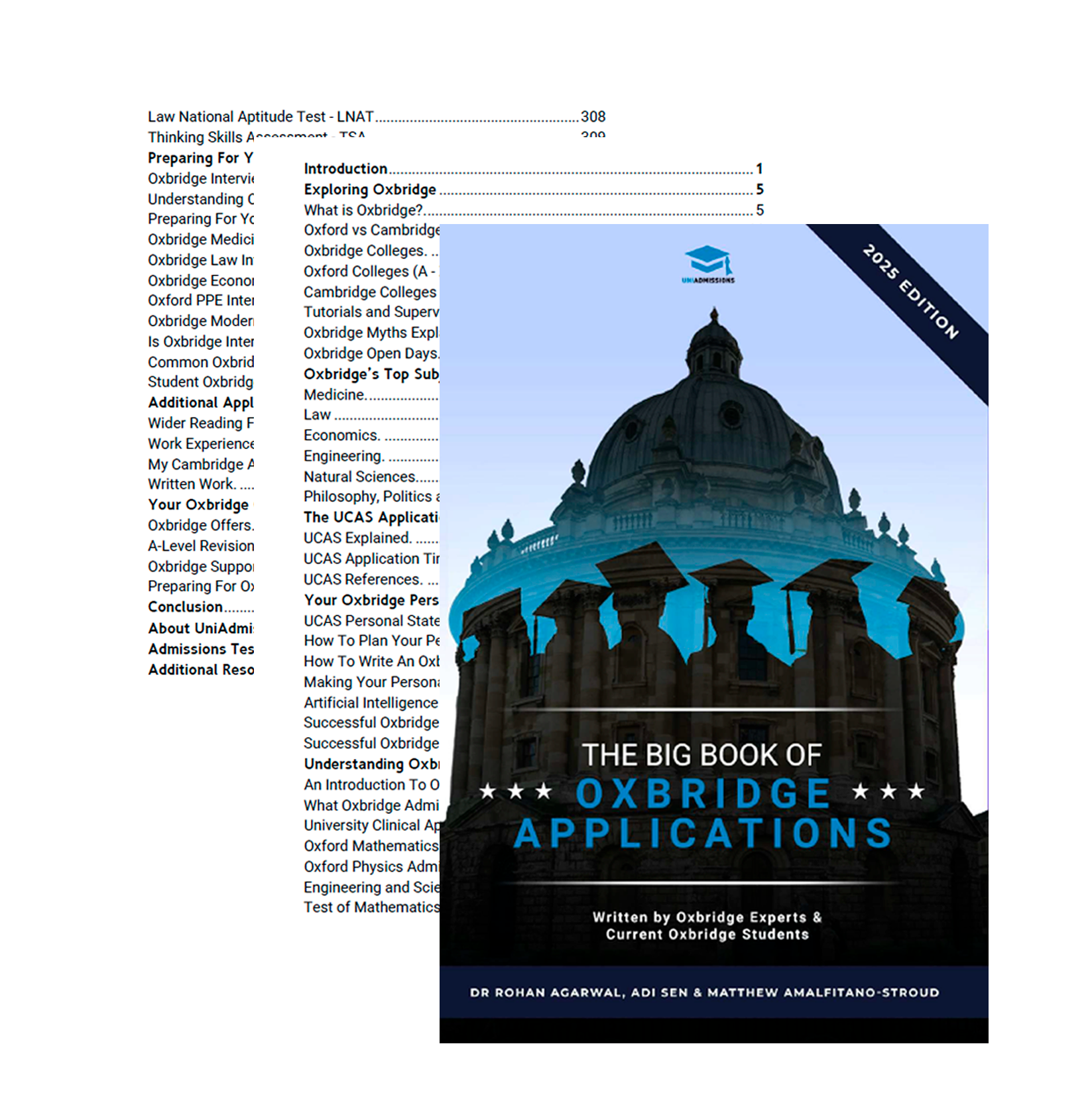
- Over 40 admissions test practice questions
- 28 example Oxbridge Personal Statements
- Interviews with Oxbridge students and graduates
- Additional downloadable resources
Where Do Aerospace Engineers Work?
Aerospace engineers work across a wide range of industries that design, build, operate, or support aircraft and spacecraft. Their expertise is vital in both commercial and government sectors, with roles available in hands-on engineering, research, simulation, testing, and more.
Types of Aerospace Engineering Jobs
Commercial Aviation
Aerospace engineers in commercial aviation work with airlines and aircraft manufacturers to design, test, maintain, and improve passenger and cargo aircraft. They help enhance fuel efficiency, safety systems, aerodynamics, and onboard technologies used in everyday flights.
Space Sector
In the space industry, aerospace engineers design and develop spacecraft, satellites, launch vehicles, and exploration equipment. They also work on mission planning, orbital mechanics, and systems that support space travel, communication, and Earth observation.
Defense
Aerospace engineers support national defence projects involving military aircraft, drones, missiles, and surveillance systems. Their focus is on performance, reliability, and advanced technologies that improve security and tactical capabilities.
Research & Development (R&D)
R&D roles allow aerospace engineers to explore new materials, propulsion methods, aerodynamic models, and innovative technologies. R&D engineers often work at universities, government labs, or private companies developing the next generation of aerospace systems.
Simulation & Modelling
In simulation and modelling, engineers create digital models to test aircraft and spacecraft behaviour under different conditions. They analyse performance, predict failures, and support the design process without needing full physical prototypes.
Manufacturing & Testing
Aerospace engineers in this area oversee the production and quality assurance of aircraft and spacecraft components. They run structural tests, performance checks, and ensure all systems meet strict industry regulations and safety standards.
Where Do Aerospace Engineers In the UK Work?
The UK has a large, well-established aerospace sector, including aircraft manufacturing, defense organisations, space agencies, research institutions, and specialist engineering firms.
Major UK employers for aerospace engineers include:
- BAE Systems – One of the UK’s largest defence and aerospace companies, specialising in military aircraft, autonomous systems, and advanced aviation technologies.
- Rolls-Royce – A global leader in aircraft engine design and manufacture, employing thousands of aerospace engineers across the UK.
- Airbus UK – Airbus is a key employer for aerostructures, wing design, manufacturing, and systems engineering.
- Leonardo UK – A defence and security manufacturer working in helicopters, avionics, and advanced technology systems.
- QinetiQ – A major research and technology organisation supporting aerospace testing, simulation, defence applications, and R&D.
In addition to manufacturers, the UK is home to regulators such as the Civil Aviation Authority (CAA), the armed forces, and the Ministry of Defence, which can provide further job opportunities.
Is Aerospace Engineering a Good Career?
Aerospace engineering can be a highly rewarding and stimulating career for those who enjoy solving complex technical challenges, working with cutting-edge technology, and contributing to advancements in defense and space exploration. Career suitability is a subjective topic, but let’s take a look at four key areas to help you decide for yourself: career stability, job satisfaction, impact, and progression opportunities.
Career Stability
The aerospace sector is a cornerstone of modern transport, defence, and space industries. In the UK, companies such as BAE Systems, Rolls-Royce, and Airbus, along with government agencies and research organisations, provide steady demand for skilled aerospace engineers. While global economic fluctuations can affect some areas, the long-term need for aircraft, spacecraft, and advanced technologies provides strong career stability.
Job Satisfaction
If you’re passionate about innovation and enjoy seeing your ideas take shape, aerospace engineering can be an extremely rewarding career. Additionally, the field offers a mix of office-based design work, hands-on testing, and problem-solving in labs or on prototypes, providing variety and intellectual challenge in your daily tasks.
However, because of the field’s complexity and specialised nature, aerospace engineers often start in more supportive roles and progress with experience. Patience and persistence, particularly during the early years of your career, are therefore essential.
Impact
Few careers allow you to influence technology on a global scale. Aerospace engineers contribute to safer, more efficient aircraft, pioneering space missions, and advancements in satellite communications, climate monitoring, and defence systems. Their work can directly shape transportation, security, and scientific exploration, leaving a lasting societal and technological impact.
Progression Opportunities
Aerospace engineering offers clear progression routes. Early-career engineers can gain experience in design, testing, or R&D, and with professional accreditation (such as Chartered Engineer status), they can move into senior roles, project management, or specialised technical leadership. There are also opportunities to work internationally, transition into consultancy, or contribute to cutting-edge innovation in emerging fields such as sustainable aviation, AI-driven systems, or space exploration technologies.
Oxbridge engineering admissions are competitive. With the right preparation you can triple your chances of success.
Applying to Oxbridge is immensely competitive, and you must give yourself the best chance of success. We help you craft the perfect personal statement, achieve a highly competitive admissions test score and teach you how to interview effectively – covering all areas of your Oxbridge application.
Discover our Oxbridge Engineering Preparation Programme today.
Aerospace Engineering Skills You Need To Succeed
Aerospace engineering requires a mix of technical expertise, analytical thinking, and strong interpersonal skills. Developing these skills early on will help you thrive in this field.
Analytical Thinking
Aerospace engineers must be able to assess complex systems, interpret data, and predict outcomes. Analytical thinking is essential for designing aircraft, spacecraft, and subsystems that are safe, efficient, and reliable.
Maths & Physics
A strong foundation in mathematics and physics underpins almost every aspect of aerospace engineering, from calculating aerodynamics forces to structural loads and propulsion system performance.
Problem-Solving
Engineers in any field constantly face technical challenges and unexpected issues. Strong problem-solving skills allow you to develop practical solutions under time and budget constraints.
Advanced Technical & Software Skills
Familiarity with engineering software such as CAD (Computer-Aided Design), CAM (Computer-Aided Manufacturing), simulation tools, and modelling software is essential for designing, testing, and analysing aerospace systems.
Communication
Clear communication is crucial for collaborating with design teams, technicians, and stakeholders. Engineers must be able to explain technical concepts in a way that is understandable to both technical and non-technical audiences.
Creativity & Innovation
Aerospace engineers often need to think outside the box to improve designs, optimise performance, or solve unique challenges in aviation and space systems. Creativity combined with technical knowledge are crucial for driving innovation in the field.
Aerospace Engineering Salary (UK, USA & Global)
Although this branch of engineering is not among the highest-paying degrees in the UK, aerospace engineering is widely regarded as a well-paid, stable, and technically rewarding career. Salaries vary depending on your level of experience, location, specialisation, and whether you work in the public or private sector. Let’s take a look at global trends and country-specific data.
Aerospace Engineer Salary UK
In the UK, In the UK, aerospace engineering salaries are competitive but vary according to experience:
- Graduate Salary: According to the National’s Career Service, entry average salaries start from £27,000 per year. Glassdoor says that entry salaries can vary between £26,000 and £37,000 per year.
- Mid-Level /Chartered Engineers: £40,000–£60,000
- Senior/Specialist Roles: Up to £80,000.
Aerospace Engineer Salary USA
The USA remains one of the highest-paying markets for aerospace engineers:
- Entry-Level Salary: $60,000–$70,000 per year.
- Mid-Level Engineer: $85,000–$100,000 depending on specialisation (structural, propulsion, avionics, or space systems).
- Senior / Lead Engineer: $110,000–$130,000+, especially in aerospace manufacturing hubs such as Seattle, Los Angeles, and Houston.
For a detailed breakdown of salaries across different engineering disciplines, experience levels, and regions, see our full Engineering Salary Guide.
Is Aerospace Engineering Hard?
Aerospace engineering is widely regarded as one of the more challenging engineering disciplines due to its technical complexity, high academic demands, and interdisciplinary nature. Students are required to master advanced mathematics, physics, materials science, and engineering principles while also applying them to real-world systems such as aircraft, spacecraft, and satellites.
The coursework is often intensive, combining lectures, lab work, simulations, and design projects. Students must be comfortable with abstract reasoning, analytical thinking, and problem-solving under tight deadlines.
While the subject is demanding, many students find aerospace engineering incredibly rewarding. The ability to design a component that could one day fly in space or contribute to safer, more efficient aircraft offers a tangible sense of accomplishment. The field also cultivates highly transferable skills, such as project management, teamwork, and critical thinking, which are valued across multiple industries.
How To Become An Aerospace Engineer
There are two main pathways into aerospace engineering in the UK: the traditional university route and the apprenticeship route. Both lead to highly respected qualifications and can set you up for a successful engineering career, so the right choice depends on your learning style and long-term goals.
University Route
The most common route is to study the subject at university. You typically have two options: a dedicated aerospace engineering degree or a general engineering degree with the option to specialise later. Both routes are respected by employers and lead to strong career prospects, but each has its own advantages:
- A general Engineering degree provides a broader foundation through mechanical, electrical, materials, and systems engineering. It offers greater flexibility if you’re unsure about specialising early or if you later decide to pursue interdisciplinary fields such as robotics, energy, or systems engineering. Prestigious programmes like Engineering Science at the University of Oxford and Engineering, BA (Hons) and MEng at the University of Cambridge, are particularly valued by major employers, because of their rigorous, wide-ranging curriculum.
- A dedicated Aerospace Engineering degree is ideal for students who are confident from the outset that aerospace is their chosen field. These programmes have a narrower technical scope but offer aerospace-specific modules, labs, and projects from day one, giving you a more direct pathway into the aviation and space sectors.
If you want to explore what grades and subjects you’ll need for top engineering programmes, take a look at our Engineering University UK Entry Requirements Guide.
Apprenticeship Route
An alternative to university is completing an aerospace engineering apprenticeship, which allows you to earn a salary while gaining practical experience. Most aerospace employers in the UK offer Level 4, Level 6, or integrated degree apprenticeships, with Level 6 being the most relevant for aspiring engineers because it includes a full Bachelor’s degree alongside professional training.
Degree apprenticeships in aerospace typically combine:
- On-the-job training with major aerospace companies
- Academic study provided by a partnered university
- Rotations through engineering departments such as design, manufacturing, testing, or avionics
This pathway is well suited to students who prefer hands-on learning or want a debt-free route into the industry. However, competition can be extremely high, and apprenticeships usually require strong A-level performance in maths and physics. Students should also be aware that progression into highly specialised or research-heavy roles may be more limited than with a traditional MEng pathway.
How to Prepare for Oxbridge Engineering Admissions
Gaining a place at Oxbridge to study engineering is highly competitive, which makes early and focused preparation essential. Applicants are assessed through several components in addition to specific academic entry requirements:
- Admissions tests such as the ESAT (for engineering at Cambridge) and PAT (for engineering at Oxford) , which evaluate mathematical reasoning, problem-solving, and physics knowledge.
- A strong personal statement that demonstrates academic curiosity, supercurricular experiences, and genuine motivation for engineering is required by both Oxford and Cambridge.
- Interviews, where you’ll be asked to think aloud, break down unfamiliar engineering problems, and demonstrate your ability to reason under pressure.
Structured preparation can significantly improve your performance across all three stages. Many students struggle not because they lack ability, but because they are unfamiliar with the test format, the pace of Oxbridge-style questions, or how to articulate their thinking clearly during interviews.
Expert, personalised support – such as the tailored tutoring offered through UniAdmissions’ Oxbridge Engineering Programme – helps students build confidence, refine their academic skills, and approach the application process strategically. This gives you the strongest possible chance of securing a place.
The Future of Aerospace Engineering
Aerospace engineering is an ever-evolving field, driven by technological advancements, sustainability goals, and the increasing demand for faster, safer, and more efficient air and space travel. Some of the key industry trends include:
Sustainability
The industry is prioritising low-emission propulsion systems, lightweight composite materials, and energy-efficient designs to reduce environmental impact. Engineers are also exploring ways to decarbonise air travel and develop eco-friendly space technologies.
Space Exploration & Commercial Opportunities
The rapid growth of the commercial space sector presents new opportunities for aerospace engineers. From satellite deployment and space tourism to interplanetary exploration, engineers are increasingly required to work across multidisciplinary teams, combining aeronautical, astronautical, and systems engineering expertise to solve complex challenges.
Conclusion
Aerospace engineering is a dynamic, innovation-driven branch of engineering that combines creativity, technical expertise, and problem-solving to shape the future of flight and space exploration. From designing commercial aircraft and spacecraft to advancing defence technologies and sustainable aviation, aerospace engineers play a vital role in developing the systems that move people, goods, and information around the world and beyond.
By understanding what aerospace engineering involves, the skills required, and the career pathways available – from university degrees to apprenticeships – you can make a more informed decision about whether this challenging yet highly rewarding field is the right fit for you. For those passionate about technology, innovation, and exploration, aerospace engineering offers the opportunity to turn ideas into real-world solutions that have lasting impact on society.
Still unsure whether aerospace engineering is the right pathway for you? Explore our career guides below to learn more about other specialised engineering routes:
Oxbridge engineering admissions are competitive. With the right preparation you can triple your chances of success.
Applying to Oxbridge is immensely competitive, and you must give yourself the best chance of success. We help you craft the perfect personal statement, achieve a highly competitive admissions test score and teach you how to interview effectively – covering all areas of your Oxbridge application.
Discover our Oxbridge Engineering Preparation Programme today.


