

So, you’ve decided to study in the UK as an international student. The next question is: how much will studying in the UK cost, and how can you fund your tuition fees and living expenses? Having gone through the same process myself, I’ll break down the key costs and funding options you need to know.
To answer your cost-related queries, I have outlined the different UK international tuition fees, accommodation prices and living costs, and explained how to budget as an international student. If you are looking for location-specific cost insights for students, my guide The Most and Least Expensive Cities in the UK for Students is a good, complementary read.
Home vs International tuition fee Status: What’s the Difference?
If you’re thinking about studying in the UK at the moment, there are two ways you can be classified:
- Home (UK)
- International (Overseas)
What Is A Home Fee Status Student?
A home fee status student is someone who qualifies to pay the lower “home” tuition fees charged by UK universities, rather than the higher international student fees.
If you are a Home student studying your first undergraduate degree, most top-tier universities currently charge tuition fees in line with the government’s regulated fee cap. For the 2026/27 academic year, this is set at £9,790, with a planned increase to £10,050 for 2027/28.
The eligibility criteria for being classed as a home fee status student in the UK generally require students to meet three key conditions: they must have an eligible nationality or immigration status, be “settled” in the UK, and meet residency requirements. In most cases, this means being a British or Irish citizen, holding indefinite leave to remain (ILR), settled or pre-settled status under the EU Settlement Scheme, refugee status, or another qualifying immigration category. Students must also usually have been ordinarily resident in the UK, Ireland, the Channel Islands, or the Isle of Man for the three years before the start of their course, and this residence cannot have been mainly for full-time education.
Universities assess fee status individually using UK government regulations, so eligibility can vary depending on personal circumstances and the nation of the UK where the university is based.
What Is An International Fee Status Student?
An international student is someone who does not qualify for UK home fee status and is therefore required to pay overseas tuition fees at a UK university. International student status is typically assigned to students who do not meet the UK’s residency or immigration requirements for home fee eligibility. This often includes students who live outside the UK, do not hold settled immigration status, or have not been ordinarily resident in the UK, Ireland, the Channel Islands, or the Isle of Man for the required three-year period before their course begins.
If you are classified as an international (overseas) student, you will usually be charged higher tuition fees, which vary depending on your chosen course and university. In most cases, international students are not eligible for UK government tuition fee loans, meaning you will need to fund your studies through alternative sources. These can include university scholarships or bursaries, external funding from organisations or governments in your home country, personal or family support, or private education loans where available.
Oxbridge University Fees for international students in the UK
Let’s focus on the two giants — the University of Oxford and the University of Cambridge — because, chances are, these are the universities you’re most interested in.
Oxford University Fees for International Students (2026-27)
The Overseas fee at the University of Oxford is between £37,380 and £62,820 for 2026/27, with some exceptions. Medicine overseas students at Oxford for example, are charged £49,400 in the first three years (pre-clinical fees) and £65,250 in years 4 to 6 (clinical fees).
Here are the overseas fees for a few different Oxford degrees:
| Oxford Course | International Tuition Fee |
|---|---|
| Medicine | £49,400 (years 1-3), £65,250 (years 4-6) |
| Engineering Science | £62,820 |
| Philosophy, Politics and Economics (PPE) | £43,600 |
| Law (Jurisprudence) | £43,600 |
University of Cambridge Fees for International Students (2026-27)
The Overseas tuition fee at the University of Cambridge is between £29,052 and £70,554 for 2026/27, with some exceptions.
Below are the overseas fees for a few different Cambridge degrees:
| Cambridge Course | International Tuition Fee |
|---|---|
| Medicine | £70,554 |
| Engineering | £44,214 |
| Psychological & Behavioural Sciences (PBS) | £44,214 |
| Law | £29,052 |
For Cambridge, all international status students, and those Home fee status students who aren’t eligible for tuition fee support (e.g. affiliate students), normally have to pay an annual college fee in addition to university tuition fees. This covers the cost to your College of providing a range of educational, domestic and pastoral services and support. The cost can be from £11,500 to £14,500 for 2026/27.
| College Name | 2026–27 Fee (£) |
|---|---|
| Christ's | 12,600 |
| Churchill | 14,500 |
| Clare | 13,570 |
| Clare Hall | 12,000 |
| Corpus Christi | 12,933 |
| Darwin | 11,500 |
| Downing | 14,140 |
| Emmanuel | 13,000 |
| Fitzwilliam | 13,860 |
| Girton | 13,100 |
| Gonville & Caius | 13,398 |
| Homerton | 12,990 |
| Hughes Hall | 13,545 |
| Jesus | 13,930 |
| King's | 13,356 |
| Lucy Cavendish | 13,200 |
| Magdalene | 13,065 |
| Murray Edwards | 14,950 |
| Newnham | 13,040 |
| Pembroke | 13,150 |
| Peterhouse | 13,000 |
| Queens' | 12,411 |
| Robinson | 13,696 |
| Saint Catharine's | 12,920 |
| Saint Edmund's | 13,440 |
| Saint John's | 13,300 |
| Selwyn | 13,237 |
| Sidney Sussex | 13,480 |
| Trinity | 13,689 |
| Trinity Hall | 13,245 |
| Wolfson | 13,500 |
Applying to Oxbridge as an international student? Our expert support will help you achieve your goal of studying in the UK.
Prepare effectively over the next few months with our expert Oxbridge guidance and structured learning. We help you craft the perfect Personal Statement, achieve a highly competitive Admissions Test score and teach you how to Interview effectively – covering all areas of your Oxbridge application, from History to Medicine.
Discover our Oxbridge Premium Programmes by clicking the button below to enrol and triple your chances of success.
How many places are available for international students?
The UK government imposes a quota on the number of international students that UK medical schools can admit. For example, at the University of Oxford, they are limited to 7.5% of those in both undergraduate and graduate entry degrees (shown below). For 2026 entry, 8 international students were admitted out of 210 that applied with an international status.

This makes admissions considerably more competitive as there are far more international students than home applying for a smaller number of places.
One university of note and worth mentioning in the context of international applicants is the University of Buckingham. They admit more international applicants as it is a private not-for-profit university.
This means it can be much less competitive and will still give you the right to work in the UK as a doctor without having to go through any messy conversion of qualifications.
Access "The Big Book Of Oxbridge Applications" For FREE
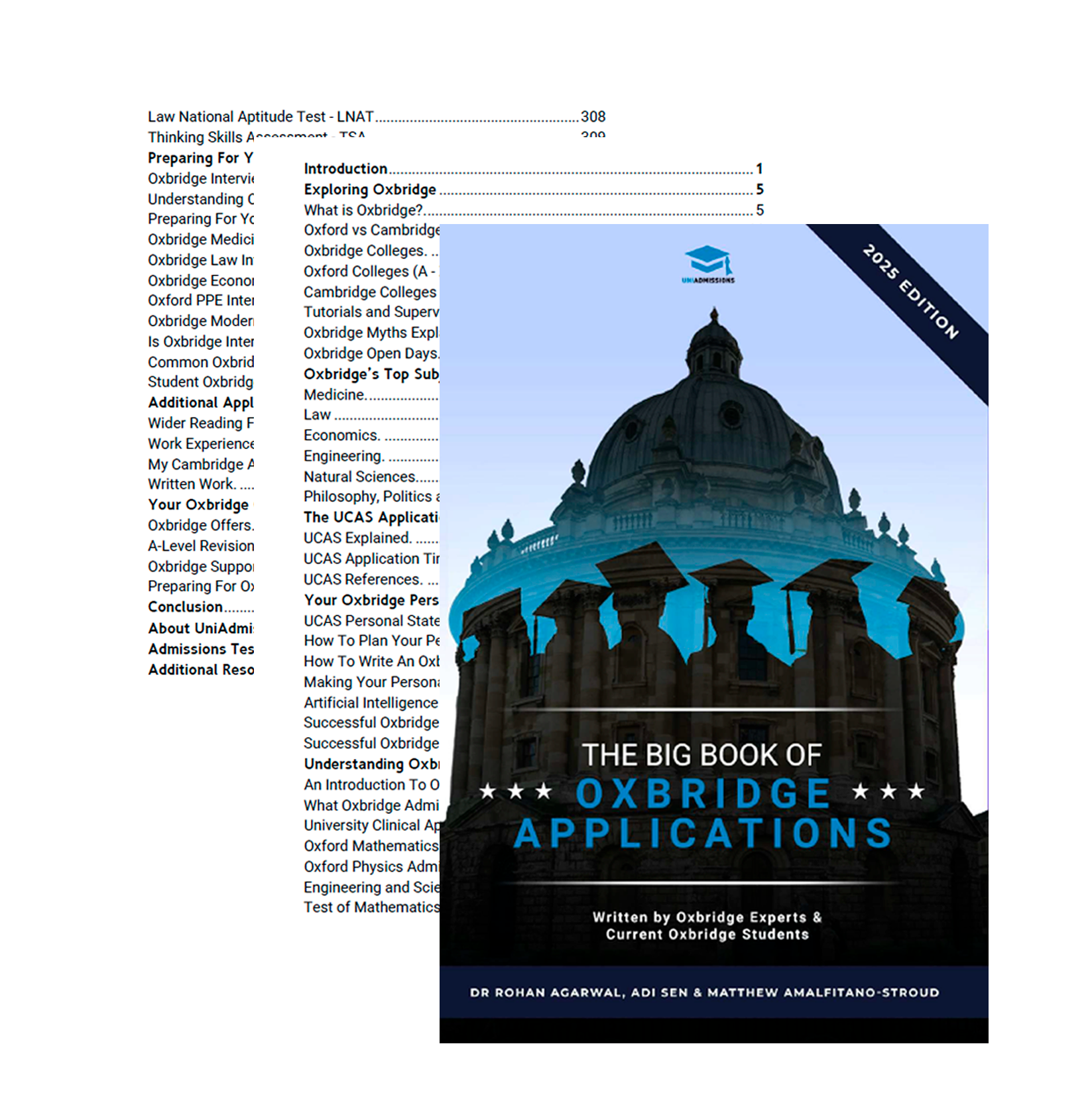
Are you considering applying to Oxford or Cambridge? The Big Book of Oxbridge Applications is your must-have resource. Whether you’re exploring colleges, preparing for admission tests, mastering your UCAS application, crafting a standout Personal Statement, or looking to excel in your interviews, this free book will be invaluable to your preparation. You’ll find:
- Over 40 admissions test practice questions
- 28 example Oxbridge Personal Statements
- Interviews with Oxbridge students and graduates
- Additional downloadable resources
How much does accommodation cost in the UK?
Accommodation is another significant cost and can vary widely from city to city, with the average monthly rent in London being the highest.
Most university websites have a “living expenses” page (here is the University of Oxford’s for example) and can give you more specifics about the living costs of that particular city and university.
| City | Avg Rent for a Room |
|---|---|
| London | £860 |
| Oxford | £810 |
| Cambridge | £790 |
| Manchester | £700 |
| Cardiff | £650 |
| Birmingham | £620 |
There are several options for where you can live including student halls and private accommodation. Here are the normal options students choose in their first year and beyond:
First-year Accommodation
- Normally in your first year, your university will provide ‘halls’ which they own. You will pay rent to the university and it's a great opportunity to make friends and socialise at the start of your further studies, as you are surrounded by people who are also starting their university journey.
- You normally pick a room type (e.g. single, double, ensuite double) and then are randomly sorted into flats to share other amenities like a kitchen.
- Some accommodation in universities is catered meaning you have food included in your rent and don’t have to cook for yourself (although the quality of this food can be variable).
Post First-Year Accommodation
- After your first year, the majority of people move out into privately rented houses with friends they have made, although sometimes you can continue to live in halls.
- If you’re living in a privately rented house, you’ll often have to factor in paying for energy, internet, water, and insurance as well as your rent.
- For international students, privately renting a house can sometimes be a headache. UK landlords will want a ‘guarantor’ which is someone who will pay your rent in case you can no longer afford it. Often this is someone’s parent but since it is unlikely that your parents live in the UK, you cannot have a guarantor.
- This sometimes means that you have to pay a very large deposit (an amount that is returned to you) or you could be required to pay a significant amount of rent up front (e.g. 6 months). This could run into £10,000+ and is something to be aware of.
Cost of Living in the UK for international students
Expenses for basic living can also vary widely from city to city. For example, a cinema ticket in London can be double that of one in Manchester.
We recently conducted a research to rank the most and least expensive UK cities for students. Below are some useful raw data from our study of over 20 UK cities.
| Expense | Avg Cost Per Month |
|---|---|
| Groceries | £100 – £200 |
| Utilities | £275 |
| Transportation | £98 |
| Lifestyle Activities (cinema, gym, eating out) | £224 |
Most universities in the UK will loan you core texts from their libraries, or you will at least be able to view reference copies in libraries. This can save you a lot in terms of course costs as textbooks are usually very expensive.
Travel Costs
Travel for international students is, of course, going to be a significant cost. Since you will have to be in the UK for ‘term time’, which normally aligns roughly with UK school times, you are likely to be flying during peak season when returning home for holidays. This can lead to extremely expensive flights, even if you book far in advance.
Our Oxbridge application support is designed to cover the whole year and provide you with structured learning to give you the best chances of success.
Prepare effectively over the next few months with our expert Oxbridge guidance and structured learning. We help you craft the perfect Personal Statement, achieve a highly competitive Admissions Test score and teach you how to Interview effectively – covering all areas of your Oxbridge application, from History to Medicine.
Discover our Oxbridge Premium Programmes by clicking the button below to enrol and triple your chances of success.
Budgeting As An International Student
Budgeting is a key part of financial discipline. Many university students use banks like Monzo or Starling which offer budgeting tools. These banks link their debit cards to apps that send you handy notifications when it looks like you’re spending too much on the wrong things (e.g. takeaways), and can estimate when you’re going to run out of money in that month.
Setting out how you’re going to allocate and spend your money via these apps or even by a spreadsheet can help keep you on track to avoid overspending during your time studying.
Before you arrive in the UK, you should set up a bank account. Several banks can help you do this internationally, such as HSBC. You can use online tools, such as Transferwise, for transferring money internationally which tend to have the lowest fees of any exchange online.
Exchange rates can be problematic when studying in the UK as an international student. If, for example, your parents are sending you a certain amount of money in your home currency and the exchange rate drops, this could leave you significantly short on financial commitments in the UK such as rent. Factor in the potential for ups and downs in the exchange rate when thinking about how much you’ll need.
International Bursaries and Scholarships
Most bursaries and scholarships, at the undergraduate level, will sadly only be open to UK students. However, many countries provide national initiatives which will fund their students to study abroad. For example, the Fulbright program helps US students’ study in the UK and vice versa.
At the master’s level and above, there are many scholarships offered by UK universities that are funded by alumni and other countries which allow international students to study in the UK. Some of these can be extremely niche and they are worth seeking out as they can provide valuable opportunities.
Another thing to note is that many of these scholarships start accepting applications years before your prospective date of entry, so start looking at these early if you are seriously considering them.
Visa Costs and Restrictions
Visa costs are a relatively small cost to factor into your overall budget. As of 8 April 2026, the application fee for a Student visa (formerly known as the Tier 4 General Student visa) is £558 when applying from outside the UK, or when applying to extend or switch to a Student visa from inside the UK.
You will also need to pay the Immigration Health Surcharge (IHS) to access the National Health Service (NHS) during your stay. For students, this is currently £776 per year.
You must also show proof of funds to cover your living costs: £1,483 per month if you’re studying in London, or £1,136 per month if you’re studying outside London, for up to nine months (so a maximum of £13,347 for London and £10,224 elsewhere).
Your Student visa has certain conditions attached to it, and working while you study is generally restricted to 20 hours per week during term time (with full-time work permitted during official holidays). To put this in context, two full-day shifts at a coffee shop would use up most of your weekly hours, meaning you cannot rely on a part-time job to provide a large amount of supplementary income. Some international students do make this work, however, by picking up more highly skilled roles, such as self-employed tutoring, which pays considerably more per hour.
Overall Costs For International Students
In short, your degree at Oxbridge will cost a minimum of £200,000, but most will end up paying well over £350,000. As you can see in the table at the beginning of this article, this varies greatly from course to course.
Start your Oxbridge application journey in the best way possible with effective support from our Oxbridge Tutors.
We help you craft the perfect Personal Statement, achieve a highly competitive Admissions Test score and teach you how to Interview effectively – covering all areas of your Oxbridge application, from History to Medicine.
Discover our Oxbridge Premium Programmes by clicking the button below to enrol and triple your chances of success.
Frequently Asked Questions
Home fee status means paying the lower, government-capped tuition fee of £9,790 for 2026/27 (£10,050 from 2027/28). To qualify, students usually need British or Irish citizenship, settled or pre-settled status, and three years of UK residency before their course starts. International fee status applies to everyone else, with significantly higher tuition fees and no access to UK government tuition fee loans.
For 2026/27, international tuition fees at Oxford range from £37,380 to £62,820, and at Cambridge from £29,052 to £70,554, with Medicine at the top end. Cambridge international students also pay an annual college fee of £11,500–£14,950. Over a full degree, most international students at Oxbridge spend a minimum of £200,000, with many paying well over £350,000 once living costs are included.
Living costs vary by city. Average monthly rent ranges from around £620 in Birmingham to £860 in London, with Oxford (£810) and Cambridge (£790) close behind. On top of rent, students typically spend £100–£200 on groceries, £275 on utilities, £98 on transport, and around £224 on lifestyle activities such as cinema, gym, and eating out each month.

