

With your UCAS Application and Personal Statement behind you, only one major hurdle remains in the Oxford PPE application process: your interviews. For many applicants, this proves the toughest stage of all, whether the culprit is nerves, difficulty communicating, or uncertainty about what lies ahead.
Oxford’s interviewers use these conversations to gauge a range of qualities: an applicant’s historical knowledge, their motivation for studying at the university, and their broader abilities as an academic. While the range of questions they might ask is almost endless, that’s no reason to go in unprepared.
Below, we’ll walk you through everything you need to know for your interviews, from the types of questions that tend to come up to concrete examples of what to expect. Let’s dive in!
Oxford Interview Format
To kick things off, let’s run through answers to some of the questions most frequently asked about Oxford interviews. For a fuller picture of the interviews as a whole, head to our Oxford Interview Preparation Guide; what follows here is simply a brief overview.
When Are Oxford PPE Interviews?
Each year, the main round of Oxford interviews takes place across the first three weeks of December. Although a subject-by-subject timetable of interview dates is published in advance, all the specific times and dates you need to keep track of will arrive in your invitation.
When Are Interview Invitations Sent Out?
Interview invitations from the colleges tend to land just one to three weeks ahead of the interview period, which leaves you with precious little time to prepare. That’s exactly why you shouldn’t hold off until your invitation arrives; getting a head start well in advance is essential.
How many applicants does Oxford Interview?
Oxford is very selective when it comes to interviewing applicants for PPE. Overall, roughly 30% of applicants are interviewed each year, and PPE had an interview rate of 38%.
Where Are Oxford Interviews Held?
Since 2020, the majority of Oxbridge interviews have taken place remotely, meaning you can attend from home or school via Microsoft Teams or Zoom (your invitation will specify which platform you’ll need). Oxford has confirmed that all of its interviews will remain online for the foreseeable future.
How Many Interviews Will I Attend?
For Oxford PPE, you will need to complete three interviews during the interview period. Each one covers one of the three subjects covered in the course, Philosophy, Politics and Economics.
Who Will Be Interviewing Me?
Generally speaking, the people interviewing you will be the college’s admissions tutors and lecturers, most of them working within your subject area. Each interview tends to feature a pair of interviewers, and it’s rare that any one of them will cross your path more than once.
What Format Are The Interviews?
Every Oxbridge interview follows a traditional panel format. In essence, it’s a conversation between you and your interviewers, who pose questions and offer prompts for discussion. Since they’ll usually follow up on what you say to keep things moving, you should be ready to explore the same topic from several different angles.
In remote interviews, you’ll use a digital whiteboard instead, which will be available in the virtual meeting room throughout your interview.
How Long Are The Interviews?
Oxford interviews will last 30 minutes in most cases. Interviewers don’t tend to give out extra time, so be sure to be concise when answering questions.
What Happens After My Interviews?
Once your final interview is over, all that remains is to wait for an offer or any further updates.
Should your chosen college decide not to offer you a place, another college may take up your application instead, giving you a second shot at admission. Cambridge sees this more frequently, where the process goes by the name of the Winter Pool, so don’t expect this to happen as an Oxford applicant.
That’s all the essential background on Oxford interviews you’ll need for the time being. With that covered, let’s turn our attention to the kinds of questions you can expect to come up.
Get your Oxford PPE offer with support from UniAdmissions
Our PPE Interview Programme is the most effective way to prepare for your PPE interviews at Oxford. You’ll be working with expert PPE tutors who have experienced the process, taking part in mock interviews, attending live courses and utilising a large library of resources to cover everything you need for your preparation.
Discover our Oxford PPE Interview Programme by clicking the button below to learn how you can enrol and triple your chances of success.
Common Oxford PPE Interview Questions
Broadly speaking, the interview questions you’ll face at Oxford fall into six distinct categories:
- Generic Questions
- Subject-Related Questions
- Academic Questions
- Reading-Related Questions
- Personal Statement Questions
- Thinking Questions
Every one of these question types fulfils a specific purpose in the eyes of the admissions tutors, even if some prove more relevant to PPE interviews than others. To get a clearer sense of them, let’s take each category in turn:
Generic Questions
You’d expect to come across these kinds of questions in any interview. Easy to anticipate they may be, but answering them isn’t always so simple. Their focus tends to fall on your motivations, probing why you’re there to begin with. Examples include:
- Why PPE?
- Why Oxford?
- Why this college?
Preparing for these is straightforward enough, but steer clear of scripting your answers word for word, or you risk sounding passionless and robotic. A better approach is to commit the key motivational points to memory for each question and build your answer around those. The result will come across as far more authentic, even when your delivery isn’t flawless.
Whenever the conversation turns to your personal motivations, be sure that what you say lines up with what you wrote in your Personal Statement.
Subject-related Questions
With humanities and social science subjects such as PPE, you can count on subject-related questions cropping up frequently. The first variety is the more general kind, in which the interviewer might probe your understanding of a topic or ask where you stand on something specific.
Questions of this sort aren’t about expecting you to know a particular time period or historical event inside out. Rather, the aim is for you to draw on the knowledge you already have, using it to discuss a topic or build an argument of your own.
The trick with these questions is to verbalise your thinking as you work things through. A ready-made answer won’t be at your disposal, so taking a moment to weigh the question carefully is important. There’s nothing wrong with a brief pause, but since what these questions really set out to reveal is how you tackle problem-solving, talking through your reasoning as it unfolds is the best way to show it.
Coming up in the next section are some examples of these question types, each of which is unique and demands its own particular set of skills if you’re to prepare effectively.
Academic Questions
This is another type of question, but one that you won’t commonly encounter in a PPE interview. Essentially, it’s when the interviewer gives you a problem to solve, similar (though not identical) to something you’d find in an exam. The Economics interview may feature questions like this, but Philosophy and Politics are far too multi-faceted to provide questions with simple, linear answers.
Reading-Related Questions
Tied to any wider reading you’ve done or mentioned in your Personal Statement, these questions are relatively straightforward to answer: all you need to do is talk through what you’ve been reading, what you made of it, and any intriguing concepts or facts you’ve stumbled upon. Their importance comes down to just how highly Oxford prizes independence in its students, not least the ability to seek out and read relevant texts in one’s own time.
- Tell me about something you’ve read recently.
- What did you think about X?
The scope here extends well beyond books, so feel free to draw on any relevant articles, papers, news stories, or documentaries you’ve taken in of late.
Personal Statement Questions
The intention behind these questions is simple enough: the admissions tutor wants to talk through something from your Personal Statement. They crop up less often, though, because Oxford admissions tutors tend to pay less attention to your Personal Statement, preferring instead to test your knowledge in more unusual contexts.
On the occasions when an interviewer does bring up your statement, the chances are they want to hear more about an experience you’ve had or a super-curricular activity you’ve been involved in. Handling these is easy: just offer a bit more context around what you wrote, and answer honestly.
In some cases, they might use an excerpt from your statement as a springboard into a Subject-related Question, for instance, if you mention a particular topic you’re interested in.
Thinking Questions
These are sometimes called the “weird” questions because they can seem quite abstract and unrelated to the course. In reality, they’re designed to test your general thinking skills, such as critical thinking and problem-solving, in unconventional settings. They aren’t meant to catch you out, but they’ll probably make you pause and think for a moment (just remember not to stay silent for too long).
You might have come across some horror stories about the bizarre general questions or scenarios thrown at certain applicants, and humanities applicants are typically the most likely to be on the receiving end of them.
When you have a question that you initially can’t seem to understand, it can often just be a logical problem in disguise, so just be prepared to work in more detailed scenarios and contexts that may not relate to PPE.
Now that we understand the question types they like to ask at Oxford interviews, it’s time to explore some worked examples of PPE interview questions.
Crack the Oxbridge Interview with The Big Book of Oxbridge Applications
Wherever you are in your Oxbridge journey—just getting started or looking to sharpen your approach—The Big Book of Oxbridge Applications is your essential companion. The dedicated interview chapter takes the mystery out of the process, helping you walk into your interview with clarity and confidence.
Don’t leave your preparation to chance. Get a head start with this free, expertly written guide. Inside, you’ll find:
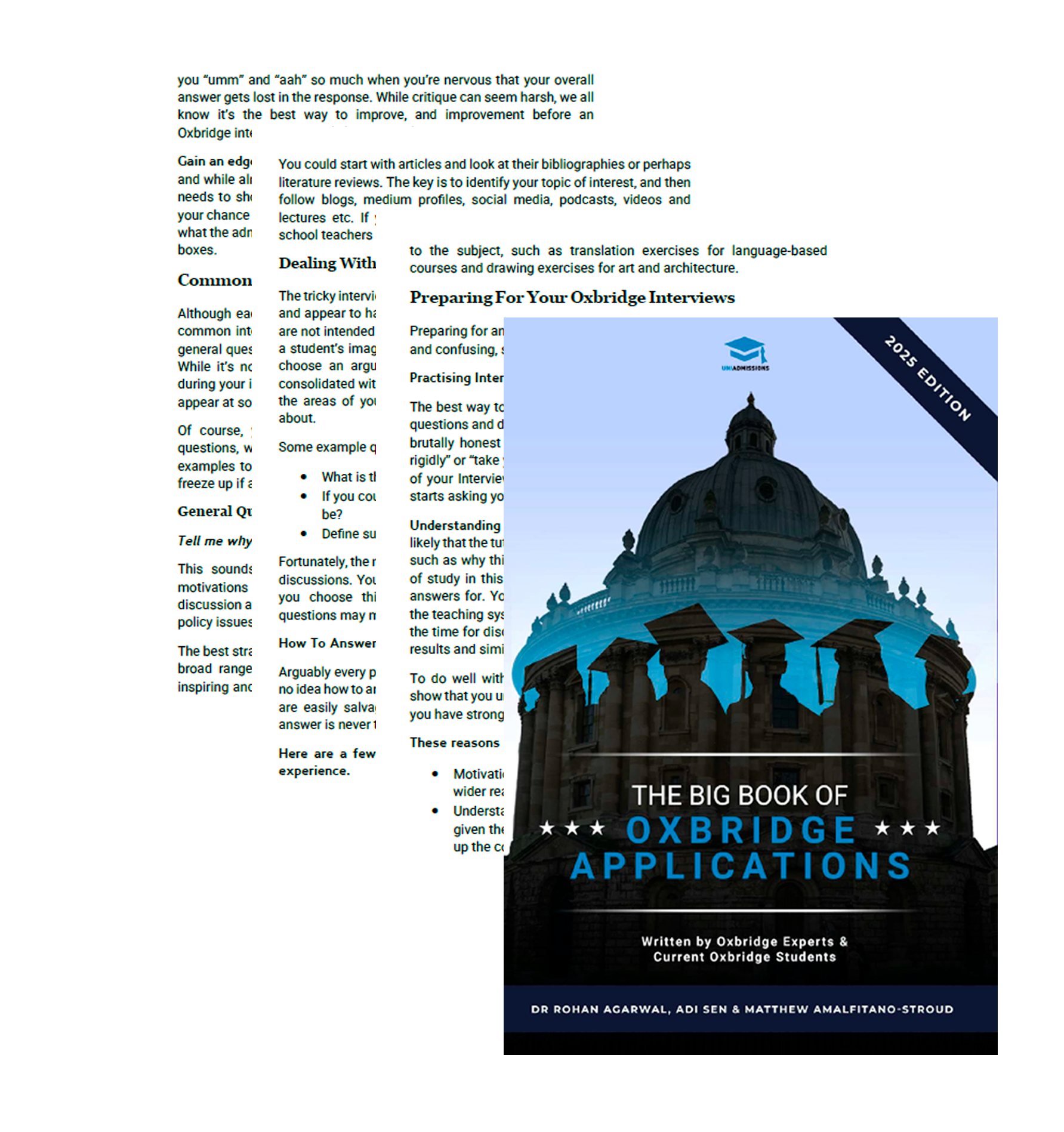
- Real examples of common and subject-specific interview questions
- Insight into what admissions tutors are really looking for
- Interviews with Oxbridge students and graduates
- Practical tips and strategies for practice
Example Oxford PPE Interview Questions
Here are nine questions asked by a successful Oxford PPE student, along with details of their experience answering them. These questions tackle a variety of subjects and question types, so try to recognise which categories they fall under:
Oxford PPE Interview Question 1
Is it possible to deceive someone without lying? If so, give some examples to explain the answer.
How to Answer
A good way to answer this question is by looking at the distinctions between the definitions of the words “deception” and “lying” and exploring whether their definitions necessarily overlap completely. If they don’t overlap, then what examples lie within that space and why?
Model Answer
Deception might be considered to mean “intentionally getting others to believe something false”. Lying might be considered to mean “knowingly saying something false”. According to these definitions, it could be possible to omit the truth as a form of deception that is not lying. It might also be possible to say something true in such a way that makes it sound like a joke or irony and thus deceive someone without using lies.
Other good answers might investigate where “intention” comes into both concepts. Other good answers might also use different definitions of the concepts and so have different answers overall. Many other answers not explained here will also be good – what is important is that you engage with the question and the terms and use examples to explain what you are saying.
Oxford PPE Interview Question 2
Does the government have a right to tell us what to do? Do we have a duty to do what the government tells us to do? What is the difference between a right and a duty?
How to Answer
Good answers here might explore whether having a democratic vote makes a government ‘legitimate’ – or, in other words, gives a government some ‘right’ to threaten us with legal penalties in order to make us obey the law.
They might discuss whether people who do not vote for a leader and are then subject to their laws can truly be said to have a duty to obey them (or for those leaders to tell those people what to do). If this is so, perhaps even democratic leaders are ruling through violence and threat, and have no real authority at all.
As for the last part of the question, good answers will aim to define each word – ideally, the definitions will cover the relationship between the two. For instance, rights cover things that we ought to be able to do/be/say/have, duties are responsibilities we have – things we ought to do/not do/not say etc.
Thus, we have a duty not to deprive others of their rights. Both concepts induce ‘normative’ elements. It could be said that each right has a correlative duty not to overstep other people’s rights.
Oxford PPE Interview Question 3
Is there a difference between donating to charity to impress someone and donating to charity secretly? If so, why? If not, why not?
How to Answer
This question has hordes of possible good answers. Think about what you actually think about this – don’t worry about being objective, this is a question with no agreed-upon answer, and so the important thing is to link your reasons to values that you think are important and then explain why those values are important.
It is, of course, great to establish that that’s how you are answering the question. Saying something like “of course many people will answer this question differently based on their own values and cultural norms, but for the purposes of this I want to highlight x y z as important human values and therefore my answer is a b c” is a good way to show you know that your answer comes with its own set of assumptions without getting you lost in a sea of “some would say” and “others might argue” which keeps you at a surface level.
Using examples is normally a really useful tool, especially when you use them to explain your thinking and reasoning in more detail. They show you know what you’re saying and can apply your logic to situations.
Model Answer
I think that acts are differentiated on the basis of the intentions behind them. I realise that not all people agree, but many people do believe that intent changes the character of an act. For instance, if I save someone by accident when trying to injure someone else, the act seems to have a different character from one where I intend to save that person.
I also think that the intention to help others is positive – whether objectively positive or positive within our social context, or simply because good intentions tend to produce good results. Therefore, intent to do good is present in one charity donation, and perhaps less present or at least not central, in the other. On this basis, the two donations differ.
Oxford PPE Interview Question 4
Is it immoral to eat meat? What about animal products?
How To Answer
If you do eat meat, don’t take that to mean you have to answer in the negative. Just try to find the most convincing arguments and evaluate them. This question in particular will have an enormous range of good answers, and so let’s outline ‘best approaches’ with examples.
Engage with key ethical questions about the rights of animals and humans and how those rights intersect. A good answer may well find what the answer to the question “hinges on”. For instance: if someone believes that animals have a right to life that human beings are uniquely capable of respecting, then they will probably be against the eating of meat. If a person believes the contrary, they will probably not be against it.
You can then argue why you agree with one answer in particular and use more subjective reasons to back up your answer. Finding these structural explanations for answers can be a powerful way to dissect them, but there will be many ways to ‘deconstruct’ any answer. For instance it might go down the route of:
A – ‘humans naturally eat animals, why should it be wrong? It is not wrong when lions eat animal’.
B – ‘but humans are not lions, they possess reason; we cannot use such an excuse. Especially when there are ways for us to be healthy without eating animals. Besides, we do not generally accept that something being natural makes it morally acceptable – we eat seedless grapes and operate heavy cranes – neither of those things are natural’
A – ‘but then does that mean the morality of meat eating depends on whether our biological makeup has meant we could be healthy without eating meat?’ That seems an arbitrary reason for whether an act is moral’.
and so on…
When you argue a particular point, make sure you canvass the opposing arguments for their strongest arguments and try to show that they do not pose a serious threat to your argument.
In fact, a good way to answer questions like this is to treat the time as an ‘investigation’ where you are gradually trying to work out the truth from the various arguments you can think of. Reasoning out loud to the interviewer is a great way to show that you can engage in arguments like this.
Remember to pay a lot of attention to points that they add to your reasoning – they will be targeted in a way to help you out, and showing that you can take external reasoning and evaluate your own reasoning in context with that external reasoning is really important.
Oxford PPE Interview Question 5
What is the difference between the mind and the brain? Is there one?
How To Answer
Start by looking at the two concepts and trying to figure out whether there is an area where they don’t overlap – then explore that area and give examples that illustrate what the character of the difference between the two is. Brain is easier to define scientifically – we can measure it and record it and take pictures of it.
What, though, is ‘mind’. This is more complicated and will have more varied answers. Some answers might suggest that mind is a product of the brain – it is the experiences that the brain produces for us. If this is true then there is a clear difference.
The question that remains here is why it would be the case that those experiences should be considered separate from the brain that produces them.
Are they a ‘part’ of the brain, that we are labelling ‘mind’ but that still falls within the umbrella term ‘brain’ – thus calling them ‘brain’ is correct whilst calling something like neurons ‘mind’ is incorrect? Or – perhaps they are actually separate from the brain? Maybe there is something about experience that occurs somewhere else, or not in any ‘place’ at all, if it is not a physical entity.
Oxford PPE Interview Question 6
Should smokers receive NHS treatment for smoking-related illnesses? Why/why not?
Student Response
Answers to this question will be varied, but all of them should acknowledge to some level the argument that smoking is often not a simple choice that people make. Especially for people who start smoking at a young age and become addicted to nicotine before they reach a stage a maturity where we would tend to hold people so thoroughly responsible for their actions.
Additionally, it should take into account the addictive nature of nicotine and explore the ethical elements of punishing behaviour that is addictive.
Good answers should initially explore reasons on both sides. Two adjacent reasons that might be given against treating smokers through the NHS would be to save resources in a highly pressured system as well as a way of encouraging people not to continue or start smoking.
Good answers will also take reasons from both sides of the argument and look at factors that mitigate or work against those reasons, using the cumulative results from such an investigation to make a final decision. For instance:
Not treating smokers leaves serious ethical issues when smokers unable to afford private healthcare are left without any healthcare and suffer tremendously as a result. This treatment might be considered to have no place in a wealthy society.
This argument is bolstered by the higher proportion of smokers having lower economic power. The link between lower incomes and the propensity for smoking should also be considered here – if having a lower income is a risk factor for people starting smoking, it would be irresponsible for the state to abandon such individuals.
Oxford PPE Interview Question 7
Is wanting something enough to make it good for us?
Student Response
This answer should once again look at outlining what it means for something to be good for us. It should use examples to bring out when we want things that are not, in fact, good for us. It should also aim to outline what it means for something not to be good for us, and whether any definition would make it so that ‘something we want’ is just another way of saying ‘something that is good for us’.
Perhaps we can define “good for us” as being another way of saying “we want that” – since “good for us” is fairly vague and can be defined in numerous ways. Is stuff “good for us” when it is healthy, or when it helps us feel satisfied with our lives in the long term? Why should we decide that it is the long term that matters? Perhaps a perfectly reasonable possible definition of “good for us” is just stuff that we subjectively perceive as having value – a “good”.
It is certainly possible to interpret it such a way. But on a more obvious level there are many things we might want that very few people would claim are “good for us”. For example we might want to eat lots and lots of chocolate cake, but that can make us feel sick.
The discussion here can be long and go back and forth for a very long time. The crucial point is that the answer depends on how we define “good for us” – whether this is in the standard way that society uses it, or in a more specific way. Good answers will note this fact and then look at the different ways that the term can be defined.
Oxford PPE Interview Question 8
A-Level Question
Full Question
Choose the two most similar of your A-level subjects (e.g. if you do both maths and economics, choose these two, and do not choose maths and further maths) – now imagine you are explaining what the difference between them is to an alien. This alien does not use ‘concepts’ in the way we do. They tend to think in particular examples, and rarely conceptualise broad, representative concepts like “economics” and “maths”. Concepts in our language often group things together and represent collections, but the alien struggles to think in this way – it needs support to do so.
How To Answer
Your answer needs to solve the problem of communicating a difference between two broad concepts without using broad generalisations.
Use particular examples of things to explain the differences. Focus first on how to communicate the fact that these two things are considered “subjects” – for this you might talk about ‘learning’ and ‘children’ and talk about how lots of facts get grouped together to organise things in our society.
For maths and economics you might talk about how economics is often a practical application of maths – that the two therefor share a lot of overlap. ‘Pure’ maths is more like a mental ‘tool’ that we use in other places – such as in economics. Economics is a grouping of information we know about all the stuff we have (‘resources’) and all the people who want that stuff. For example, when my brother and I both want the same treat, we must decide between us how to share (or whether we don’t share at all, but rather fight for it).
This answer is designed to give an idea of how an answer might start and the routes it might take. The best answers will probably be longer and go into more detail, using more examples.
Oxford PPE Interview Question 9
The Trolley Problem
Full Question
Would you change the direction of a train to run over 1 person instead of 5? Following that, would you kidnap someone and harvest their organs to save 5 others who would die without those organs if it meant the person kidnapped would die? Are these two examples similar in some way? Why or why not? Would you do one but not the other? Why?
How To Answer
There are many ways to answer this question. The heart of the tension here is that the first question is, in some ways, similar to the second question. Yet many people answer yes to the first and certainly not to the second.
The best answers will acknowledge that and look to eliminate this inconsistency. This can be done by either arguing that the two questions are significantly different – that it is okay to alter the train’s direction but not to kidnap and harvest organs.
Or, the answer will argue that the questions are morally equal, and so either it is ‘okay’/ ‘good’ to change the train’s direction and to harvest the organs, or that it is not ‘okay’ or ‘good’ to do either.
These are just a handful of examples of questions that might come up in a PPE interview at Oxford. Since PPE is such a broad subject, you’re unlikely to face these exact questions, but the purpose of these examples is to show how you can effectively approach any PPE-based interview question and deliver a thorough, insightful response.
At this stage, it’ll be difficult to feel fully confident with the concepts behind every potential question, so don’t be discouraged if you don’t grasp everything covered in these examples. All of these questions are based on concepts you should have learnt during your A-Levels, so everything you’re asked will be within reach at your level of knowledge.
Oxford PPE Interview Tips
To finish, here are some general tips to help you make the most of your Oxford interview and ensure you perform well.
Be Early
Just as you would for any important interview or appointment, aim to arrive somewhere between 10 and 20 minutes early, with the exact margin depending on the type of interview. If yours is remote, see to it that your computer is set up, that your camera and microphone have been tested, and that there’s no risk of being interrupted partway through.
Remain Calm
This is advice you’ll hear time and again where interviews are concerned, and rightly so, even if nerves are entirely natural and near impossible to banish altogether. Staying calm and composed as you head into the interview remains essential all the same, since it helps you keep your communication clear and your responses considered. Bear in mind that correct answers aren’t the whole story; a good deal of what they’re assessing is your personality and your reasons for wanting to study there, and these are what matter most to convey.
Think Out Loud
Although we’ve mentioned this already, just how important it is to avoid long silences while you think bears repeating. It isn’t always easy, given that some of these questions call for a great deal of thought, but do try to make a habit of simply describing whatever’s going through your mind (without falling back on filler that adds nothing of substance).
Sharing your thought process and the knowledge behind it remains essential even when you’re unsure how to answer a question. Demonstrate that you’re weighing up the right elements as you go, and any mistakes made along the way will count for far less.
Opinions Don’t Matter
Given how subjective PPE can be, this tip is a crucial one for the interview. That said, when you’re answering questions about your views on a topic, your feelings count for less than your ability to underpin your reasoning with logic and facts, together with your own reading of the more subjective issues. Answer honestly, even if you suspect your viewpoint runs against the grain.
Use Visuals
While PPE isn’t always the most visual of subjects, this can still carry real weight in an interview. For some applicants, writing and drawing out their thought process is simply a natural way of tackling certain questions, so don’t hesitate to do it if you think it’ll help. Sketching out a timeline, for instance, might help you keep track of key dates or events as you discuss the history of a topic.
Final Advice From PPE Student
An important part of PPE interviews is how you respond to follow up questions from the interviewers – I think that part of their purpose is to test how well you react to their guidance in a question and how you use the extra information they give you to find an answer. So don’t worry if you can’t figure it out straight away and need some guidance to get you started.
And that brings our guide to the types of questions you might meet in PPE interviews at Oxford to a close. Think of it as a starting point: while it lays a solid foundation of what to expect, your next move should be to carry on revising your subject and, at the same time, start preparing through mock interviews. Sitting several of these, ideally with someone you’re not close to, will do much to sharpen your technique and settle your nerves before the real thing arrives.
Remember: preparation isn’t something to put off until your invitation lands, since reaching a comfortable position for your interviews takes rather more than a couple of weeks (and last-minute cramming is far from ideal)! There’s certainly plenty else to juggle in the months building up to December, but striking the right balance across it all is what keeps you from leaving any weak points that might cost you your place.
If getting started feels like a struggle, or your current methods of preparation don’t seem to be paying off, UniAdmissions has a proven record of improving applicants’ interview performance, placing more students into Oxbridge on average than any other school. Built around an expert curriculum and our full range of support methods, our PPE Interview Programme exists to shape students into ideal Oxbridge applicants in good time for their interviews.
Working alongside experienced PPE tutors, our students benefit from both one-to-one tutoring sessions and mock interviews, and they also gain access to live sessions and an extensive library of resources, all of it housed within the one-of-a-kind UniAdmissions Portal. Ready to perfect your interview technique? Book a free consultation today to find out more about enrolment. Good luck!
Triple your chances of Oxbridge success with UniAdmissions
With our Oxford PPE Interview Programme, you will have access to everything you need to perfect your interview technique and stand out from the competition. Our expert tutors are experienced in the Oxford interview processes and can provide insight into the process that can’t be found anywhere else.
Discover our Oxford PPE Interview Programme by clicking the button below to learn how you can enrol and triple your chances of success.

