

With your UCAS Application and Personal Statement behind you, only one major hurdle remains in the Cambridge HSPS application process: your interviews. For many applicants, this proves the toughest stage of all, whether the culprit is nerves, difficulty communicating, or uncertainty about what lies ahead.
HSPS at Cambridge draws together sociology, politics, social anthropology, and social psychology into a single course that asks students to question how the social world works and how we can know anything about it.
This guide walks you through everything you need to know about the Cambridge HSPS interview: what format it takes, the types of questions you’ll face, and — most importantly — six real HSPS interview questions with example answers so you can see exactly what strong responses look like.

Cambridge HSPS Interview Format
Before diving into the questions themselves, it’s worth getting clear on the logistics. Below are the most common questions applicants have about the HSPS interview process at Cambridge. To learn more about the Cambridge interviews, our guide How to Prepare for a Cambridge Interview is a useful complementary read.
When Are Cambridge HSPS Interviews?
Cambridge interviews typically take place in December, usually across the first two to three weeks of the month. The exact dates shift slightly from year to year, but the pattern is consistent. If you apply by the UCAS deadline in mid-October, you can expect to hear whether you’ve been shortlisted for interview in late November.
When Are Interview Invitations Sent Out?
Interview invitations tend to arrive around the end of November, which means you’ll usually have only two to three weeks to prepare before the interview period begins. That’s not a lot of time to get comfortable with difficult, open-ended questions, so if you’re reading this well in advance of your application, you’re already making a smart decision.
How Many Applicants Does Cambridge Interview?
Cambridge is highly selective but has historically interviewed a large proportion of applicants, meaning it remains relatively flexible before the interview stage. The interview rate at Cambridge is roughly 70%. Being shortlisted is therefore not uncommon, but it’s only the beginning of the process.
Where Are Cambridge Interviews Held?
Cambridge interviews have generally been held online in recent years. However, since 2025, some Cambridge colleges have resumed hosting in-person interviews, especially for applicants based in the UK. You’ll receive detailed instructions from your college well in advance of your interview.
How Many Interviews Will I Attend?
For HSPS, you can typically expect one or two interviews, though some applicants may have up to four. These are usually conducted by academics from within the HSPS faculty, although the exact combination of interviewers varies by college. One interview may focus more heavily on a particular discipline—such as politics or social anthropology—depending on the areas of HSPS that interest you most.
Who Will Be Interviewing Me?
Your interviewers will generally be the college’s admissions tutors and lecturers, often specialists in one of the disciplines that make up HSPS. Don’t be surprised if you recognise their names from reading you’ve done, it happens. If it does, mention it. Engaging with their work, where genuine, is always a strong move.
What Format Are The Interviews?
Cambridge HSPS interviews follow a tutorial-style format. Think of it less as a job interview and more as an academic conversation — one where the interviewer is genuinely interested in how you reason, how you respond to challenge, and whether you can engage with ideas in real time. There’s no script. The conversation will follow wherever your answers lead.
How Long Are The Interviews?
Each interview typically lasts around 35 minutes to an hour. The pace can feel fast, and you won’t always have time to think of a polished answer before speaking. That’s deliberate — interviewers want to see how you think under pressure, not how well you’ve rehearsed.
What Happens After My Interviews?
Once your interviews are complete, you’ll wait for a decision from the college through your UCAS application in January. Cambridge may make you an offer outright, or your application may be considered by other colleges through the Winter Pool – a system by which strong candidates who weren’t offered a place by their first-choice college can still receive an offer from another college with remaining spaces. Don’t bank on it, but don’t rule it out either.
That’s all the essential background on Cambridge interviews you’ll need for the time being. With that covered, let’s turn our attention to the kinds of questions you can expect to come up.
Get your Cambridge HSPS offer with support from UniAdmissions
Our HSPS Interview Programme is the most effective way to prepare for your HSPS interviews at Cambridge. You’ll be working with expert HSPS tutors who have experienced the process, taking part in mock interviews, attending live courses and utilising a large library of resources to cover everything you need for your preparation.
Discover our Cambridge HSPS Interview Programme by clicking the button below to learn how you can enrol and quadruple your chances of success.
Common Cambridge HSPS Interview Questions
The questions you’ll encounter in a Cambridge HSPS interview fall into several broad categories. Understanding what each type is designed to test helps you approach every question with the right mindset.
- Generic Questions
- Subject-Related Questions
- Academic Questions
- Reading-Related Questions
- Personal Statement Questions
- Thinking Questions
Every one of these question types fulfils a specific purpose in the eyes of the admissions tutors, even if some prove more relevant to HSPS interviews than others. To get a clearer sense of them, let’s take each category in turn:
Generic Questions
You’d expect to come across these kinds of questions in any interview. Easy to anticipate they may be, but answering them isn’t always so simple. Their focus tends to fall on your motivations, probing why you’re there to begin with. Examples include:
- Why HSPS?
- Why Cambridge?
- Why this college?
Preparing for these is straightforward enough, but steer clear of scripting your answers word for word, or you risk sounding passionless and robotic. A better approach is to commit the key motivational points to memory for each question and build your answer around those. The result will come across as far more authentic, even when your delivery isn’t flawless.
Whenever the conversation turns to your personal motivations, be sure that what you say lines up with what you wrote in your Personal Statement.
Subject-related Questions
Subject-related questions ask you to engage with ideas from the disciplines that make up HSPS: sociology, politics, social anthropology, and social psychology. These are the bread and butter of a Cambridge HSPS interview. The question might be about race, inequality, democracy, globalisation, or method, but the underlying objective is always the same: can you think carefully about something complex and contested?
The trick with these questions is to verbalise your thinking as you work things through. A ready-made answer won’t be at your disposal, so taking a moment to weigh the question carefully is important. There’s nothing wrong with a brief pause, but since what these questions really set out to reveal is how you tackle problem-solving, talking through your reasoning as it unfolds is the best way to show it.
Academic Questions
This is another type of question, but one that you won’t commonly encounter in a HSPS interview. Essentially, it’s when the interviewer gives you a problem to solve, similar (though not identical) to something you’d find in an exam. The Economics interview may feature questions like this, but Philosophy and Politics are far too multi-faceted to provide questions with simple, linear answers.
Reading-Related Questions
Reading-related questions probe your wider reading (or super curricular activities) and intellectual curiosity. If you’ve mentioned a book, article, or documentary in your personal statement, expect to be asked about it. Be prepared to go beyond summarising – interviewers want to know what you actually thought of it, what it changed or confirmed in your thinking, and where you’d push back.
- Tell me about something you’ve read recently.
- What did you think about X?
The scope here extends well beyond books, so feel free to draw on any relevant articles, papers, news stories, or documentaries you’ve taken in of late.
Personal Statement Questions
Personal statement questions are another area to prepare carefully. Interviewers may use your statement as a launchpad into a broader academic discussion, so anything you’ve claimed intellectual interest in should be something you can talk about fluently and with genuine engagement.
Thinking Questions
Thinking questions (sometimes called “weird” questions) exist to test your capacity for analytical reasoning in real time. They’re not looking for a right answer. They’re looking for a structured, intellectually honest approach to a question you’ve never been asked before.
You might have come across some horror stories about the bizarre general questions or scenarios thrown at certain applicants, and humanities applicants are typically the most likely to be on the receiving end of them.
When you have a question that you initially can’t seem to understand, it can often just be a logical problem in disguise, so just be prepared to work in more detailed scenarios and contexts that may not relate to HSPS.
Now that we understand the question types they like to ask at Cambridge interviews, it’s time to explore some worked examples of HSPS interview questions.
Crack the Oxbridge Interview with The Big Book of Oxbridge Applications
Wherever you are in your Oxbridge journey—just getting started or looking to sharpen your approach—The Big Book of Oxbridge Applications is your essential companion. The dedicated interview chapter takes the mystery out of the process, helping you walk into your interview with clarity and confidence.
Don’t leave your preparation to chance. Get a head start with this free, expertly written guide. Inside, you’ll find:
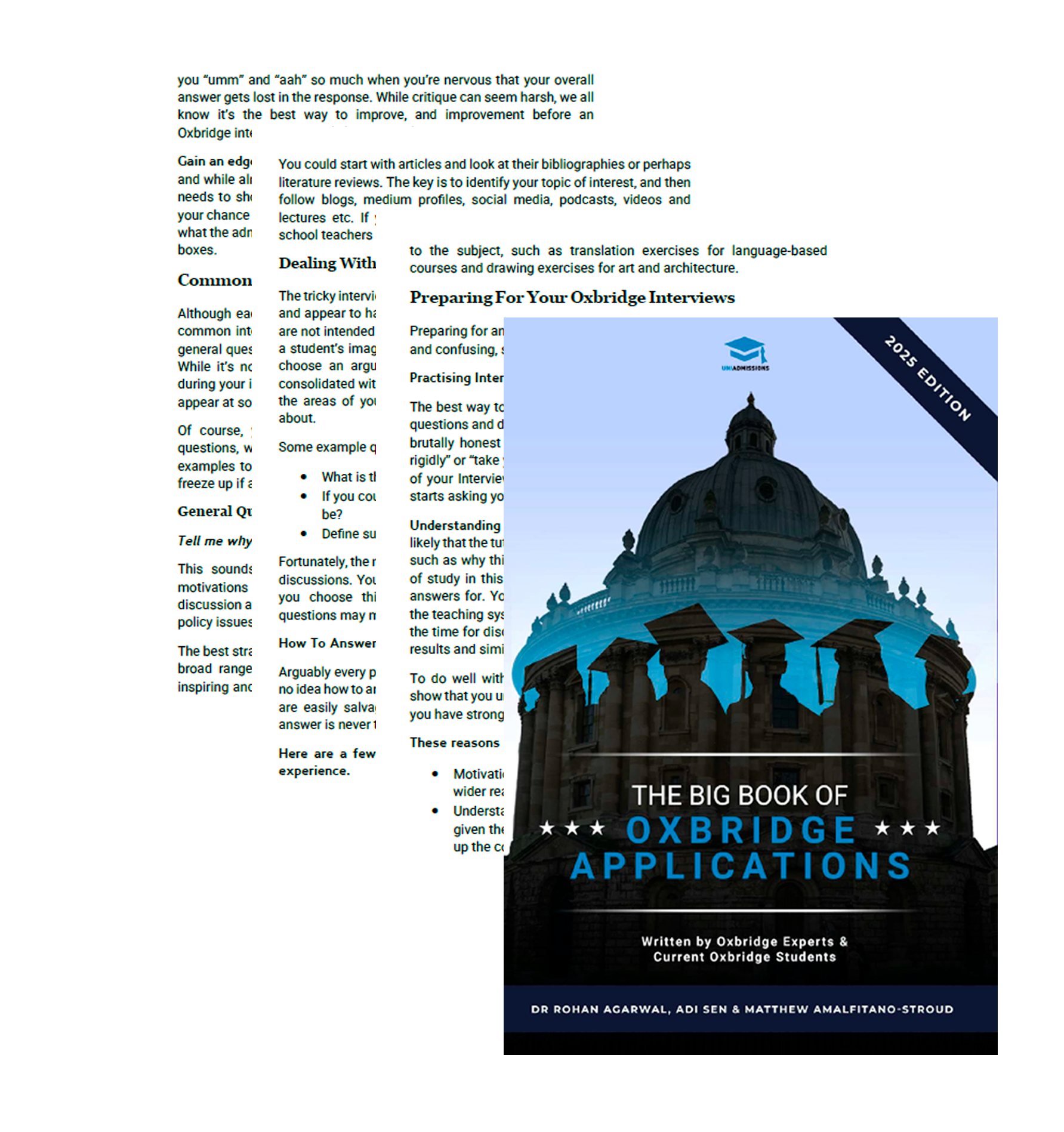
- Real examples of common and subject-specific interview questions
- Insight into what admissions tutors are really looking for
- Interviews with Oxbridge students and graduates
- Practical tips and strategies for practice
Example Cambridge HSPS Interview Questions and Answers
Here are six questions asked in real Cambridge HSPS interviews, along with guidance on how to approach them and model answers from a successful applicant.
Cambridge HSPS Interview Question 1
Why does it matter if race is socially constructed?
How to Answer
This question is doing two things at once. First, it’s testing whether you understand what “social construction” actually means, a concept that gets thrown around a lot but is often only vaguely grasped. Second, it’s asking you to think about the implications of a theoretical claim: even if something is socially constructed, why should anyone care?
Good answers resist the temptation to treat “socially constructed” as synonymous with “fake” or “unimportant”. The stronger move is to draw the distinction between ontological claims (what race is) and normative or political claims (what follows from that). Use examples — money, gender, legal concepts — to show that social constructions can have very real effects.
Model Answer
Social constructions can have real consequences. If institutions, laws, or everyday interactions treat people differently based on race, then race affects people’s lives regardless of whether it has a biological basis.This creates an interesting distinction between something being socially constructed and something being unreal. Money is also socially constructed, yet it clearly matters. Therefore, race matters not because it is biologically fixed but because societies organise resources, opportunities and identities around it.
Cambridge HSPS Interview Question 2
Can national borders be justified?
How to Answer
This is a politics and political philosophy question that rewards candidates who can hold two competing positions in mind simultaneously and work through them rigorously rather than defaulting to a simple yes or no.
The strongest answers engage with both the cosmopolitan critique of borders (all humans have equal moral worth; birthplace is morally arbitrary; borders perpetuate global inequality) and the communitarian or statist defence of borders (states provide public goods, foster political community, and create obligations that can’t easily exist at a global scale). Avoid pretending the question has an obvious answer — it doesn’t, and interviewers know that.
Model Answer
National borders are difficult to justify if we believe all human lives have equal moral worth. The opportunities available to someone are often determined by where they happen to be born, which seems morally arbitrary. However, borders also allow states to provide public goods, maintain political communities, and fulfil obligations to citizens. Without borders, it becomes harder to define who governments are responsible for. So the ethical question is really whether special obligations to fellow citizens can outweigh universal obligations to humanity.
Cambridge HSPS Interview Question 3
Should anthropologists suspend their own beliefs when studying another culture?
How to Answer
This is one of the more philosophically rich questions you might encounter in an HSPS interview, sitting at the intersection of social anthropology and the philosophy of social science. It’s essentially asking you about the problem of cultural relativism and the ideal of objectivity in fieldwork.
The key concept here is reflexivity. The idea, developed by anthropologists from Malinowski through to contemporary ethnographers, that researchers need to be aware of how their own backgrounds, assumptions, and cultural frameworks shape what they see and how they interpret it. Good answers don’t simply argue that anthropologists can or should suspend their beliefs; they question whether that’s even possible, and what follows if it isn’t.
Model Answer
Anthropologists often try to understand practices from the perspective of the people who participate in them rather than immediately judging them according to external standards. This is important because behaviours that seem irrational or problematic from the outside may have a very different meaning within their social and cultural context.
However, completely suspending one’s beliefs is probably impossible. Researchers bring their own values, language and assumptions into the field, which inevitably shape what they notice and how they interpret it. The goal is therefore not neutrality in the absolute sense, but reflexivity: being aware of how one’s own position influences the research process.
Cambridge HSPS Interview Question 4
Do western liberal democracies still need feminism today?
How To Answer
Questions about feminism in a Cambridge interview are not traps. The interviewers are not checking whether you are a feminist. They’re checking whether you can engage with a contested political and sociological question with nuance, evidence, and intellectual rigour.
The weakest answers assert that feminism is either definitely still needed or definitely finished without engaging with the substance of the question. Strong answers acknowledge that formal legal equality has advanced considerably in many western democracies while pointing to the ways in which structural inequality persists — in pay, representation, unpaid labour, healthcare, and the intersections of gender with race and class.
Model Answer
Whether feminism is still needed depends partly on how we define equality. In many societies, women now have legal rights that previous generations lacked, which might suggest feminism has largely achieved its goals. However, many feminists argue that inequality does not operate only through laws. Expectations around caregiving, leadership, appearance and work can continue to shape opportunities and outcomes even when formal barriers have been removed. At the same time, contemporary feminism also faces questions about whose experiences it prioritises and how it addresses differences of class, race and culture. Rather than asking whether feminism is finished, it may be more useful to ask what forms inequality takes today.
Cambridge HSPS Interview Question 5
Does social media make us more connected or more isolated?
How To Answer
On the surface, this looks like a question with an obvious answer. Probably both, you might think. But that’s actually not wrong; the point is to demonstrate that you can articulate the tension precisely and say something analytically interesting about it rather than just offering a lazy “it depends.”
Bring in some sociology here if you can. Think about Durkheim’s distinction between mechanical and organic solidarity, Putnam’s work on social capital and its decline, or more recent empirical research on loneliness. The interviewers will be impressed by candidates who don’t just rely on anecdote but engage with the social scientific literature, even at a relatively introductory level.
Model Answer
Social media appears to increase connection in some ways while reducing it in others. It allows people to maintain relationships across large distances, find communities based on shared interests, and access information quickly. For many individuals, particularly those who feel isolated in their immediate environment, these benefits can be significant. However, critics argue that social media may encourage broader but weaker forms of connection, replacing deeper face-to-face relationships with more superficial interactions. It can also shape how people present themselves and compare themselves to others. Rather than asking whether social media is simply good or bad, I think the more interesting question is what kinds of social relationships it encourages and what kinds it discourages.
Cambridge HSPS Interview Question 6
How would you study a group of traders on the London Stock Exchange?
How To Answer
This is a methods question, and it’s a genuinely interesting one. It’s testing whether you’ve thought about social scientific methodology at all. Not just what you want to study, but how you’d go about studying it and why your chosen approach suits the phenomenon in question.
Don’t just name-drop a method. Explain why it’s appropriate for this particular setting and what it would allow you to see that other methods wouldn’t. Think about access (how do you get into this world?), validity (do traders act differently when observed?), and the specific kinds of knowledge that qualitative versus quantitative approaches produce.
Model Answer
I would use a mixed qualitative approach, mainly ethnography and semi-structured interviews. Traders operate in a high-pressure environment where behaviour, language, risk-taking and hierarchy may not be fully captured through surveys. Observation would allow me to study everyday practices: how traders communicate, how decisions are made under uncertainty, and how status is performed through speech, speed, confidence or technical knowledge. Semi-structured interviews would then help me understand how traders interpret their own work, for example whether they see themselves as rational calculators, risk managers, or members of a competitive masculine culture.
These are just a handful of examples of questions that might come up in a HSPS interview at Cambridge. Since HSPS is such a broad subject, you’re unlikely to face these exact questions, but the purpose of these examples is to show how you can effectively approach any HSPS-based interview question and deliver a thorough, insightful response.
At this stage, it’ll be difficult to feel fully confident with the concepts behind every potential question, so don’t be discouraged if you don’t grasp everything covered in these examples. All of these questions are based on concepts you should have learnt during your A-Levels, so everything you’re asked will be within reach at your level of knowledge.
Cambridge HSPS Interview Tips
Here are some practical things to keep in mind as you prepare for your HSPS interviews.
Be Early
Just as you would for any important interview or appointment, aim to arrive somewhere between 10 and 20 minutes early, with the exact margin depending on the type of interview. If yours is remote, see to it that your computer is set up, that your camera and microphone have been tested, and that there’s no risk of being interrupted partway through.
Think Out Loud
This is probably the single most important habit to build. Interviewers don’t expect you to arrive at a perfect answer instantly. What they want to see is the quality of your reasoning as it unfolds. Narrate your thought process. Say “Let me think about what that would actually mean…” or “There’s a tension here between…” That kind of structured thinking is exactly what they’re looking for.
Remain Calm
This is advice you’ll hear time and again where interviews are concerned, and rightly so, even if nerves are entirely natural and near impossible to banish altogether. Staying calm and composed as you head into the interview remains essential all the same, since it helps you keep your communication clear and your responses considered. Bear in mind that correct answers aren’t the whole story; a good deal of what they’re assessing is your personality and your reasons for wanting to study there, and these are what matter most to convey.
Opinions Don’t Matter
Given how subjective HSPS can be, this tip is a crucial one for the interview. That said, when you’re answering questions about your views on a topic, your feelings count for less than your ability to underpin your reasoning with logic and facts, together with your own reading of the more subjective issues. Answer honestly, even if you suspect your viewpoint runs against the grain.
Read your personal statement the night before
Your interviewers will have read it. Anything you’ve claimed to have read, to be interested in, or to have thought about is fair game. Don’t get caught out not being able to speak fluently about something you said motivated your application.
Final Advice From A cambridge HSPS Student
A) Engage with the question being asked, not the question you wanted to get. HSPS interviews are conversations, and interviewers will often take your answers in directions you don’t expect. Don’t try to steer the conversation back to your prepared territory. Engage genuinely with whatever they’re asking. That’s what impresses them.
These six questions are just a sample of the range and style of what you might encounter in a Cambridge HSPS interview. The specific topics will vary. You might be asked about climate policy, immigration, institutional racism, methodology, or a passage you’re given on the day. But the underlying skills the interviewers are assessing stay consistent: the ability to reason clearly, engage honestly with difficulty, and show genuine intellectual curiosity about the social world.
Remember: preparation isn’t something to put off until your invitation lands, since reaching a comfortable position for your interviews takes rather more than a couple of weeks (and last-minute cramming is far from ideal)! There’s certainly plenty else to juggle in the months building up to December, but striking the right balance across it all is what keeps you from leaving any weak points that might cost you your place.
If getting started feels like a struggle, or your current methods of preparation don’t seem to be paying off, UniAdmissions has a proven record of improving applicants’ interview performance, placing more students into Oxbridge on average than any other school. Built around an expert curriculum and our full range of support methods, our HSPS Interview Programme exists to shape students into ideal Oxbridge applicants in good time for their interviews.
Working alongside experienced HSPS tutors, our students benefit from both one-to-one tutoring sessions and mock interviews, and they also gain access to live sessions and an extensive library of resources, all of it housed within the one-of-a-kind UniAdmissions Portal. Ready to perfect your interview technique? Book a free consultation today to find out more about enrolment. Good luck!
Triple your chances of Oxbridge success with UniAdmissions
With our Cambridge HSPS Interview Programme, you will have access to everything you need to perfect your interview technique and stand out from the competition. Our expert tutors are experienced in the Oxford interview processes and can provide insight into the process that can’t be found anywhere else.
Discover our Cambridge HSPS Interview Programme by clicking the button below to learn how you can enrol and triple your chances of success.

