

Once you’ve finished your UCAS Application and Personal Statement, your interviews are the last major step of the Oxbridge History application process. Many will find that this is the hardest part of the process, whether it’s due to nerves, communication issues or not knowing what to expect.
The interviewers at Oxford and Cambridge interview applicants to assess a variety of things, including their historical knowledge, their motivation for studying at Oxbridge and their general skills as an academic. The pool of potential questions is near limitless, but that doesn’t mean you can’t be prepared.
In this guide, we’ll cover the facts you need to know for your interviews, including the kinds of questions you’re likely to be asked and examples of what to expect. Let’s begin!
Oxbridge Interview Format
Before we start, here are answers to some of the most common questions relating to Oxbridge interviews. Our Oxford Interview Preparation Guide and Cambridge Interview Preparation Guide will offer more details about the interviews as a whole, so this will just be a brief overview.
When Are Oxbridge History Interviews?
The main round of Oxbridge interviews is held in the first three weeks of December each year. A timetable of interview dates sorted by subject is made available beforehand, but you will receive all of the times and dates you’ll need to be aware of in your invitation.
When Are Interview Invitations Sent Out?
Interview invitations from the colleges typically arrive just one to three weeks before the interview period begins. That leaves very little time to get ready, so it’s vital that you start preparing well in advance rather than waiting for your invitation to land.
How Many Applicants Do Oxford and Cambridge Interview?
Both Oxbridge universities take different approaches to their shortlisting process. Oxford is far more selective, generally interviewing 30% of applicants depending on the course, although History had a far more generous interview rate of 73%. Cambridge is much more generous with its interview slots, with roughly 70% of applicants being invited each year.
Where Are Oxbridge Interviews Held?
Since 2020, the majority of Oxbridge interviews have taken place remotely, meaning you can attend from home or school via Microsoft Teams or Zoom (your invitation will specify which platform you’ll need).
Oxford has confirmed that all of its interviews will remain online for the foreseeable future. At Cambridge, however, a handful of colleges still hold in-person interviews, whether as a requirement or an alternative option. These are conducted on the college campus, and your invitation will include full instructions on where to go.
How Many Interviews Will I Attend?
At both Oxford and Cambridge, you can expect to attend at least two interviews in December. These interviews will typically be split into different themes spanning the subject.
Who Will Be Interviewing Me?
Your interviewers are usually admissions tutors and lecturers from the college, typically drawn from your subject department. Most interviews involve two interviewers, and you’re unlikely to face the same one more than once.
What Format Are The Interviews?
All Oxbridge interviews are held in a traditional panel format. Basically, it will be a conversation between you and your interviewers, who will ask you questions and provide discussion prompts. They will typically follow up on your responses to keep the conversation going, so be prepared to discuss the same topic from different angles.
For in-person interviews, you may be asked to write or draw on paper, and all the materials you need will be provided. In remote interviews, you’ll use a digital whiteboard instead, which will be available in the virtual meeting room throughout your interview.
How Long Are The Interviews?
Oxbridge interviews will last 30 minutes in most cases. Interviewers don’t tend to give out extra time, so be sure to be concise when answering questions.
What Happens After My Interviews?
Once your final interview is over, all that remains is to wait for an offer or any further updates.
If your chosen college turns down your application, it may be picked up by another college, offering you a second route to admission. This happens more often at Cambridge, where the process is known as the Winter Pool. Some applicants placed in the pool will be asked to attend a further interview in January, while others are admitted without any additional interviews.
That covers all of the basic information regarding Oxbridge interviews that you’ll need for now. Now, let’s take a look at the types of questions you can expect to find.
Get your Oxbridge History offer with support from UniAdmissions
Our History Full-Blue Programme is the most effective way to prepare for your History interviews at Oxford or Cambridge, along with the rest of your application. You’ll be working with expert history tutors who have experienced the process, taking part in mock interviews, attending live courses and utilising a large library of resources to cover everything you need for your preparation.
Discover our Oxbridge History Full-Blue Programme by clicking the button below to learn how you can enrol and triple your chances of success.
Common Oxford and Cambridge History Interview Questions
In a basic sense, interview questions at Oxbridge can be broken down into six categories:
- Generic Questions
- Subject-Related Questions
- Academic Questions
- Reading-Related Questions
- Personal Statement Questions
- Thinking Questions
Each of these questions serves a particular purpose that matters to the admissions tutors, though some are more relevant to history interviews than others. Let’s work through each category to understand them better:
Generic Questions
These are the kinds of questions you’d expect in any interview. While they’re easy to anticipate, they’re not always easy to answer. They tend to focus on your motivations, exploring why you’re there in the first place. Examples include:
- Why History?
- Why Oxford/Cambridge?
- Why this college?
These are straightforward enough to prepare for, but avoid scripting your answers word for word, as you risk coming across as passionless or robotic. Instead, memorise the key motivational points for each question and build your answer around them. This will sound far more authentic, even if your delivery isn’t flawless.
If you find yourself discussing your personal motivations, make sure your answer aligns with what you wrote in your Personal Statement.
Subject-related Questions
For humanities subjects like history, questions relating to the subject will be very common. This first variety is the more general type of question, where the interviewer might ask about your understanding of a topic or your thoughts on something specific.
With questions like these, they don’t expect you to have complete knowledge of a specific time period or historical event. Instead, they want you to utilise your existing knowledge to discuss a topic or construct a unique argument.
The key to these questions is to think out loud as you work through your thoughts. Since you won’t have a ready-made answer, it’s important to take a moment to consider the question carefully. A brief pause is fine, but the main aim of these questions is to see how you approach problem-solving, and articulating your reasoning in real time is the best way to demonstrate that.
In the next section, we’ll look at some examples of these types of questions, as each one is unique and calls for a different set of skills to prepare effectively.
Academic Questions
This is another type of question, but one that you won’t commonly encounter in a history interview. Essentially, it’s when the interviewer gives you a problem to solve, similar (though not identical) to something you’d find in an exam. History doesn’t generally provide questions that function in this way, so subject questions will typically be more open-ended.
Reading-Related Questions
These questions relate to any wider reading you’ve done or referenced in your Personal Statement. They’re relatively straightforward to answer: you simply need to talk about what you’ve been reading, your thoughts on it, and any interesting concepts or facts you’ve come across. These questions matter because of how highly Oxbridge values independence in its students, including their ability to seek out and read relevant texts in their own time.
- Tell me about something you’ve read recently.
- What did you think about X?
These questions aren’t limited to books, so feel free to discuss any articles, papers, news stories, or documentaries you’ve seen recently if they’re relevant.
Personal Statement Questions
The idea behind these questions is simple: the admissions tutor wants to discuss something from your Personal Statement. That said, they’re less common, since Oxford and Cambridge admissions tutors tend to focus less on your Personal Statement and are more interested in testing your knowledge in more unique contexts.
If an interviewer does reference your statement, they’re most likely looking for more detail about an experience you’ve had or a super-curricular activity you’ve taken part in. These questions are easy to handle: simply provide some extra context around what you wrote, and be honest in your answer.
Sometimes, too, an excerpt from your statement might serve as their springboard into a Subject-related Question, perhaps prompted by a particular topic you’ve mentioned an interest in.
Thinking Questions
Sometimes referred to as the “weird” questions, these can come across as fairly abstract and disconnected from the course. What they’re actually designed to do is test your general thinking skills, critical thinking and problem-solving among them, in unconventional settings. Catching you out isn’t the goal, though they’ll likely give you reason to pause and think for a moment (just be careful not to stay silent for too long).
You may well have heard the odd horror story about the bizarre general questions or scenarios sprung on certain applicants, and it tends to be humanities applicants who find themselves on the receiving end most often.
A question that leaves you baffled at first will often turn out to be nothing more than a logical problem in disguise, so be ready to work through more intricate scenarios and contexts that might bear no obvious connection to History.
Now that we’ve got to grips with the question types favoured at Oxbridge interviews, it’s time to turn to some worked examples of history interview questions.
Crack the Oxbridge Interview with The Big Book of Oxbridge Applications
Wherever you are in your Oxbridge journey—just getting started or looking to sharpen your approach—The Big Book of Oxbridge Applications is your essential companion. The dedicated interview chapter takes the mystery out of the process, helping you walk into your interview with clarity and confidence.
Don’t leave your preparation to chance. Get a head start with this free, expertly written guide. Inside, you’ll find:
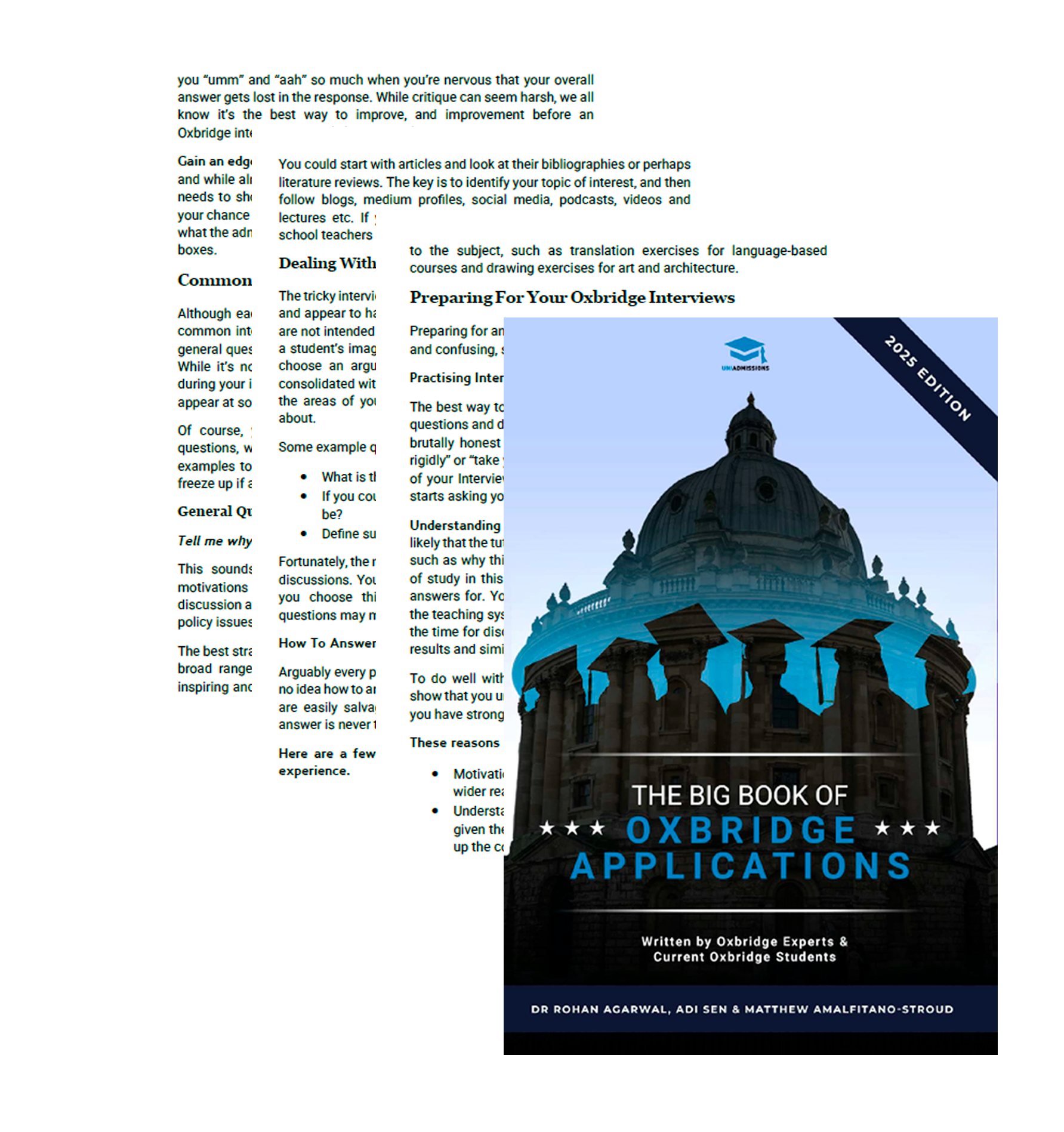
- Real examples of common and subject-specific interview questions
- Insight into what admissions tutors are really looking for
- Interviews with Oxbridge students and graduates
- Practical tips and strategies for practice
Example Cambridge And Oxford History Interview Questions
Here are six questions asked to a successful Cambridge History student, along with details of their experience answering them. These questions tackle a variety of subjects and question types, so try to recognise which categories they fall under:
Oxbridge History Interview Question 1
What have you been reading recently?
Student Response
While this seems like a simple question from the outset, it caught me off guard. I had been so busy preparing for the interview, the examination and my mock exams that I hadn’t actually been reading about my subject for pleasure. Even if this is the case for you, you need to have something on hand because they are trying to measure whether you are truly curious about learning or if you are simply applying for the brand name.
I didn’t have anything to hand, so I repurposed a news article I had seen the day prior to relate it to a historical moment as a means of contrast.I discussed the differences between the current approach to migrants and Ellis Island, how we had shifted what we mean by the term illegal, the changes in passports and borders.
Knowing this is a question that could come up, I would recommend reading something that genuinely interests you but has no relation to your course or your personal statement. Have something to hand that you can speak passionately about. They won’t be quizzing you on how many died at X battle, they want to know why X battle was a significant point, not only in history, but to you. The question isn’t simply what have you been reading, it is why have you read that.
Oxbridge History Interview Question 2
Should the Bible be seen as a historical artefact?
Student Response
You can answer yes or no to this question, but you have to be prepared to defend your decision. For me, it was a decisive yes. My position was that anything that was produced with a purpose in the past can be considered a historical artefact. This could change and be interpreted depending on your religious beliefs.
You could, for example, believe that the Bible is the word of God with no author bias, but be fascinated with how a physical book was bound. The artwork and the leather indicate who owned it, their wealth, and their significance. You can contrast how original oral stories have been changed and adjusted with each new translation, which reveals what important message a new producer wants to highlight; the King James Bible is an example of this.
I would struggle to answer no to this question because I think everything from the past can reveal something, even/especially a holy text.
If I were to answer it again, I think I would consider the Holy Wars waged in the name of the Bible, such as the Crusades. The call and response effect of the source material and the subsequent actions taken.
Oxbridge History Interview Question 3
Tell us about your local culture
Student Response
This is a weird-sounding, open-ended question to give you the chance to demonstrate the history you have noticed around you and how it has influenced you. I made a small mistake by giving the interviewer options.
Being from Durham, I said, “We have the miners, the castle, and the cathedral. What would you like to talk about?” knowing that the only one I felt comfortable enough to discuss was the cathedral. Luckily, my interviewer specialised in religious history and jumped at the chance to discuss the cathedral; I didn’t know this would be the case.
If you get a question like this, be decisive and just speak about the thing you want to speak about; if you give options, they could pick something you’d rather not speak about. You want to look knowledgeable and in control.
I gave a brief background to the cathedral, the saints that were buried there, and some of the stories I remembered from school trips, which prompted further, broader questions. This question is a way to start small and comfortably for you and then break into wider, historical debates.
Oxbridge History Interview Question 4
When do sites of Pilgrimage become Historical sites?
Student Response
This was the follow-up question to my local culture discussion. This is how they expand the conversation further than telling us what you can see.
I argued that they can work in tandem; it doesn’t have to be one or the other. To this day, Durham Cathedral operates as a site of pilgrimage because people believe they have a connection and continue to make the journey.
However, that religious element doesn’t negate the history. It is a burial site of two saints. It is architectural history dating back to the Normans. This is the kind of question where they want to see your thought process, how you defend something, and why.
Anyone can say yes or no, or say after one hundred years it is historical, they want to know why you think that, whether you think uniquely or whether you can defend a simpler answer well. I would answer the same way now because I always have quite gut instinct answers. If you’re the kind of person who deliberates, you can show that too by weighing it up out loud.
Oxbridge History Interview Question 5
Compare and Contrast two sources
Student Response
This is more so a common question type for history interviews, but one that you need to be prepared for.
In my second interview, I was shown a slideshow of 10-12 different paintings/artwork/posters from the 18th-19th centuries. I was able to pick any I liked, but it had a pair within the deck that I didn’t know that I would be contrasting with.
This period was not my area of expertise or interest, and I was really nervous that I wasn’t going to know anything. I picked one depicting aristocrats eating simply because I liked the colours. They ask what you can see, what you think is significant, and where your mind goes.
My picture revolved heavily around food, which was not my favourite thing about history. I believe I linked both to the class divide, the wasteful behaviour of aristocrats, how distasteful they appear to those from the lower classes and how this was shown in the artworks’ characterisation.
Essentially, it was a spot-the-difference where I related it to wider themes and attempted to navigate my way through something I hadn’t read about. I think the pictures change depending on college and throughout the years, but it’s a popular exercise because they like to see what you do with the unfamiliar.
Oxbridge History Interview Question 6
Please discuss the essay you submitted to us
Student Response
Finally, as part of the process, they have you submit two high-quality essays you completed for your classwork. They didn’t ask me about my personal statement at all, but they did spend a lot of time asking me about the essays I had written, why I made a certain point or took the position that I did.
They focused predominantly on an essay I had written about the Tudors and whether I thought Henry VIII was a good ruler or not. I summarised my discussion with the response “I think Henry VIII brought it all on himself”, which made them laugh and say I was a “personality historian”.
For my second essay on American presidents Nixon, Carter, and Ford, I forgot Ronald Reagan’s name in the middle of it and thought I had messed everything up. I hadn’t, as they knew I was nervous, and they just wanted to see how I responded.
I know others who have been asked about why they used a specific word or phrase in their essays. You defend your position and show your thinking. This question is generic because they take a different line of questioning depending on which essay you submitted.
Make sure when it comes to handing in your essays, you don’t just send in your highest scoring piece (especially if it’s high scoring but bland), make sure you send something that has your clear position within it.
These are just six examples of questions that might come up in a history interview at Oxbridge. Since history is such a broad subject, you’re unlikely to face these exact questions, but the purpose of these examples is to show how you can effectively approach any history-based interview question and deliver a thorough, insightful response.
At this stage, it’ll be difficult to feel fully confident with the concepts behind every potential question, so don’t be discouraged if you don’t grasp everything covered in these examples. All of these questions are based on concepts you should have learnt during your A-Levels, so everything you’re asked will be within reach at your level of knowledge.
Oxbridge History Interview Tips
To finish, here are some general tips to help you make the most of your Oxbridge interview and ensure you perform well.
Be Early
As with any important interview or appointment, you should aim to arrive 10 to 20 minutes early, depending on the type of interview. For remote interviews, make sure your computer is set up, your camera and microphone have been tested, and that you won’t be interrupted partway through. If your interview is in person, give yourself plenty of time to get to the college, as finding the right room can sometimes be tricky.
Remain Calm
You’ll often hear this advice in relation to interviews, and it holds true, though feeling nervous is perfectly normal and hard to eliminate entirely. Even so, it’s essential to stay calm and composed as you go into the interview, as this helps you maintain clear communication and thoughtful responses. Remember, it’s not only about answering questions correctly; a significant part of what they’re assessing is your personality and your motivation for studying there. These are the most important things to get across.
Think Out Loud
We’ve already touched on this, but it’s worth stressing how important it is to avoid long silences while you think. This can be tricky, since some of these questions demand a lot of thought, but try to get into the habit of simply describing what’s going through your mind (without resorting to filler that doesn’t actually add anything).
Even if you’re unsure how to answer a question, it’s essential to share your thought process and the knowledge you’re drawing on. If you can demonstrate that you’re considering the right elements as you respond, any mistakes you make along the way will matter far less.
Opinions Don’t Matter
This tip is crucial for a history interview, given how subjective the subject can be. However, when answering questions about your views on a topic, your feelings matter less than your ability to back up your reasoning with logic and facts, alongside your own interpretations of more subjective issues. Be honest in your answers, even if you think your viewpoint is less conventional.
Use Visuals
This can be important for history interviews, although it isn’t always the most visual subject. Writing and drawing out your thought process is a natural way for some applicants to respond to certain questions, so don’t be afraid to do so if you feel it will help. For example, drawing a timeline may help you keep track of key dates that you’re discussing during your answer.
That concludes our guide to the types of questions you may come across in history interviews at Oxford and Cambridge. This is only a starting point: the guide gives you a solid foundation of what to expect, but your next step should be to keep revising your subject while also beginning to prepare through mock interviews. Taking part in several mock interviews, ideally with someone you’re not close to, will help you refine your technique and ease your nerves ahead of the real thing.
Remember: don’t wait until your invitation arrives to begin preparing, as it takes more than a couple of weeks to reach a comfortable position for your interviews (and last-minute preparation is far from ideal)! While there’s plenty else to juggle in the months leading up to December, it’s important to balance everything well so you don’t leave any weak points that could cost you your place.
If you’re struggling to get started or feel your current preparation methods aren’t working, UniAdmissions has a consistent track record of improving applicants’ interview performance and, on average, places more students into Oxbridge than any other school. Our History Full-Blue Programme is dedicated to shaping our students into ideal Oxbridge applicants in time for their interviews, drawing on an expert curriculum built around our range of support methods.
Our students work with experienced history tutors in both one-to-one tutoring sessions and mock interviews, as well as having access to live sessions and an extensive library of resources, all featured within the one-of-a-kind UniAdmissions Portal. If you’re ready to perfect your interview technique, book a free consultation today to learn more about enrolment. Good luck!
Triple your chances of Oxbridge success with UniAdmissions
With our Oxbridge History Full-Blue Programme, you will have access to everything you need to perfect your interview technique and stand out from the competition. Our expert tutors are experienced in the Oxbridge interview processes and can provide insight into the process that can’t be found anywhere else.
Discover our Oxbridge History Full-Blue Programme by clicking the button below to learn how you can enrol and triple your chances of success.

