

Once you have submitted your UCAS Application and Personal Statement, the interview is the final major hurdle in the Oxbridge English application process. For many applicants it is also the most nerve wracking, usually because of the unknowns rather than the subject itself.
It is worth being precise about what you are applying to, because the two courses are named differently. At Oxford the degree is called English Language and Literature, and it places real weight on language, linguistics and the history of English alongside literary study. At Cambridge the degree is simply called English, and it leans more heavily towards literary criticism, critical theory and practical criticism. The interview style at both universities is broadly similar, but knowing the emphasis of your particular course helps you read the room.
Interviewers at Oxford and Cambridge use the interview to assess several things at once: how you read, how you think on your feet, your motivation for studying at Oxbridge, and your potential to thrive in a tutorial or supervision. The bank of possible questions is effectively limitless, but that does not mean you cannot prepare. In this guide we cover the facts you need, the categories of questions you are likely to face, and fully worked examples of what strong answers can look like. Let us begin.

Oxbridge Interview Format
Before we get into the questions, here are clear answers to the most common queries about how Oxbridge English interviews actually work. Our Oxford Interview Preparation Guide and Cambridge Interview Preparation Guide go into much greater depth, so treat this as a focused overview.
When Are Oxbridge English Interviews?
The main round of Oxbridge interviews takes place across the first three weeks of December each year. Exact dates vary by college and subject, so once you are shortlisted you should keep your December calendar as clear as you reasonably can.
When Are Interview Invitations Sent Out?
Interview invitations from the colleges usually arrive only one to three weeks before interviews begin. That short window leaves very little time for serious preparation, which is precisely why the best applicants start early rather than waiting for the email to land.
How Many Applicants Do Oxford and Cambridge Interview?
Both Oxbridge universities take different approaches to shortlisting. Oxford is generally far more selective, generally interviewing 50% of applicants depending on the course, although English and Literature had a far more generous interview rate of 67% for 2023-2025.. Cambridge is much more generous with its interview slots, with roughly 70% of applicants being invited each year.
Where Are Oxbridge Interviews Held?
Since 2020, the majority of Oxbridge interviews have taken place remotely, meaning you can attend from home or school via Microsoft Teams or Zoom (your invitation will specify which platform you’ll need).
Oxford has confirmed that all of its interviews will remain online for the foreseeable future. At Cambridge, however, a handful of colleges still hold in-person interviews, whether as a requirement or an alternative option. These are conducted on the college campus, and your invitation will include full instructions on where to go.
How Many Interviews Will I Attend?
At both Oxford and Cambridge, you can expect to attend at least two interviews in December. These interviews will typically be split into different themes spanning the subject.
Who Will Be Interviewing Me?
Your interviewers are typically the college admissions tutors and lecturers who teach English, often the very people who would go on to teach you in tutorials or supervisions. You will usually face two interviewers per panel, sometimes one leading the conversation while the other listens and takes notes.
What Format Are The Interviews?
All Oxbridge interviews are held in a traditional panel format. Basically, it will be a conversation between you and your interviewers, who will ask you questions and provide discussion prompts. They will typically follow up on your responses to keep the conversation going, so be prepared to discuss the same topic from different angles.
For in-person interviews, you may be asked to write or draw on paper, and all the materials you need will be provided. In remote interviews, you’ll use a digital whiteboard instead, which will be available in the virtual meeting room throughout your interview.
How Long Are The Interviews?
Oxbridge interviews will last 30 minutes in most cases. Interviewers don’t tend to give out extra time, so be sure to be concise when answering questions.
What Happens After My Interviews?
Once your final interview is over, all that remains is to wait for an offer or any further updates.
If your chosen college turns down your application, it may be picked up by another college, offering you a second route to admission. This happens more often at Cambridge, where the process is known as the Winter Pool. Some applicants placed in the pool will be asked to attend a further interview in January, while others are admitted without any additional interviews.
That covers all of the basic information regarding Oxbridge interviews that you’ll need for now. Now, let’s take a look at the types of questions you can expect to find.
Get your English offer with support from UniAdmissions
Our English Full-Blue Programme is the most effective way to prepare for your English interviews at Oxford and Cambridge. Discover our programme by clicking the button below to learn how you can enrol and quadruple your chances of success.
Common Oxford & Cambridge English Interview Questions
At a basic level, Oxbridge interview questions fall into six broad categories:
- Generic Questions
- Subject-Related Questions
- Academic Questions
- Reading-Related Questions
- Personal Statement Questions
- Thinking Questions
Each category serves a distinct purpose for the admissions tutors, though in practice the boundaries blur and a single question can do several jobs at once.
Generic Questions
These are the kinds of questions you would expect in any interview. While they are easy to anticipate, they still require thoughtful answers that reflect genuine motivation rather than rehearsed lines. Typical examples include:
- Why English?
- Why Oxford/Cambridge?
- Why this college?
Prepare for these, but do not script them word for word, because memorised answers tend to sound hollow. If you talk about your personal motivation, make sure it connects to what the course actually offers. Remembering that Oxford teaches English Language and Literature while Cambridge teaches English can help you tailor a convincing answer.
Subject-related Questions
For a humanities subject like English, questions about the discipline itself are extremely common. This is the category most applicants picture when they imagine the interview, and it is where the unseen poem or prose extract usually appears. Interviewers do not expect you to know everything about a period, author or genre. They want to see how you read closely, how you build an argument from evidence in the text, and how you respond when they push back.
The key here is to think out loud. Because you will not have prepared a specific answer, your reasoning process is the thing being assessed, not a polished final verdict. We look at worked examples of these below.
Academic Questions
This category is less common in English than in some sciences, but it can appear, particularly at Oxford where the language and linguistics element of the course gives interviewers scope to probe how English works as a system. You might be asked about grammar, etymology, or how meaning is produced, rather than about a particular text.
Reading-Related Questions
These questions relate to any wider reading / super curriculars you have done or referenced in your Personal Statement. They are relatively approachable: you talk about what you have read, what you made of it, and any ideas that stayed with you. They matter because Oxbridge prizes intellectual independence, and reading beyond the syllabus is the clearest evidence of it.
- Tell me about something you have read recently.
- What did you think about X?
These are not limited to novels. Poetry collections, plays, essays, criticism, articles and even a well chosen piece of long form journalism are all fair game if you can talk about them thoughtfully.
Personal Statement Questions
The premise is straightforward: the tutor wants to discuss something from your Personal Statement. These are less frequent than many applicants fear, because Oxbridge tutors often prefer to test your thinking in fresh contexts rather than rehearse what you have already written. When a statement is referenced, it is usually a springboard: expect a follow up that turns your claim into a subject related discussion, so be ready to defend and develop anything you chose to include.
Thinking Questions
Sometimes referred to as the “weird” questions, these can seem abstract or oddly disconnected from the course. What they are really doing is testing how you reason under pressure. You may have heard the odd horror story about a strange opening gambit, but a question that baffles you at first is usually just a logical problem with an unfamiliar surface. Stay calm, break it down, and reason your way through it aloud. Several of the example questions below sit in exactly this territory.
Now that we’ve got to grips with the question types favoured at Oxbridge interviews, it’s time to turn to some worked examples of history interview questions.
Crack the Oxbridge Interview with The Big Book of Oxbridge Applications
Wherever you are in your Oxbridge journey—just getting started or looking to sharpen your approach—The Big Book of Oxbridge Applications is your essential companion. The dedicated interview chapter takes the mystery out of the process, helping you walk into your interview with clarity and confidence.
Don’t leave your preparation to chance. Get a head start with this free, expertly written guide. Inside, you’ll find:
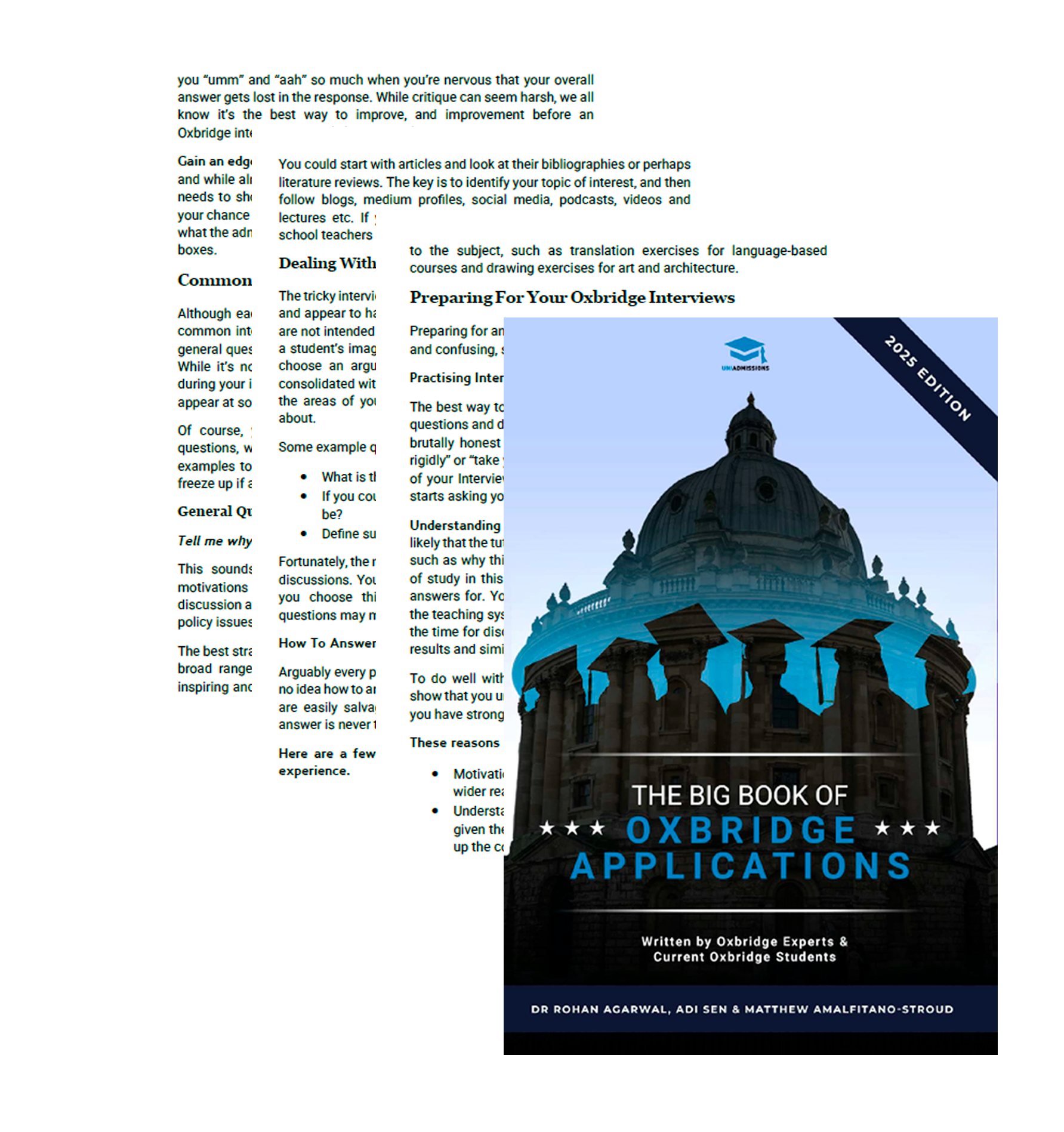
- Real examples of common and subject-specific interview questions
- Insight into what admissions tutors are really looking for
- Interviews with Oxbridge students and graduates
- Practical tips and strategies for practice
Example Cambridge and Oxford English Interview Questions
Below are six English questions with model answers, followed by an expert tutor’s tip for each. Read the answers as illustrations of how to structure and reason, not as scripts to memorise. In an English interview the shape of your thinking matters far more than landing on the “right” verdict.
Oxbridge English Interview Question 1
What is more important: form or content?
Model Answer
“Neither: form and content are inextricably linked, and neither one takes precedence. The reader’s interpretation of the content of a work, say a sonnet, is inevitably impacted by its form, while the impact of the form of a piece of literature is dependent on its content. In other words, form only works because of content, and vice versa.”
Our Expert Tutor's Tip:
Do not be afraid to reshape the question. You are welcome to approach it from a different angle and even disagree with your interviewers, as long as you can back this up with solid reasons.
Oxbridge English Interview Question 2
What criteria would you use to categorise a work as “canonical”?
Model Answer
“There are various ways to define the canon, but this is the approach I would take. Firstly, if it is of foundational value: if the work uses an innovative new form or an unprecedented approach to language. Secondly, its widespread renown: canonical works tend to be well known and widely read. Thirdly, its influence over time: for a work to be part of the canon, it is usually appreciated and drawn on over an extended period of time.”
Our Expert Tutor's Tip:
Ask your interviewers if you do not know what a specific word, such as canonical, means. You are far better off asking for clarification than guessing wrongly.
Oxbridge English Interview Question 3
What is your favourite book?
Model Answer
“My favourite book is John le Carré’s “Absolute Friends”, for three main reasons. Firstly, because I first read it during a family holiday to the South of France and, whenever I re-read it, I’m instantly transported to that time. Secondly, because I love how le Carré creates such vivid, interesting characters, from sinewy Sasha to devoted Mundy, that really jump off the page. Lastly, because the plot is full of unexpected twists and turns that keep you hooked to the very last page, even if you’ve read it before.”
Our Expert Tutor's Tip:
There is no correct answer to this question, and you do not need to impress your interviewers by name dropping high brow literature. They are looking to see whether you can structure your answer, and numbering the parts as here can help, and whether your answer reflects a genuine passion for the subject.
Oxbridge English Interview Question 4
In the age of AI, is human written literature going to die out?
Model Answer
“No. From the invention of the printing press to the rise of visual media, literature has survived all kinds of technological innovations that had been predicted to replace it. That said, literature isn’t just about the stories themselves; it can also function as a commentary on the goings-on of the time. So, I don’t expect AI to replace human-created literature, but I do expect literature to talk about AI more frequently.”
Our Expert Tutor's Tip:
Either “no” or “yes” are viable answers here. The most important thing is how you back up your assertion with evidence.
Oxbridge English Interview Question 5
Do you need to know an author’s biography in order to understand their work?
Model Answer
“It depends. Sometimes knowledge of an author’s life experiences can help shed light on their writings: for instance, Sylvia Plath’s psychological anguish clearly informed her despair-laden work. However, it’s not necessarily possible, or advisable, to link an author’s work to their past, as you run the risk of over-interpretation. J.K. Rowling’s Harry Potter series, for example, is obviously not based on real-life interactions with the wizarding world.”
Our Expert Tutor's Tip:
It is fine to hedge your bets. “Sometimes” or “it depends” are perfectly valid responses, as long as you show clear arguments in each direction.
Oxbridge English Interview Question 6
What is literature? Are scientific reports, for example, literature?
Model Answer
“At its broadest definition, literature includes any written work, which would mean that scientific reports could be classed as literature. However, we tend to associate the term ‘literature’ with creative works, like novels and poems. That said, literature isn’t synonymous with fiction: factual works like travel writing are also literature.”
Our Expert Tutor's Tip:
With a sweeping question like this, the interviewers are checking whether you can marshal your thoughts rather than drift off on a tangent. It is fine to take a moment before answering so you can give a clear, concise response.
A word from our expert tutor, Jenni
University of Cambridge, Peterhouse, English
“For English, your interviewers are more interested in how you reflect on and express your reading than in what you have read per se. Obviously, the more works you have read and been exposed to, the more material you have to draw on to illustrate your answers, but there is no need to stress if you have not got through the complete works of Shakespeare by your interview.”
These are only six examples of the questions that might come up in an English interview at Oxford or Cambridge. Because every text and every conversation is different, you cannot revise a fixed set of answers. What you can do is practise reading closely, arguing from evidence, and thinking aloud under gentle pressure.
At this stage it is normal not to feel fully confident with every concept behind every possible question. That confidence is built through practice, not memorisation.
Oxbridge English Interview Tips
To finish, here are general tips to help you make the most of your Oxbridge English interview and give the best possible account of yourself.
Be Early
As with any important appointment, aim to be ready 10 to 20 minutes early, whether that means logging into the video call in good time or arriving at the college. For online interviews, test your camera, microphone and connection well beforehand so a technical glitch does not eat into your 30 minutes.
Remain Calm
You will hear this advice constantly, and it holds true, though feeling nervous is entirely natural and interviewers expect it. A few slow breaths before you begin, and permission to pause and think, will do more for you than trying to appear unshakeable.
Think Out Loud
This matters enormously in English, where the interview is essentially a live demonstration of how you interpret texts. Avoid long silences. Even when you are unsure, share the thought process and the possibilities you are weighing, because your reasoning is the thing being assessed. A tentative idea explained clearly beats a confident silence every time.
There Is No "Correct" Reading
English is interpretive by nature, so interviewers are not hunting for the single right answer. When you offer a reading of a poem or passage, ground it in specific evidence from the text: a word choice, an image, a shift in rhythm or tone. A defensible interpretation supported by close reading is exactly what they want, even if it differs from their own view.
Use the Text
When you are given an unseen poem or extract, annotate it and refer back to it constantly. Point to the exact lines that prompt your claims rather than speaking in generalities. Treating the text as the anchor for everything you say keeps your answers precise and shows the close reading skills the course is built on.
When you are given an unseen poem or extract, annotate it and refer back to it constantly. Point to the exact lines that prompt your claims rather than speaking in generalities. Treating the text as the anchor for everything you say keeps your answers precise and shows the close reading skills the course is built on.
That concludes our guide to the questions you may meet in English interviews at Oxford and Cambridge. Remember not to wait until your invitation arrives to begin preparing, because it takes far more than a couple of weeks to build genuine confidence, and last minute preparation is far from ideal.
If you are looking for structured support, UniAdmissions works with students through both one-to-one tutoring sessions and mock interviews with experienced Oxbridge tutors, all available within the UniAdmissions Portal. You can book a free consultation today to find out more about enrolment.
Triple your chances of Oxbridge success with UniAdmissions
With our Oxbridge English Full-Blue Programme, you will have access to everything you need to perform at your best in your English interviews at Oxford and Cambridge. Discover our programme by clicking the button below to learn how you can enrol and triple your chances of success.
FAQs
No. Oxford's degree is English Language and Literature and gives real weight to language, linguistics and the history of English, while Cambridge's degree is called English and leans more towards literary criticism and critical theory. The interview styles are similar, but knowing your course's emphasis helps you prepare.
Very often, yes. A short unseen poem or prose extract is a hallmark of Oxbridge English interviews. You may get a few minutes to read and annotate it, then discuss it. Practise close reading of unfamiliar texts so this feels routine rather than alarming.
There is no set reading list, and breadth matters less than depth. Interviewers care more about how thoughtfully you engage with what you have read than about the length of your list. A handful of works you can discuss with genuine insight is worth more than a long list you have skimmed.
Yes, provided you support your position with evidence and clear reasoning. Interviewers frequently push back to test how you defend and develop an argument, so a well justified disagreement can work in your favour.

