The Oxford Physics application process is really difficult, as you have to worry about your UCAS Application, Personal Statement and ESAT. However, after all this, there’s another step to be prepared for, the interviews.
Being prepared for your interviews is important because they are one of the biggest deciding factors as to who gets a place on the course. Success rates are low for Oxford Physics (11.4% at Oxford), so you’ll need to be within the top 10% of applicants to stand a chance.
The point of the Oxford interview process, isn’t just to ensure that you’re academically capable of completing this course, it’s for admissions tutors to learn more about you and how you would fit in. They focus on your motivations, academic abilities, and overall approach to education and problem-solving, which means you’ll need to be prepared for questions related to all of these factors. In this guide, we’ll explore the types of questions typically used to assess these areas and provide strategies for addressing them effectively.
Oxford Interview Format
If you aren’t already aware of how Oxford interviews work, here are some commonly asked questions that cover the essential information for attending your interviews. You can more information about them in our Oxford Interview Guide.
When Are Oxford Physics Interviews?
Interviews take in the first three weeks of December at each university. A timetable is made available that shows when different courses hold interviews, but the information provided in your invitation (dates and times) will be more important to follow. Dates and times cannot be unadjusted, so you’ll need to be free for these appointments.
When Are Interview Invitations Sent Out?
Colleges will send their invitations around one to three weeks prior to your interview date, so this doesn’t give you much time to prepare. While an interview is never guaranteed, it’s still important to begin your preparation at least a month before your invitation is due, as you don’t want to be caught unprepared if you are invited.
How Many Applicants Does Oxford Interview?
Oxford is particularly selective in its shortlisting process, typically inviting only 20% – 30% of applicants for interviews, with Physics specifically having a 31% interview rate between 2023 and 2025.
Where Are Oxford Interviews Held?
As a response to the pandemic in 2020, all Oxford interviews were changed to be remote, and the majority have remained this way since. This enables applicants to attend from home or school via Microsoft Teams or Zoom (the specific platform will be detailed in your invitation).
While Oxford has confirmed that all interviews will remain online for the foreseeable future, though this may change in future years.
How Many Interviews Will I Attend?
Typically, an Oxford applicant will attend at least two interviews during the December period. These interviews will typically be held with different admissions tutors, and some may focus on different areas of Physics.
Who Will Be Interviewing Me?
Your interviewers are typically admissions tutors and lecturers from the college you applied to, specialising in your subject areas. Each interview usually involves two interviewers, but it’s rare to encounter the same one more than once.
What Format Are The Interviews?
Oxford interviews follow a traditional panel format similar to a standard job interview. Here, you’ll have a back-and-forth conversation with your interviewers, answering their questions and working through Physics-related problems, which may involve analysing reference images or data.
In remote interviews, you’ll get to use a digital whiteboard available in the virtual meeting room. Try to get some practice using systems like this beforehand so you can work through question faster and more neatly.
How Long Are The Interviews?
Your interviews will last around 20 – 30 minutes each. There won’t be any extra time granted, so you’ll need to ensure you make the most of the time you have available.
What Happens After My Interviews?
After your final interview, the application process is essentially complete, and there’s nothing more to do but wait for your offer or further communication.
If your chosen college rejects your application, another college may review it, though this is less common at Oxford than it is at Cambridge.
That covers the basics of Oxford interviews, although there are still plenty of finer details and elements that may be unique to your college or subject. For now, though, let’s focus on the kinds of questions you may encounter.
Triple your chances of getting your place in Oxford Physics with UniAdmissions
Preparing for your Oxford interview is tough, but working with UniAdmissions will make the process far easier and more effective. Through one-to-one tuition and mock interviews with an Engineering expert, combined with live courses and extensive resources, you will be able to craft the perfect interview strategy and boost your performance.
Discover our Oxford Physics Full-Blue Programme by clicking the button below to learn how you can enrol and triple your chances of success.
Common Oxford Physics Interview Questions
Although there are no official categories for the types of questions you might encounter in your interviews, most questions can generally be grouped into six broad themes or types:
- Generic Questions
- Subject-Related Questions
- Academic Questions
- Reading-Related Questions
- Personal Statement Questions
- Thinking Questions
Although all of these question types are useful to admissions tutors, Physics interviews tend to prioritise certain types over others. Let’s break down each category to help you understand what to expect.
Generic Questions
Firstly, we have the kinds of questions you’d anticipate in a standard interview. While these questions are easy to anticipate, they can be difficult to answer effectively if you’re not prepared. Typically, they focus on your motivations and delve into why you’re attending the interview. Examples include:
- Why Physics?
- Why Oxford?
- Why our college?
When responding to a question like this, it’s important to stay genuine and honest instead of simply trying to guess what the interviewer wants to hear. Providing generic motivations won’t help you stand out or convey enthusiasm for studying at Oxford, so trust your instincts, even if you’re unsure whether your reasoning is compelling enough.
Subject-related Questions
For STEM subjects like Physics, questions related to the field are very common. These questions are often more general, with the interviewer asking about your understanding of a concept or your opinion on a specific issue, although can verge outside of this style (though these will tend to fit in other categories better).
In such cases, they do not expect you to have a thorough understanding of every concept and recognise that some applicants may be less familiar with certain topics. The tutors are interested in seeing how you apply your existing knowledge to discuss a topic or creatively solve a problem, even if you don’t have all the information at hand.
The key to approaching these questions is to articulate your thoughts as you work through them. Since you won’t have a pre-prepared answer, it’s crucial to take the time to consider the question carefully. A brief pause is acceptable, but the main goal is to understand your problem-solving approach. Sharing your thought process in real-time is the best way to showcase this.
Academic Questions
This is also an incredibly common type of question you’ll face during your interviews, as Physics interviewers are particularly keen on assessing your ability to solve problems relating to Maths and Physics. Essentially, the interviewer will present you with a problem to solve that is similar (though not identical) to what you might encounter in an exam setting.
Depending on your grasp of the topic, these questions can be relatively straightforward to answer. However, keep in mind that the interviews are not solely focused on finding the correct answer; you must also articulate your thought process while you work through the problem, as this is of greater value to the interviewers. You will be given paper or a digital whiteboard (depending on the interview format), so make sure to visualise your steps as you progress.
Sometimes, these questions can take a more interesting form (which we’ll cover soon), but the principle is generally the same. We will delve deeper into these questions in the next section too, as there are various strategies for approaching them.
Reading-Related Questions
You should be engaging in wider reading related to Physics during your application process, as interviewers may ask about the materials you’ve explored and your perspectives on them. They might also inquire about recent news stories or developments in the field of computing, so it’s important to stay updated on industry trends and significant events.
Possible questions in this category include:
- Tell me about something you’ve read recently.
- What do you think about X?
Bear in mind, wider reading doesn’t just mean books, so feel free to mention any articles, papers, news stories, or documentaries you’ve recently come across if they are relevant.
Personal Statement Questions
These questions are pretty simple; the interviews may ask about your Personal Statement. However, they tend to be less frequent since Oxford admissions tutors usually prioritise evaluating your relevant skills over your Personal Statement.
If an interviewer does want to talk about your statement, they will probably want some more details about a work experience placement you mentioned or a super-curricular activity you participated in. These questions are straightforward to address; just offer more context about what you wrote and respond honestly.
Thinking Questions
These are often called “weird” questions of your interview because they can appear abstract and disconnected from the subject matter. However, their purpose is to assess your general thinking abilities, including critical thinking and problem-solving in unusual scenarios. While they aren’t intended to surprise you, they might lead you to pause and think for a moment (just be mindful not to stay silent for too long).
In Physics interviews specifically, you could also consider some of the questions from previous categories as a part of this one. We’ll explore some questions like this later, but you may sometimes be asked a question that seems strange at first. However, as you think about it, you’ll realise there is a very clear purpose behind it, typically to test your scientific understanding.
Now that we understand the types of questions typically asked in Oxford interviews, let’s examine some example Physics interview questions.
Crack the Oxbridge Interview with The Big Book of Oxbridge Applications
Wherever you are in your Oxbridge journey—just getting started or looking to sharpen your approach—The Big Book of Oxbridge Applications is your essential companion. The dedicated interview chapter takes the mystery out of the process, helping you walk into your interview with clarity and confidence.
Don’t leave your preparation to chance. Get a head start with this free, expertly written guide. Inside, you’ll find:
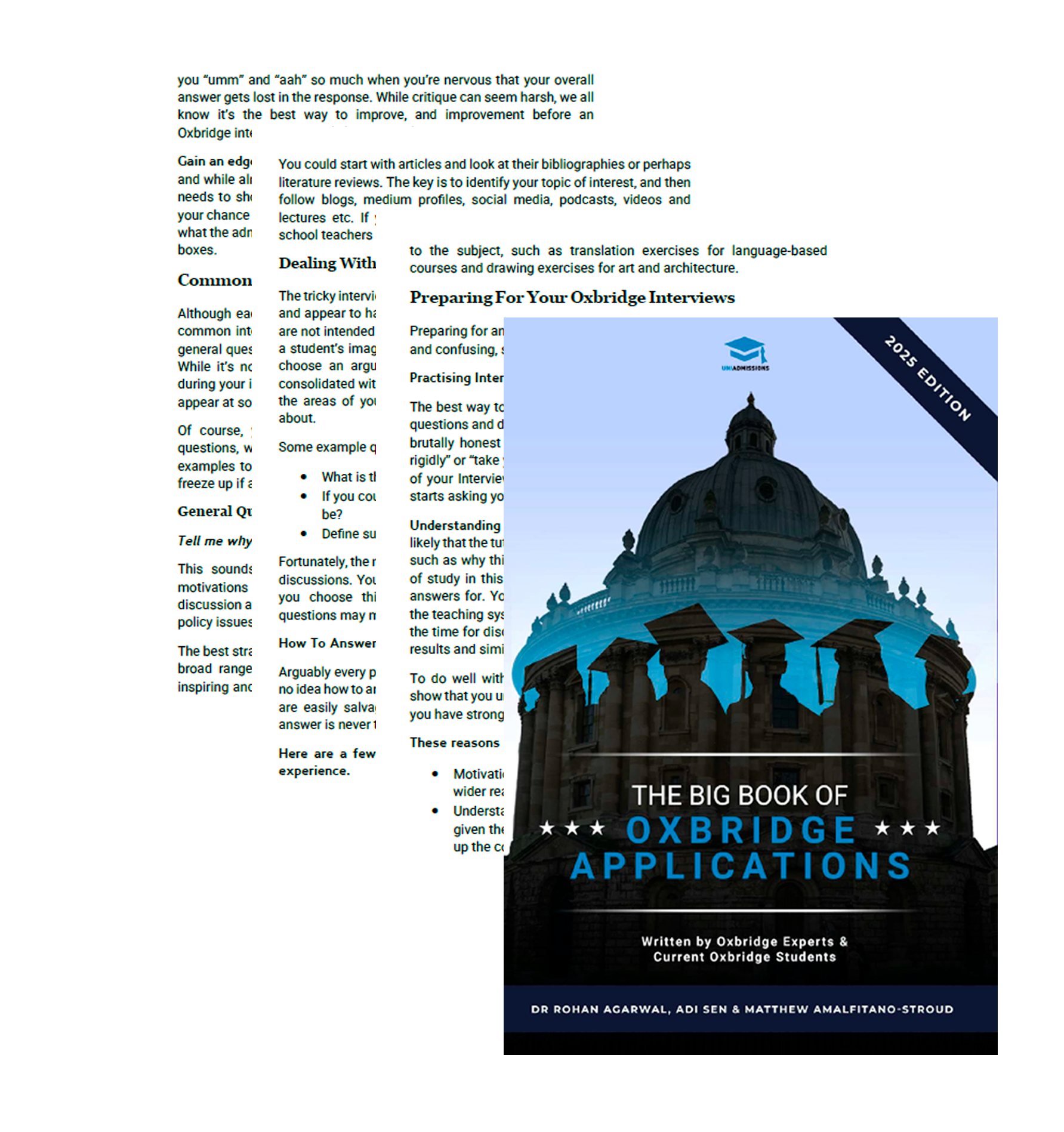
- Real examples of common and subject-specific interview questions
- Insight into what admissions tutors are really looking for
- Interviews with Oxbridge students and graduates
- Practical tips and strategies for practice
Example Oxford Physics Interview Questions
Let’s look at a selection of questions that could be seen at an Oxford Physics interview. These questions are all very specific and focus on subject-relevant problems, so don’t expect to see these exact questions in your interviews. However, look at the answers provided for each of these to help you in your preparation and consider how you would answer a question like it in your interviews.
Oxford Physics Interview Question 1
An ice cube floats in a glass of water. When the ice melts completely, what happens to the water level?
How to Answer
As you’ll see from most of these example questions, a lot of your interviews will revolve around explaining your understanding of Physics in a variety of contexts. Whether it’s something practical like this example or something more theoretical, Oxford tutors are looking for applicants who are confident in their knowledge and able to articulate what they know.
Model Answer
The water level stays the same. The quickest method uses Archimedes’ principle. The ice cube displaces a volume of water equal to the weight of the ice. When the ice melts, it turns into water of exactly the same mass as the original ice. Since the melted water has the same mass and density as the displaced water, it occupies the same volume. Therefore, the water level does not change. The candidate can also note that this holds for pure water and ice; salt water would give a different result.
For this particular question, the response’s greatest strength is that it reaches immediately for the right tool. An Oxford interviewer isn’t only checking whether a candidate reaches the correct conclusion; they’re watching how the candidate navigates to it. By naming Archimedes’ principle at the outset and calling it “the quickest method,” the candidate signals they recognise the efficient route rather than groping toward it.
The reasoning that follows is a clean, unbroken chain that crucially keeps mass and volume distinct – the very point where most candidates stumble. The floating ice displaces a volume of water whose weight equals the weight of the ice; melting conserves mass. Because the melted water shares the density of the surrounding water, that conserved mass occupies precisely the volume the submerged ice had displaced. The melted water fills the hole exactly, so the level is unchanged.
What elevates the answer from correct to genuinely impressive is the closing caveat about salt water. A weaker candidate stops the moment they have an answer; this one instead probes the boundary of their own result, spotting the hidden assumption of equal densities and recognising that relaxing it changes the outcome. That instinct to ask “under what conditions does my answer hold, and what would break it?” is precisely the intellectual habit Oxford tutors are trying to detect, so this response shows the candidate understands the physics, not merely the answer to this question.
Finally, it also sets up the natural follow-up beautifully: fresh meltwater is less dense than the salt water it joins, so it occupies a slightly larger volume than the salt water originally displaced, and the level rises. This can be a great use of your limited interview time, as it keeps the discussion on a topic you are confident in rather than moving to another question that may be more challenging.
Oxford Physics Interview Question 2
Why does hot air rise?
How to Answer
This question is similar to the last, providing a real world phenomenon that should be easy to understand. As such, the question could be approached in a similar way.
Model Answer
Hot air rises because it is less dense than the surrounding cooler air. Using the ideal gas equation (PV = nRT), for a fixed pressure, an increase in temperature causes the volume to increase. If the volume increases but the mass stays the same, the density (mass/volume) decreases. The cooler, denser air around it sinks, forcing the warmer, less dense air upward, natural convection.
This response doesn’t explore as many avenues of thought as the previous one, instead remaining focussed on the main point. However, the answer is strong because it doesn’t stop at the intuitive statement that hot air is “lighter”. Instead, it grounds buoyancy in the equation of state.
By invoking PV = nRT and explicitly fixing the pressure, the candidate isolates the right variable: at constant pressure, raising the temperature increases the volume, and since the mass of the parcel is unchanged, the density (mass/volume) must fall. This is exactly the move an Oxford interviewer wants to see – not reciting a memorised fact but deriving why the fact holds from first principles.
There are plenty of other good details in this response, but the main takeaway is that it’s concise but complete in it’s explanation.
Oxford Physics Interview Question 3
The acceleration due to gravity, g, is not the same everywhere on Earth. Explain why.
How to Answer
Model Answer
First, the Earth is not a perfect sphere – it is an oblate spheroid, flattened at the poles and bulging at the equator. The equator is further from the centre than the poles, so gravitational force (g = GM/r²) is slightly weaker at the equator. Second, the Earth rotates. At the equator, the centrifugal force due to rotation partially counteracts gravity, further reducing the effective g. At the poles, there is no such effect. The candidate can also note local variations due to differences in rock density (gravity anomalies).
The thought process behind this response is similar to the previous two questions, but choosing to tackle two unique points shows that the candidate is able to trim down explanations of complex concepts into just a sentence or two. Being concise is one of the most important things you can learn and prepare for before an Oxford interview.
Oxford Physics Interview Question 4
Estimate the number of electrons transferred when you rub a balloon on your hair.
How to Answer
This question is different from the ones we’ve seen so far, as the interviewer is asking for an estimate rather than a factual explanation. Therefore, the candidate needs to reconsider how they approach their response:
Model Answer
I would say there are approximately 10¹⁰ to 10¹¹ electrons.
After rubbing, the balloon can pick up small pieces of paper or stick to a wall. This requires electrostatic attraction, which needs a significant charge. A charged balloon can lift a small piece of paper weighing roughly 0.01 g (10 mg). The force needed to overcome gravity is F = mg ≈ 10⁻⁴ N.
Using Coulomb’s law, we can assume the charged balloon and the induced opposite charge on the wall are separated by about 1 cm (10⁻² m). Coulomb’s law gives F = k·q²/r², assuming equal charges. With k ≈ 9×10⁹ Nm²/C², we get q ≈ √(10⁻⁴ × 10⁻⁴ / 9×10⁹) = √(10⁻⁸ / 9×10⁹) = √(1.1×10⁻¹⁸) ≈ 1×10⁻⁹ C.
Each electron has charge 1.6×10⁻¹⁹ C. The number of electrons is q / e ≈ 10⁻⁹ / 1.6×10⁻¹⁹ ≈ 6×10⁹, or around 10¹⁰ electrons.
Of course, a question like this will require you to use the digital white that should be available to you, so ensure that you are well practiced in the software before the start of your interviews.
This method uses Coulomb’s law and a rough estimate of force, which is much more accessible to a candidate. The candidate could also note that this is a rough order‑of‑magnitude estimate, and the actual number could be slightly higher or lower depending on the conditions of rubbing and the environment.
Oxford Physics Interview Question 5
Electricity is transmitted over long distances using overhead cables. Should the voltage be high or low, and the current high or low? Explain why.
How to Answer
As physics is such a broad subject, applicants should be prepared for questions on any of the core principles within it.
Model Answer
Voltage should be high and current should be low. Power loss in a cable is given by P_loss = I²R, where I is the current and R is the resistance of the cable. To minimise heat (power) loss, the current must be as low as possible.
For the same transmitted power (P = VI), a lower current requires a higher voltage. Therefore, high voltage and low current are used for efficient transmission.
The candidate should also mention that transformers are used to step up voltage for transmission and step it down for domestic use.
Oxford Physics Interview Question 6
Imagine you are explaining physics to someone who knows nothing about it. Choose one everyday phenomenon and use it to explain what physics is and why it matters.
How to Answer
This last question is less about subject knowledge and more about communication and collaborative skills, both of which are essential for succeeding at Oxford. This also isn’t a question that is exclusive to physics, as this type of question could be used in any STEM subject (its particularly common for medicine).
Model Answer
I would use the example of a bicycle moving and stopping.
Physics is about understanding why things happen the way they do. When you pedal a bike, you apply a force that accelerates you forward – that’s Newton’s second law (force causes acceleration). When you brake, friction between the brake pads and the wheel rim converts kinetic energy into heat, slowing you down – that’s energy conservation and friction.
If you go over a bump, your body wants to keep moving upward while the bike stops – that’s inertia (Newton’s first law). Physics explains not just how the bike works, but how everything moves, stops, and interacts – from a ball rolling to a rocket flying to space. It turns the world from a set of random events into a system of predictable, understandable rules.
This answer succeeds because it anchors everything in a single, universally familiar object rather than reaching for something exotic. The bicycle is an ideal choice because one ordinary activity contains three distinct principles, and the candidate links each to a concrete sensation the listener has felt: pedalling and accelerating (Newton’s second law), braking and feeling the warmth of converted energy (friction and energy conservation), and being jolted off the seat over a bump (inertia, Newton’s first law).
An interviewer sees a candidate who can move fluently between everyday experience and the formal principle underneath it, which is exactly the skill that distinguishes someone who understands physics from someone who has merely memorised it.
The closing is what lifts the answer from a competent list to a genuine articulation of what physics is. Rather than stopping at the bike, the candidate widens the lens – “from a ball rolling to a rocket flying to space” – to make the point that the same handful of rules govern wildly different scales, and then lands on the central idea: physics “turns the world from a set of random events into a system of predictable, understandable rules.” That captures the discipline’s real claim to significance, which is exactly what the question asks for.
If someone wanted to probe further, the bump example is the loosest of the three and invites a follow-up, pressing the candidate to state precisely what keeps moving and in which direction would test whether their grasp of inertia is as secure as their phrasing suggests.
These are just a few examples of questions that could come up in your interviews. Since Physics is such a vast subject, the likelihood of encountering these specific questions is low, but the purpose of these examples is to illustrate how you can effectively tackle any physics-based interview question to provide a thorough and insightful response.
In these interviews, admissions tutors are looking to stretch your abilities as far as they can go, so don’t be discouraged if you’re less confident in the topics covered in these examples. All of the questions in your interview will be based upon concepts that you should have learnt during your A-Levels, so everything you’re asked will be achievable at your level of knowledge, provided you prepare effectively and give yourself time to work through the question carefully.
Oxford Physics Interview Tips
The last thing to cover in this guide is some general tips to help you with your interview on the day.
Be Early
You would aim to be a bit early at most important appointments you have in life, so be sure to give yourself extra time before your Oxford interview to ensure you’re available to start on time.
For remote interviews, make sure your computer is set up correctly and that your camera and microphone are functioning properly. Additionally, confirm that you won’t be interrupted during the interview, as any disruptions could disrupt the flow. If your interview is in person, allow yourself ample time to reach the college, as navigating the campus can be challenging if you haven’t been there before.
Remain Calm
You’ll hear this from everyone offering advice, but it’s important to remember. Interviews can be stressful, and it’s perfectly normal to feel that pressure. However, as an Oxford applicant, you must learn to manage your nerves and demonstrate that you have what it takes to thrive as an Oxford student.
Interviewers understand that applicants are likely to be nervous, but their demeanour can vary—some may be warm and reassuring, while others might be more stern and unsympathetic. Regardless of their approach, it’s up to you to assert yourself and show that you deserve an offer.
Think Out Loud
We’ve already highlighted this, but it’s extremely important. The primary purpose of the interview is for the college to assess how you function as an academic. Keeping your thoughts to yourself and leaving the interviewers in silence for extended periods is likely to lead to failure.
When thinking aloud, your comments don’t need to be brilliant or even accurate; the goal is to articulate your thought process, which might include some errors in your methodology. As long as you approach the problem logically and reasonably, you’ll be providing the interviewers with exactly what they’re looking for.
Opinions Don’t Matter
Subjective questions that require you to express your opinion are less common in Physics interviews but don’t hesitate to defend your opinions when appropriate. When expressing your thoughts on a topic, the emphasis should be on supporting your reasoning with logic and facts, rather than on your personal feelings, especially when dealing with more subjective issues. Thus, it’s better to be honest and articulate the reasoning you genuinely hold, rather than altering your beliefs to justify something you don’t truly believe.
Use Visuals
This is essential for a Physics interview and something you should practice regularly. Physics can be a very visual subject, so many components found in equations and diagrams cannot be conveyed effectively through words alone. To thoroughly explain your thought process, writing and drawing while you work is the best way to showcase your understanding to the admissions tutors.
As you prepare for your interviews, concentrate on the speed of your work while ensuring everything is still legible. It doesn’t need to be flawless, as you can also explain things verbally, but it’s good practice to keep your drawings and written explanations neat and clear.
That ends our guide to Physics interview questions at Oxford. While everything we’ve discussed provides a solid foundation, it’s just the starting point for your research and preparation. Your next steps should be to continue to revise the necessary subject knowledge for Physics and begin to practice through mock interviews. Participating in multiple mock interviews, preferably with someone unfamiliar to you, will help enhance your technique and reduce any nerves leading up to the actual interview.
Remember to begin your preparation well before receiving your invitation – waiting until three weeks or less before the interview will place you at a significant disadvantage compared to other candidates (plus last-minute preparation can be much more stressful). Although there are many tasks to manage in the months leading up to December, it’s essential to effectively balance your time and ensure every aspect of your application (including your schoolwork) is strong enough to compete with the top 10% of Oxford applicants.
If you’re struggling to kick off your preparation or feel that your current methods aren’t effective, UniAdmissions has a proven history of improving interview performance and helping more students gain admission to Oxbridge than any other program on average. Our Oxford Physics Full-Blue Programme is tailored to assist students with their entire application, including interviews. With over a decade of experience helping 1,214 students gain admission to Oxford and Cambridge, our programmes are proven to work!
Our students have complete access to comprehensive one-on-one tutoring with experienced tutors, mock interviews, live sessions, access to an extensive resource library, and much more—all available within the exclusive and easy-to-use UniAdmissions Portal. If you’re ready to get your place at Oxbridge, book a free consultation today to learn more about enrolment. Good luck with your interviews!
Worried about your interviews? UniAdmissions is here to help
With our Oxford Physics Full-Blue Programme, you’ll have access to everything you need to succeed in not just your interviews, but your entire applicaiton. With personalised tuition sessions, mock interviews, live courses, and a wealth of resources, you’ll cultivate essential skills for Oxford applicants and make a strong impression on your admissions tutors.
Discover our Oxford Physics Full-Blue Programme by clicking the button below to learn how you can enrol and triple your chances of success.