

Once you’ve finished your UCAS Application and Personal Statement, your interviews are the last major step of the Oxbridge Modern Languages application process. Many will find that this is the hardest part of the process, whether it’s due to nerves, communication issues or not knowing what to expect.
The Oxbridge Modern Languages interview is not simply a chance to show what you know; it is a structured conversation designed to reveal how you think, how you engage with ideas, how you approach unfamiliar territory, general skills, and your motivation for studying at Oxbridge. The pool of potential questions is near limitless, but that doesn’t mean you can’t be prepared.
In this guide, we cover everything you need to know, from the format of the interviews themselves to the types of questions you are likely to face, along with six example questions and model answers from successful applicants. Whether you are applying to Oxford’s Modern Languages course or Cambridge’s Modern and Medieval Languages, this guide will help you walk into your interviews prepared and composed.

Oxbridge Interview Format
Before we get into the questions themselves, here are answers to some of the most common questions about how Oxbridge interviews work. Our interview preparation guides and Oxbridge programmes offer more detail about the process as a whole, so this section provides a focused overview.
When Are Oxbridge Modern Languages Interviews?
The main round of Oxbridge interviews takes place during the first three weeks of December each year. A timetable of specific college interview dates is usually published in the autumn term, though exact scheduling varies by college.
When Are Interview Invitations Sent Out?
Interview invitations from the colleges typically arrive just one to three weeks before the interview period begins. That leaves very little time to prepare from scratch, which is why it is important to begin your preparation well before any invitation lands.
How Many Applicants Do Oxford and Cambridge Interview?
Both Oxbridge universities take different approaches to shortlisting. Oxford is generally far more selective, generally interviewing 30% of applicants depending on the course, although Modern Languages had a far more generous interview rate of 94%. Cambridge is much more generous with its interview slots, with roughly 70% of applicants being invited each year.
Where Are Oxbridge Interviews Held?
Since 2020, the majority of Oxbridge interviews have taken place remotely, meaning you can attend from home or school via Microsoft Teams or Zoom (your invitation will specify which platform you’ll need).
Oxford has confirmed that all of its interviews will remain online for the foreseeable future. At Cambridge, however, a handful of colleges still hold in-person interviews, whether as a requirement or an alternative option. These are conducted on the college campus, and your invitation will include full instructions on where to go.
How Many Interviews Will I Attend?
At both Oxford and Cambridge, you can expect to attend at least two interviews in December. These interviews will typically be split into different themes spanning the subject.
Who Will Be Interviewing Me?
Your interviewers are usually admissions tutors and lecturers from the college, typically drawn from the relevant language faculties. For Modern Languages, this often means you will be interviewed by specialists in your chosen languages, which means the conversation can go into genuine academic depth.
What Format Are The Interviews?
All Oxbridge interviews are held in a traditional panel format. Basically, it will be a conversation between you and your interviewers, who will ask you questions and provide discussion prompts. They will typically follow up on your responses to keep the conversation going, so be prepared to discuss the same topic from different angles.
For in-person interviews, you may be asked to write or draw on paper, and all the materials you need will be provided. In remote interviews, you’ll use a digital whiteboard instead, which will be available in the virtual meeting room throughout your interview.
How Long Are The Interviews?
Oxbridge interviews will last 30 minutes in most cases. Interviewers don’t tend to give out extra time, so be sure to be concise when answering questions.
What Happens After My Interviews?
Once your final interview is over, all that remains is to wait for an offer or any further updates.
If your chosen college turns down your application, it may be picked up by another college, offering you a second route to admission. This happens more often at Cambridge, where the process is known as the Winter Pool. Some applicants placed in the pool will be asked to attend a further interview in January, while others are admitted without any additional interviews.
That covers all of the basic information regarding Oxbridge interviews that you’ll need for now. Now, let’s take a look at the types of questions you can expect to find.
Get your Oxbridge Modern Languages offer with support from UniAdmissions
Our Modern Languages Full-Blue Programme is the most effective way to prepare for your Modern Languages interviews at Oxford and Cambridge. Discover our programme by clicking the button below to learn how you can enrol and quadruple your chances of success.
Common Oxford & Cambridge Modern Languages Interview Questions
In a practical sense, interview questions at Oxbridge can be broken down into six categories:
- Generic Questions
- Subject-Related Questions
- Academic Questions
- Reading-Related Questions
- Personal Statement Questions
- Thinking Questions
Each of these question types serves a particular purpose for the admissions tutors, though sometimes a single question can cross several categories at once. Here is what to expect from each one.
Generic Questions
These are the kinds of questions you would expect in any interview. While they are easy to anticipate, they still require thoughtful answers that reflect genuine motivation rather than rehearsed lines. Typical examples include:
- Why Modern Languages?
- Why Oxford/Cambridge?
- Why this college?
These questions are straightforward enough to prepare for, but avoid scripting your answers word for word, as it tends to come across as flat in the room. The most convincing answers are those that feel spontaneous and rooted in real experience.
If you find yourself discussing your personal motivations, make sure your answer connects to what studying the subject at university level actually involves, not just what you have enjoyed at A-level. Admissions tutors are looking for applicants who understand the shift in scope and depth that comes with an Oxbridge degree.
Subject-related Questions
For a humanities subject like Modern Languages, questions relating directly to the subject will form the core of your interviews. This includes questions about specific texts, linguistic concepts, translation, cultural history, and the relationship between language and society.
The interviewers are not expecting you to have complete knowledge of every area of the course. What they are assessing is whether you can engage analytically with ideas you encounter, whether familiar or new. The key to these questions is to think out loud as you work through your response, since the process of your reasoning matters as much as the conclusion you reach.
In the next section, we cover six example questions of this type along with model answers and expert analysis.
Academic Questions
Academic questions are less common in Modern Languages interviews than in more technical subjects, but they do appear. An interviewer might present you with a short passage, ask you to translate a phrase on the spot, or invite you to reflect on a grammatical or structural point. These questions test precision and the ability to work carefully under pressure.
Reading-Related Questions
These questions relate to any wider reading / super curriculars you have done or referenced in your Personal Statement. Typical examples include: Tell me about something you have read recently. What did you think about X? These questions are not limited to novels, so feel free to discuss articles, critical essays, translated works, or poetry collections you have engaged with.
For Modern Languages applicants specifically, interviewers will be particularly interested in whether you have read in your target languages, not just in English translation. Reading original texts, even at a level slightly above your current ability, demonstrates exactly the kind of intellectual appetite the admissions tutors are looking for.
Personal Statement Questions
The idea behind these questions is simple: the admissions tutor wants to discuss something from your Personal Statement. That said, they’re less common, since Oxford and Cambridge admissions tutors tend to focus less on your Personal Statement and are more interested in testing your knowledge in more unique contexts.
If an interviewer does reference your statement, they’re most likely looking for more detail about an experience you’ve had or a super-curricular activity you’ve taken part in. These questions are easy to handle: simply provide some extra context around what you wrote, and be honest in your answer.
Sometimes, too, an excerpt from your statement might serve as their springboard into a Subject-related Question, perhaps prompted by a particular topic you’ve mentioned an interest in.
Thinking Questions
Sometimes referred to as the “weird” questions, these can come across as fairly abstract and disconnected from the course. What they’re actually designed to do is test your general thinking skills, critical thinking and problem-solving among them, in unconventional settings. Catching you out isn’t the goal, though they’ll likely give you reason to pause and think for a moment (just be careful not to stay silent for too long).
You may well have heard the odd horror story about the bizarre general questions or scenarios sprung on certain applicants, and it tends to be humanities applicants who find themselves on the receiving end most often.
A question that leaves you baffled at first will often turn out to be nothing more than a logical problem in disguise, so be ready to work through more intricate scenarios and contexts that might bear no obvious connection to History.
Now that we’ve got to grips with the question types favoured at Oxbridge interviews, it’s time to turn to some worked examples of history interview questions.
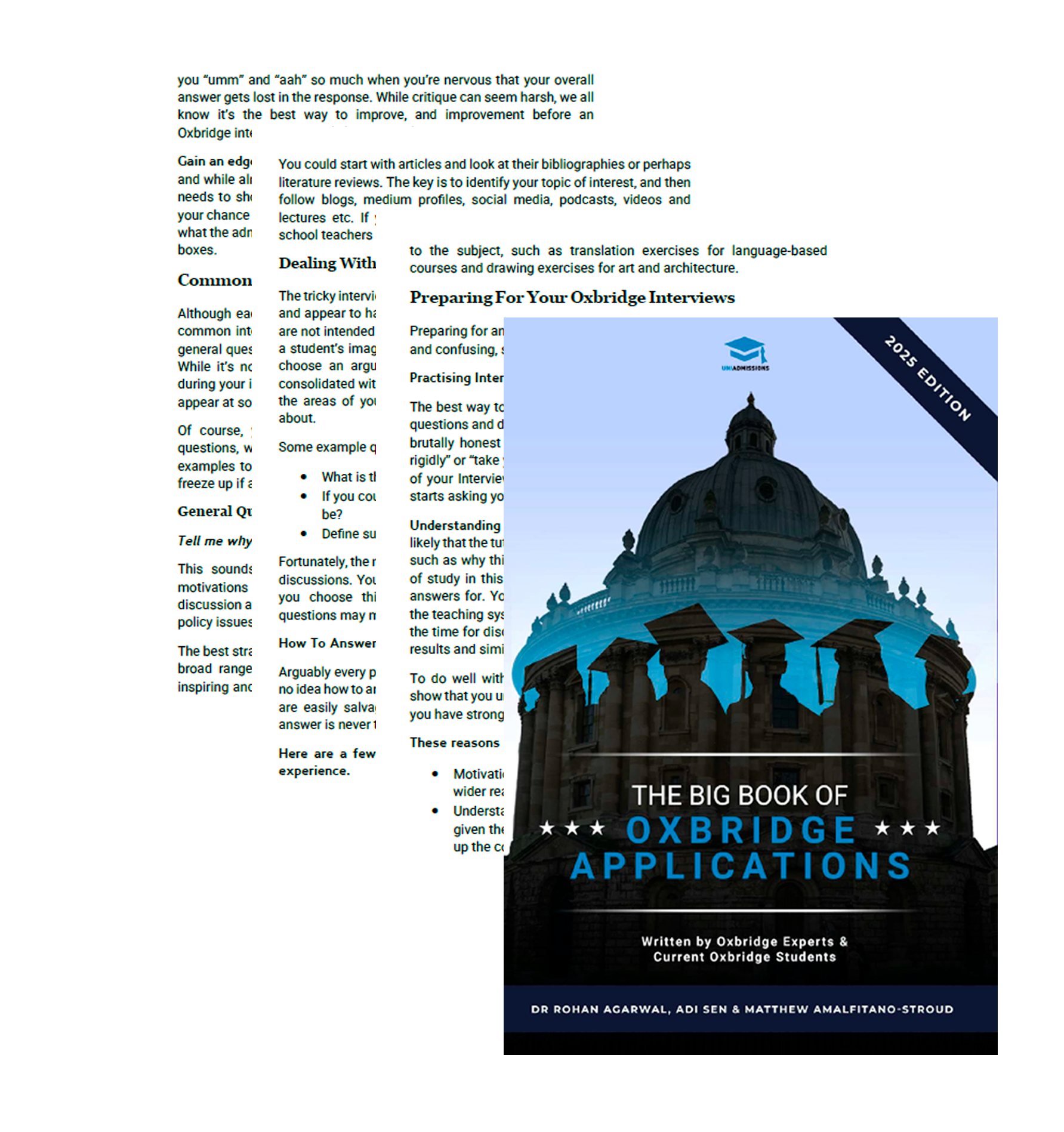
Crack the Oxbridge Interview with The Big Book of Oxbridge Applications
Wherever you are in your Oxbridge journey—just getting started or looking to sharpen your approach—The Big Book of Oxbridge Applications is your essential companion. The dedicated interview chapter takes the mystery out of the process, helping you walk into your interview with clarity and confidence.
Don’t leave your preparation to chance. Get a head start with this free, expertly written guide. Inside, you’ll find:
- Real examples of common and subject-specific interview questions
- Insight into what admissions tutors are really looking for
- Interviews with Oxbridge students and graduates
- Practical tips and strategies for practice
Example Cambridge and Oxford Modern Languages Interview Questions
Below are six questions representative of those asked in Modern Languages interviews at Oxford and Cambridge, each accompanied by a model answer and an explanation of what makes it effective. These have been developed with input from our Oxbridge admissions experts and tutors who have first-hand experience of both sides of the interview room.
Oxbridge Modern Languages Interview Question 1
Is translation an art or a science?
Student Response
Translation has aspects of both, and the tension between them is part of what makes it such a rich intellectual exercise. At one level, translation is mechanical and scientific: you read through a text and render its words into another language. There is a rigorous fidelity involved, and accuracy cannot be sacrificed. But the symbolism, tone, and texture of a text cannot be lost in the process, and that is where the artistic dimension enters. This is particularly clear when translating poetry, where a translator must decide whether to preserve the literal meaning of a line or its rhyme scheme, since it is rarely possible to do both. A skilled translator needs to find an equilibrium between these two impulses, which is neither purely scientific nor purely artistic, but a thoughtful negotiation between them.
Why this is a strong answer
It analyses and genuinely engages with both sides of the question rather than forcing a binary conclusion. Bringing in the specific example of poetry gives the argument texture and shows the candidate can move between abstract reasoning and concrete illustration.
Oxbridge Modern Languages Interview Question 2
Do you think speaking a language is the most important key to accessing a culture?
Student Response
I believe it is one of the most important keys, yes. Speaking a language allows you to engage directly with native speakers, and it signals a level of respect and investment in their culture that other forms of engagement simply cannot replicate. But speaking a language does more than improve oral communication; it also unlocks literature, cinema, journalism, and humour in their original form. These are areas that bring you far closer to a culture than any translation can, because so much of what makes them alive is embedded in the language itself. So while other routes into a culture exist, linguistic fluency remains the most powerful and most complete one.
Why this is a strong answer
It presents a clear and reasoned position while acknowledging complexity. Mentioning literature and cinema alongside conversation is particularly astute, as it points directly to the range of material studied in a Modern Languages degree and demonstrates the candidate already thinks in those terms.
Oxbridge Modern Languages Interview Question 3
Is historical context necessary for understanding a piece of literature?
Student Response
Historical context often provides an essential foundation, yes. It allows you to enter the mindset of the author and understand the pressures, assumptions, and conventions shaping the text. It helps you recognise nuances that are no longer visible in contemporary society, and to understand the significance of choices that might otherwise seem arbitrary. A novel written under censorship, or a poem produced in the aftermath of war, means something different once you understand the conditions in which it was created. That said, the greatest works also transcend their context, and a reader approaching a text with no historical knowledge can still find meaning in it. Historical context does not create the meaning; it enriches and sharpens it.
Why this is a strong answer
It takes a clear position and defends it with specific reasoning, while also acknowledging that the question is not entirely one-sided. The candidate avoids sitting on the fence while still showing intellectual nuance.
Oxbridge Modern Languages Interview Question 4
Is AI a threat to translation?
Student Response
I think AI poses a threat only to a certain extent, and it is worth being precise about what it threatens. AI can produce accurate translations of the words on a page, and for purely functional purposes, that is often sufficient. But it cannot yet replicate the human sensitivity to what words are doing beyond their literal meaning: the emotional register, the cultural resonance, the deliberate ambiguity a writer has placed in a phrase. A machine translation can be technically correct and still entirely miss the point of a sentence. For literary translation in particular, that human dimension is irreplaceable. So while AI will continue to transform the profession, it will not replace the kind of careful, interpretive work that sits at the heart of serious translation.
Why this is a strong answer
It recognises both the genuine capabilities and the real limitations of AI, and it does so with precision rather than vague reassurance. The distinction between functional and literary translation gives the answer intellectual structure and demonstrates subject-specific awareness.
Oxbridge Modern Languages Interview Question 5
What is literature?
Student Response
In the most straightforward sense, literature refers to written works of significance, most commonly novels, plays, and poetry. But I think the word points at something more than a category of objects. Literature is also the voices behind those works and the emotional responses they provoke. What distinguishes a piece of writing as literature, I would argue, is not its length or its form but its capacity to generate something in the reader: recognition, discomfort, wonder, or grief. A work becomes literature not simply by being written but by doing something to the person who reads it.
Why this is a strong answer
It moves from a grounded, literal definition toward something more expansive and personal without losing coherence. The willingness to propose an original interpretive framework, rather than simply cataloguing examples, demonstrates exactly the kind of analytical confidence admissions tutors are looking for.
Oxbridge Modern Languages Interview Question 6
In an age where people are reading less and less, why are you still interested in studying a literature-based degree?
Student Response
I think the decline in reading culture is real, and it is largely driven by the way technology and digital media have restructured our attention. But that makes reading more important to study, not less. Literature is one of the few places where you can genuinely access how people in other times and other cultures understood the world, not through a summary or a translation of experience, but through language in its full complexity. For a Modern Languages student in particular, reading in another language is not just an academic exercise; it is one of the most direct routes into understanding how a community thinks, values, and sees itself. The fact that fewer people are doing it does not reduce its significance.
Why this is a strong answer
It takes the premise of the question seriously rather than dismissing it, which immediately demonstrates intellectual honesty. Connecting the decline of reading back to the specific value of language and culture study is a smart move, because it shows the candidate understands the particular stakes of the degree they are applying for.
These are just six examples of questions that might come up in a Modern Languages interview at Oxbridge. Since history is such a broad subject, you’re unlikely to face these exact questions, but the purpose of these examples is to show how you can effectively approach any history-based interview question and deliver a thorough, insightful response.
At this stage, it’ll be difficult to feel fully confident with the concepts behind every potential question, so don’t be discouraged if you don’t grasp everything covered in these examples. All of these questions are based on concepts you should have learnt during your A-Levels, so everything you’re asked will be within reach at your level of knowledge.
Oxbridge Modern Languages Interview Tips
To conclude, here are some practical tips to help you make the most of your Oxbridge interview and ensure your preparation translates into performance on the day.
Be Early
As with any important interview or appointment, you should aim to prepare your environment and technology 10 to 20 minutes before the scheduled start time for online interviews. For in-person interviews, plan to arrive at the college with time to spare. Arriving flustered adds unnecessary pressure to an already demanding situation.
Remain Calm
You will hear this advice often, and it is worth taking seriously even if it is easier said than done. Feeling nervous is entirely normal and expected; the interviewers know this. What matters is not that you are visibly confident, but that nervousness does not cause you to shut down. A useful technique is to slow your breathing before the interview begins and remind yourself that the interviewers are not trying to catch you out; they are genuinely interested in how you think.
Think Out Loud
We have touched on this already, but it is worth stressing how important it is to avoid long silences when faced with a difficult question. Even if you are unsure how to answer, sharing your thought process is far more valuable than silence followed by a polished conclusion. Interviewers are assessing your reasoning in real time. A response that begins “I am not sure, but I think the question is asking whether…” is far better than a long pause.
Opinions Don’t Matter
This tip is particularly important for Modern Languages, given how much of the subject involves interpretation and judgement. When asked a question like “Is translation an art or a science?”, you are not being assessed on whether you give the “correct” opinion. You are being assessed on the quality of your reasoning and your willingness to commit to a position and defend it. Do not refuse to take a view; the interviewers want to see how you handle an argument, not just that you are aware one exists.
Be Ready to Be Interviewed in Your Target Language
Unlike most other Oxbridge subjects, Modern Languages interviews frequently include a portion conducted in French, Spanish, German, Italian, or whichever languages you are applying to study. This is not designed to catch you out; it is a natural part of assessing your linguistic ability and confidence. Practise discussing ideas, not just vocabulary, in your target languages before the interview. If you are comfortable talking about a novel or a film in that language, you will be far better placed when the interviewer switches register.
Use Texts and Examples
Wherever possible, anchor your answers to specific texts, writers, or cultural examples. Vague generalisations carry far less weight in a Modern Languages interview than a well-chosen reference. If you can say “there is a clear example of this in Camus” or “this is something Borges explicitly interrogates,” you immediately demonstrate the depth of engagement the interviewers are hoping to see.
That concludes our guide to the types of questions you may encounter in Modern Languages interviews at Oxford and Cambridge. Remember: do not wait until your invitation arrives to begin preparing, as it takes more than a couple of weeks to develop the analytical fluency and linguistic confidence these interviews demand, and last-minute preparation is far from ideal.
If you are looking for structured support, UniAdmissions works with students through both one-to-one tutoring sessions and mock interviews with experienced Oxbridge tutors, all available within the UniAdmissions Portal. You can book a free consultation today to find out more about enrolment.
Triple your chances of Oxbridge success with UniAdmissions
With our Oxbridge Modern Languages Full-Blue Programme, you will have access to everything you need to perform at your best in your Modern Languages interviews at Oxford and Cambridge. Discover our programme by clicking the button below to learn how you can enrol and triple your chances of success.
FAQs
Yes, in most cases. Both universities expect applicants to demonstrate linguistic ability as well as academic thinking, and it is common for at least part of an interview to be conducted in one of your target languages. The language component is not a formal oral exam; it is typically a conversation about a text, topic, or idea. Practising discussion, not just grammar and vocabulary, in your target languages is the most effective way to prepare.
Oxford's course is called Modern Languages, while Cambridge's course is called Modern and Medieval Languages. The Cambridge course places a greater emphasis on the medieval period of your chosen languages and their literary traditions, which means engagement with Old French, Medieval German, or similar forms may be expected. Both courses are literature and linguistics focused, but the medieval element at Cambridge adds a distinct dimension to interview preparation, particularly around historical context and the evolution of language over time.
Yes, wherever possible. Interviewers at both Oxford and Cambridge will be far more engaged if you can discuss a text in its original language rather than exclusively through an English translation. Even partial reading in the original, combined with a full reading in translation, puts you in a much stronger position than relying on English alone. It also gives you the opportunity to comment on specific word choices or stylistic features that cannot survive translation, which tends to impress interviewers considerably.
Honestly and analytically. If you do not know something, say so clearly and then demonstrate that you can reason toward an answer. Interviewers at Oxbridge are not looking for encyclopaedic knowledge; they are assessing your intellectual instincts and your ability to work through unfamiliar problems. A response that begins "I do not know enough about that specifically, but thinking about it from first principles..." is far stronger than silence, a guess, or a refusal to engage.

