

The UK has a limited number of Physics university degrees available, but which ones are considered the best?
The subject is one of the three core sciences and has been a cornerstone in STEM education for centuries. However, you may be surprised by how few universities actually teach it.
However, despite this, ranking tables are still available to see an overview of which universities are best at teaching this subject. In this guide, we’ll look at the two most popular university ranking tables in the UK to see how they rank these Physics degrees. Plus, we’ll explore how reliable these rankings are and in what context they should be considered when choosing university options. This guide uses the 2027 editions of both tables, published in 2026 for students applying to start university in 2027. Let’s get started!
Who Makes The Physics University rankings?
You may be wondering how multiple ranking tables can exist if they’re meant to provide an objective ranking. In reality, these rankings are far from objective and can vary based on how each organisation interprets data and scores the universities. Although the data used is taken from similar sources, it’s the use of the data that creates differing rankings between organisations.
We’ll discuss how reliable these tables actually are later, but let’s first take a look at the complete ranking tables for Physics, as well as how each organisation presents their data.
Learn more about UK University Rankings here
The Guardian Physics Rankings
To create their university rankings (including Physics), The Guardian uses the following metrics:
Guardian score/100 – rating of excellence based on a combination of the other factors.
Satisfied with the course – the rating of the overall quality of the course, given by final-year students in the latest National Student Survey (NSS) given as a percentage.
Satisfied with the teaching – the rating of the quality of teaching on the course given by final-year students in the latest NSS.
Satisfied with feedback – the rating of the feedback and assessment, given by final-year students in the latest NSS.
Student to staff ratio – number of students per member of teaching staff.
Spend-per student/10 – money spent on each student, excluding academic staff costs, given as a rating out of ten.
Average entry tariff – typical UCAS scores of young entrants to the department.
Value-added score/10 – this score compares students’ degree results with their entry qualifications, to show how effectively they are taught – given as a score out of ten.
Career after 15 months – percentage of graduates who find graduate-level jobs, or are in further study at professional or higher education level, within 15 months of graduation.
Continuation – percentage of first-year students continuing to second-year.
This data is gathered from a few different sources, including the National Student Survey (NSS) (for information on student satisfaction rates) and the universities themselves (who provide information on admissions, spending and more). Since the information is all sourced externally, it means there’s no bias from The Guardian in terms of what information their rankings are based on.
The Guardian Physics University Rankings 2027
Here is The Guardian’s 2027 league table for Physics, with each university’s 2026 position for comparison:
| Position | University | Previous Position (2026) |
|---|---|---|
| 1 | University of Oxford | 1 (=) |
| 2 | University of St Andrews | 3 (>1) |
| 3 | Durham University | 4 (>1) |
| 4 | University of Cambridge | 2 (<2) |
| 5 | University of Birmingham | 5 (=) |
| 6 | University of Liverpool | 10 (>4) |
| 7 | University of Exeter | 12 (>5) |
| 8 | University of Salford | 18 (>10) |
| 9 | Loughborough University | 8 (<1) |
| 10 | Imperial College London | 9 (<1) |
| 11 | University of Warwick | 6 (<5) |
| 12 | Lancaster University | 7 (<5) |
| 13 | University of Leeds | 25 (>12) |
| 14 | University of Edinburgh | 14 (=) |
| 15 | Keele University | NEW |
| 16 | Royal Holloway, University of London | 23 (>7) |
| 17 | University of Nottingham | 24 (>7) |
| 18 | Queen’s University Belfast | 11 (<7) |
| 19 | University of Bristol | 17 (<2) |
| 20 | Swansea University | 26 (>6) |
| 21 | Cardiff University | 20 (<1) |
| 22 | University of Southampton | 28 (>6) |
| 23 | University of Bath | 21 (<2) |
| 24 | University of Portsmouth | 13 (<11) |
| 25 | University of Leicester | 15 (<10) |
| 26 | University of Manchester | 22 (<4) |
| 27 | Newcastle University | 35 (>8) |
| 28 | Heriot-Watt University | 16 (<12) |
| 29 | University of Strathclyde | 33 (>4) |
| 30 | University of Sheffield | 37 (>7) |
| 31 | University College London (UCL) | 19 (<12) |
| 32 | University of Dundee | 27 (<5) |
| 33 | University of York | 36 (>3) |
| 34 | Aberystwyth University | 32 (<2) |
| 35 | University of Lincoln | NEW |
| 35 | University of Surrey | 34 (<1) |
| 37 | University of Hull | 41 (>4) |
| 38 | King’s College London | 44 (>6) |
| 39 | Nottingham Trent University | 31 (<8) |
| 39 | University of Sussex | 30 (<9) |
| 41 | Queen Mary, University of London | 38 (<3) |
| 42 | University of Glasgow | 29 (<13) |
| 43 | University of Kent | 43 (=) |
| 44 | University of Lancashire | 42 (<2) |
So, what can The Guardian’s 2027 table tell us? Let’s break down some of the key points.
Firstly, the top five are Oxford, St Andrews, Durham, Cambridge and Birmingham. Looking at the top ten, seven of the universities are Russell Group Universities (including both Oxford and Cambridge). Seeing Russell Group universities this high isn’t surprising, but there is only one London-based university in the top ten.
That university is Imperial College London, in 10th place, generally one of the highest-ranked universities in the world. King’s College London, last in the 2026 table, is 38th this year.
It’s important to highlight that one of the top-ranking universities – Cambridge – doesn’t offer a dedicated undergraduate Physics degree. Instead, this table is considering the Natural Science degree, which offers students the chance to specialise in physical sciences. Whether or not the data for this placement only considers the physics aspect of the degree is unknown.
Compared to the 2026 table, there are some big moves. The University of Leeds saw the largest rise, from 25th to 13th, followed by the University of Salford, up ten places from 18th to 8th. Keele (15th) and Lincoln (joint 35th) are new to the table this year.
The biggest drop came from the University of Glasgow, down 13 places from 29th to 42nd. Heriot-Watt (16th to 28th) and UCL (19th to 31st) both fell 12 places. Sheffield Hallam and UEA, both in the 2026 table, are not ranked this year.
The Complete University Guide Physics Rankings
Overall score – the total score calculated by The Complete University Guide’s independent and trusted methodology.
Entry standards – the average UCAS tariff of new students entering university.
Student satisfaction – a guide to how satisfied students are with the quality of teaching they receive.
Research quality – a measure of the quality of the research undertaken by the university.
Research intensity – a measure of the proportion of staff involved in high-quality research at the university.
Graduate prospects – outcomes – a guide to the success of graduates after leaving university.
Graduate prospects – on track – a measure of whether recent graduates agree that their current activity fits with their future plans.
Although the Complete University Guide groups various data points into broader categories, the overall results convey similar information to The Guardian’s rankings – just with fewer metrics. Data is collected from the NSS and universities, just like The Guardian, but they use different systems for interpreting and scoring it. This is what causes the variations in university placements between the two lists.
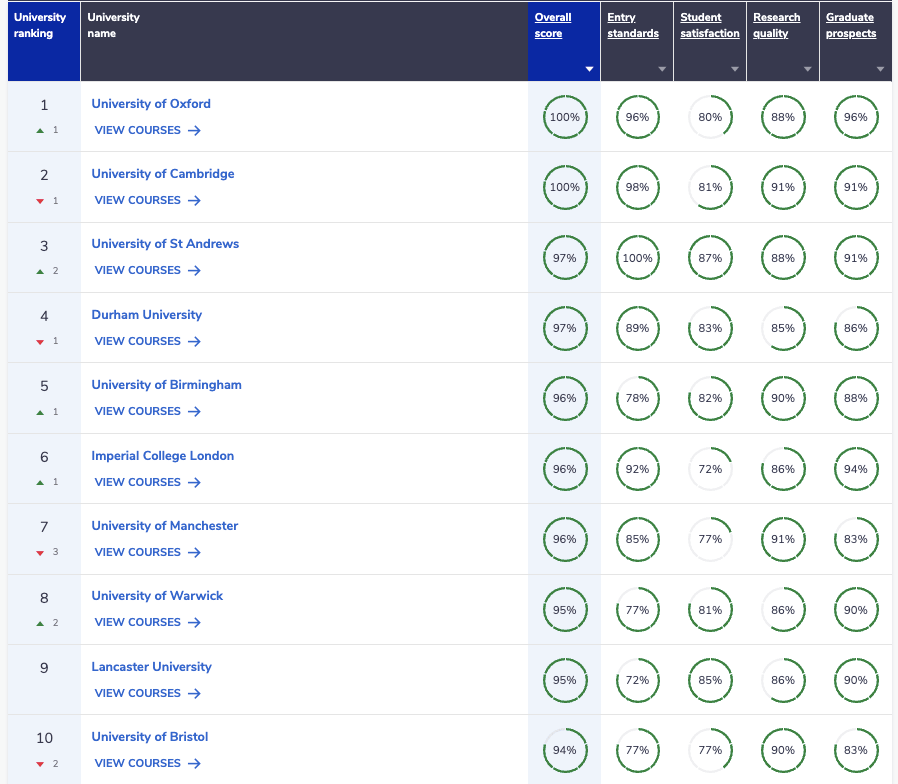
Complete University Guide Physics University Ranking Table (2025-2027)
Now, let’s look at the Complete University Guide’s 2027 Physics and Astronomy table, with each university’s 2026 and 2025 positions for comparison.
| 2027 Position | University | 2026 Position | 2025 Position |
|---|---|---|---|
| 1 | University of Oxford | 2 | 2 |
| 2 | University of Cambridge | 1 | 1 |
| 3 | University of St Andrews | 5 | 11 |
| 4 | Durham University | 3 | 3 |
| 5 | University of Birmingham | 6 | 5 |
| 6 | Imperial College London | 7 | 6 |
| 7 | University of Manchester | 4 | 4 |
| 8 | University of Warwick | 10 | 10 |
| 9 | Lancaster University | 9 | 8 |
| 10 | University of Bristol | 8 | 9 |
| 11 | University of Bath | 11 | 7 |
| 12 | University of Exeter | 13 | 15 |
| 13 | Queen’s University Belfast | 12 | 14 |
| 14 | University College London (UCL) | 17 | 13 |
| 15 | University of Glasgow | 18 | 18 |
| 16 | University of Edinburgh | 15 | 12 |
| 17 | Cardiff University | 20 | 21 |
| 18 | University of Sheffield | 16 | 17 |
| 19 | University of Liverpool | 21 | |
| 20 | University of Nottingham | 14 | 16 |
| 21 | University of York | 19 | 19 |
| 22 | University of Leeds | 22 | 23 |
| 23 | Loughborough University | 29 | 27 |
| 24 | Newcastle University | 28 | 31 |
| 25 | University of Southampton | 23 | 22 |
| 26 | Royal Holloway, University of London | 25 | 25 |
| 27 | University of Leicester | 24 | 33 |
| 28 | University of Strathclyde | 30 | 28 |
| 29 | King’s College London | 32 | 26 |
| 30 | University of Portsmouth | 26 | 35 |
| 31 | University of Hull | 34 | 36 |
| 32 | University of Aberdeen | 39 | 40 |
| 33 | University of Surrey | 27 | 20 |
| 34 | University of Dundee | 31 | 24 |
| 35 | Queen Mary, University of London | 36 | 41 |
| 36 | Nottingham Trent University | 37 | 44 |
| 37 | Swansea University | 35 | 32 |
| 38 | Heriot-Watt University | 33 | 29 |
| 39 | University of Sussex | 38 | 34 |
| 40 | Keele University | 40 | 38 |
| 41 | University of Salford | 42 | 43 |
| 42 | Aberystwyth University | 43 | 45 |
| 43 | University of Kent | 44 | 48 |
| 44 | Sheffield Hallam University | 48 | 47 |
| 45 | University of Lincoln | 47 | 37 |
| 46 | Northumbria University | 45 | 39 |
| – | University of Lancashire | 41 | 42 |
| – | University of Hertfordshire | 46 | 46 |
Compared to The Guardian’s table, these rankings are more stable from year to year, with fewer major changes since 2026. However, one important thing to note is that this ranking table considers both Physics and Astronomy degrees. The two tables also rank slightly different sets of universities, so a university missing from one may still appear in the other.
First, looking at the top ten, we can see a fairly similar selection of universities to The Guardian. Oxford and Cambridge take the top two spots, followed by St Andrews and Durham. Birmingham, Imperial College London, Manchester, Warwick, Lancaster and Bristol complete the top ten.
Six of these ten are also in The Guardian’s top ten: Oxford, Cambridge, St Andrews, Durham, Birmingham and Imperial. The biggest difference is Manchester, 7th here but 26th in The Guardian, while Bristol is 10th here and 19th in The Guardian.
The biggest rise this year was the University of Aberdeen, up seven places to 32nd, followed by Loughborough, up six places to 23rd. The biggest falls were Nottingham (14th to 20th) and Surrey (27th to 33rd), both down six places.
You don’t have to navigate your Oxbridge application alone
Join our community to share advice and connect with fellow Oxbridge applicants. Plus, get free resources and access to events.
The Best and Worst UK Universities For Physics
Now that we’ve seen the full tables, let’s home in on the tops and bottoms of each list. While it’s easy to label these universities as the “best” and “worst”, it’s important to consider that these rankings are only one measurement of a university’s quality. Take these assessments with a grain of salt, as you may find these universities appeal to you more or less than the rankings would suggest.
Best Universities For Physics UK
First, here are the top five universities on each list. Looking at these, we can see which universities are generally considered the best in the UK for Physics:
Complete University Guide (2027)
- University of Oxford
- University of Cambridge
- University of St Andrews
- Durham University
- University of Birmingham
The Guardian (2027)
- University of Oxford
- University of St Andrews
- Durham University
- University of Cambridge
- University of Birmingham
The same five universities make up the top five on both lists, in a different order. Oxford is the top university for Physics in both tables; Cambridge is 2nd in the Complete University Guide and 4th in The Guardian. Remember that, at Cambridge, this isn’t a dedicated Physics degree but a more general Natural Sciences degree.
The other three places in both top fives go to St Andrews, Durham and Birmingham. St Andrews is the only one that isn’t a Russell Group university.

Worst Universities For Physics UK
Next, here are the five lowest-ranked universities for Physics. Although they appeared at the bottom of the list, it doesn’t mean they’re objectively “bad” or “the worst” Physics degrees, they’re just the ones that ranked lower on the list.
Complete University Guide (2027)
- Northumbria University, Newcastle
- University of Lincoln
- Sheffield Hallam University
- University of Kent
- Aberystwyth University
The Guardian (2027)
- University of Lancashire
- University of Kent
- University of Glasgow
- Queen Mary, University of London
- Nottingham Trent University and University of Sussex (joint 39th)
The bottom five of Complete University Guide’s list is mostly filled with lesser-known universities in the UK, which is typical for subject ranking tables like these.
One last interesting fact is that most of these universities are based in England. The University of Kent was the only entry shared between the two lists. However, despite all of this, remember that all of this shouldn’t be taken too seriously, as these rankings aren’t definitive and can change from year to year.
Access "The Big Book Of Oxbridge Applications" For FREE
- Over 40 admissions test practice questions
- 28 example Oxbridge Personal Statements
- Interviews with Oxbridge students and graduates
- Additional downloadable resources
Which Ranking Table Should I Follow?
So, you probably shouldn’t be basing your decisions on the ranking tables alone, so what are they helpful for? Ideally, these tables should be used as a tool to start your research. While they’re not always consistent, both tables generally do a good job of highlighting the most well-regarded universities, so these may be the ones you wish to apply to if reputation is important to you. However, there are plenty of other factors to consider too.
For example, if you’re worried about how well you may do in your exams, you’ll need to review the entry requirements and acceptance rates for each university to see which ones you have a good chance of getting into.
If you’re aiming for top-ranking universities like Oxford and Cambridge, you’ll face a more rigorous application process, higher entry requirements, admissions tests, interviews and lower acceptance rates (14.2% at Oxford and 16.3% at Cambridge). It’s essential to make sure you’re a competitive candidate for these universities based on your current or predicted grades.
Statistics aren’t the only factor to consider. Keep in mind that university life involves much more than academics, as most students will spend at least three years living on campus full-time. It’s important to ensure you like the campus, facilities, and surrounding area before making a decision. Attending open days is an excellent way to get a sense of a university’s atmosphere and facilities, so be sure to visit the ones that interest you most.
The last point we’d like to emphasise is that you shouldn’t immediately overlook lower-ranking universities. While they may not match the top institutions, many still provide a high-quality education, even if there are some drawbacks. If a lower-ranked university appeals to you, it’s still worth applying, as it could be a great fit and typically comes with less competition. The key is to make sure you’ve done thorough research based on the things you value.
Applying for Physics in 2027?
If you are applying to start a Physics degree in 2027, this is where you are now:
- Oxford and Cambridge. The deadline was 15 October 2026. Most Cambridge interviews take place in the first three weeks of December, and Cambridge sends decisions on 27 January 2027. Our guide to Physics interview questions will help you prepare.
- Other universities. UCAS’s deadline for most courses, including Physics at universities other than Oxford and Cambridge, is 18:00 UK time on 13 January 2027. Universities must consider every application that arrives by then equally.
If you are still choosing, use the tables above to make a shortlist, then check each university’s entry requirements and acceptance rates before you decide.
Conclusion
That wraps up our exploration of Physics university rankings in the UK. If you are also weighing up related subjects, see our Engineering rankings and Chemistry rankings. The main thing to take away from this guide is that, while these tables are useful tools, they only provide part of the picture. Personal preference may not outweigh scores based on data for everyone, but it’s still important to consider both when choosing a university.
Most importantly, these rankings are neither definitive nor official. Since they can significantly vary, it’s up to you to decide which one you trust and how much weight you give to rankings overall. Ultimately, if you choose a university you’re happy with, the approach you took to make that decision has been a success.
FAQs
Oxford is first in both 2027 tables. In the Complete University Guide 2027, Oxford is followed by Cambridge, St Andrews, Durham and Birmingham; in The Guardian University Guide 2027, by St Andrews, Durham, Cambridge and Birmingham. Both tables are shown in full above.
Not as a separate degree. At Cambridge you study Physics through Natural Sciences: you choose three science subjects in your first year, which can include Physics, and you can specialise in Physics or Astrophysics in your third year, with an optional fourth year leading to an MSci. In the 2025 admissions cycle, Natural Sciences received 2,644 applications and accepted 576 students (21.8%). See our Natural Sciences (Physical) personal statement example.
For most universities, 18:00 UK time on 13 January 2027, UCAS’s equal consideration deadline. For Oxford and Cambridge the deadline was 15 October 2026.
Worried about your Oxford chances? Our offer success rate is 67%
Applying to Oxford Physics is immensely competitive and it is crucial that you give yourself the best chance of success. We help you craft the perfect Personal Statement, achieve a highly competitive Admissions Test score and teach you how to Interview effectively – covering all areas of your Oxbridge application.
Discover our Full-Blue Physics Programme now to learn how you can triple your chances of success.

