Test withdrawn: Oxford no longer uses the TSA. The last TSA was sat in October 2025, by applicants for 2026 entry. From 2027 entry, Economics and Management, PPE, Experimental Psychology, Human Sciences and most other courses that used the TSA ask for the TARA (Test of Academic Reasoning for Admissions) instead. We have kept this guide as a record of how the TSA was scored. If you are applying now, read our TARA scoring and results guide and our guide to the TARA. Our overview of Oxford’s new admissions tests explains every change.
Until 2026 entry, applicants to Oxford for Economics and Management and several other subjects had to sit the TSA as part of their application.
As you might expect, the TSA is not like any other test you have ever sat and in line with this, so is how it is scored.
Which is why we have put together this guide going over everything you need to know about the scoring and results of the TSA.
What makes the TSA scoring so different?
The TSA was primarily an aptitude test that assessed problem solving and critical thinking.
As with the vast majority of university Admissions Tests, the TSA is not graded as just a straight-forward percentage out of 100.
To try and make understanding this as simple as possible for you, we have put together this guide explaining it all for you.
Preparing for the TARA?
The UniAdmissions Full-Blue Programme will rapidly boost your score and triple your chances of succeeding in your application. Our expert tutors will guide you through past papers in mock exam scenarios so that you are well-prepared by the time your exam comes around.
Speak with our friendly Admissions Team today to book a free consultation session and learn how you can enrol.
When Did TSA Results Come Out?
Firstly, you will likely be wondering when do you actually get your results.
The last TSA was sat between 21 and 27 October 2025 (not on 25 or 26 October), and candidates received a PDF Statement of Results by early January 2026. TARA results come out about four weeks after the test, in your UAT-UK account: see our TARA scoring and results guide.
Results will be passed to the college at Oxford to which you have applied. The exact use of results varies between the subjects which use the test. For more information, please refer to the website for your chosen course.
Which Oxford Courses Used the TSA?
- Economics and Management
- History and Economics
- Experimental Psychology
- Geography
- Human Sciences
- Philosophy and Linguistics
- Philosophy, Politics and Economics
- Psychology and Linguistics
- Psychology and Philosophy
For 2027 entry, all of these courses except Geography ask for the TARA instead, and so does History and Politics. Geography no longer has an admissions test.
How Was the TSA Scored?
The TSA is split into two sections, with Section 1, the Thinking Skills Assessment where candidates have 90 minutes to answer 50 multiple-choice questions.
Section 1 scores one mark per question. Scores are then calculated on the TSA scale to one decimal place, running approximately 0-100.
The scale is an estimate of the candidate’s ability, which makes scoring comparable by factoring in the question and overall test difficulty. The marking of this section is automated, and Pearson VUE does not accept remarks.
Section 2 is a written task, which is reviewed by the admissions tutors of the Oxford college you are applying to. If you are applying to History and Economics, or Economics and Management you do not need to sit Section 2.
If we once again consider Section 1, the next step is converting the raw marks into the reported score.
TSA Score Conversion
The conversion is adjusted each year in line with the results that candidates achieve.
However, by looking at the conversions from 2021 (taken by those applying for 2022 entry), we can see how this has been applied.
| Critical Thinking Raw Score | Critical Thinking Reported Score |
|---|---|
| 25 | 99.4 |
| 24 | 92.1 |
| 23 | 84.5 |
| 22 | 79.8 |
| 21 | 76.3 |
| 20 | 73.4 |
| 19 | 70.9 |
| 18 | 68.7 |
| 17 | 66.6 |
| 16 | 64.7 |
| 15 | 62.8 |
| 14 | 61.0 |
| 13 | 59.3 |
| 12 | 57.5 |
| 11 | 55.8 |
| 10 | 54.0 |
| 9 | 52.2 |
| 8 | 50.3 |
| 7 | 48.2 |
| 6 | 46.0 |
| 5 | 43.6 |
| 4 | 40.7 |
| 3 | 37.3 |
| 2 | 32.7 |
| 1 | 25.2 |
| 0 | 18.0 |
| Problem Solving Raw Score | Problem Solving Reported Score |
|---|---|
| 25 | 106.0 |
| 24 | 98.6 |
| 23 | 90.9 |
| 22 | 86.1 |
| 21 | 82.4 |
| 20 | 79.4 |
| 19 | 76.7 |
| 18 | 74.3 |
| 17 | 72.1 |
| 16 | 70.0 |
| 15 | 68.0 |
| 14 | 66.1 |
| 13 | 64.2 |
| 12 | 62.2 |
| 11 | 60. |
| 10 | 58.3 |
| 9 | 56.3 |
| 8 | 54.1 |
| 7 | 51.8 |
| 6 | 49.3 |
| 5 | 46.6 |
| 4 | 43.3 |
| 3 | 39.4 |
| 2 | 34.1 |
| 1 | 25.8 |
| 0 | 18.1 |
Access "The Big Book Of Oxbridge Applications" For FREE
Are you considering applying to Oxford or Cambridge? The Big Book of Oxbridge Applications is your must-have resource. Whether you’re exploring colleges, preparing for admissions tests, mastering your UCAS application, crafting a standout Personal Statement, aiming for exam success, or preparing for your interviews, this free book will be invaluable to your preparation. Through over 350 pages, you will find:
- Over 40 admissions test practice questions
- 28 example Oxbridge Personal Statements
- Interviews with Oxbridge students and graduates
- Additional downloadable resources
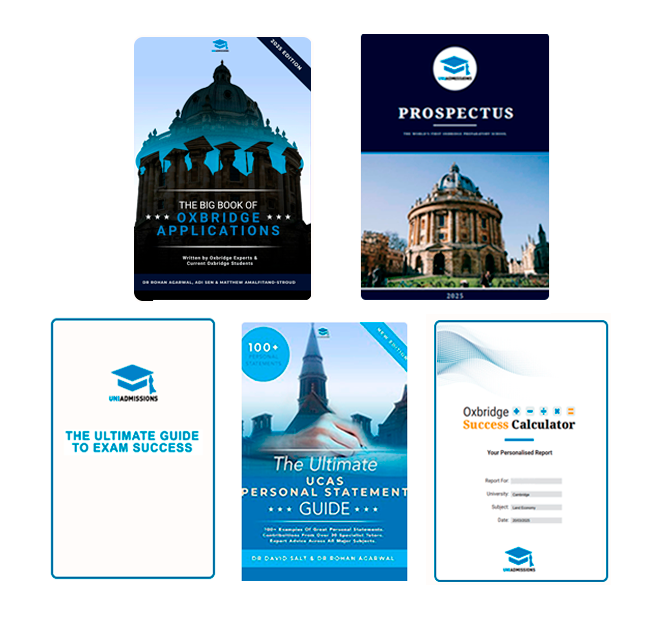
Access "The Oxbridge Application Vault"
- 300+ page ebook for Oxbridge Applicants
- 25 page ebook for Personal Statement
- 2h+ online course to succeed in any exam
- Online Oxbridge Success Calculator
- 12 page ebook about UniAdmissions
What Can we learn from past TSA Scores?
So the CAAT does provide the explanation of results dating as far back as 2007. This means there is plenty of data to look at and see what trends have been established over the years.
Since 2017, there has been two versions of the explanation of the results with one for those taking the entire TSA and the other for those just taking Section 1. There are some differences between the two, so it is interesting to see how they compare.
An average score is about 60, so around 28 out of 50 raw marks. If you score 70 or above, you will find yourself in the top 10 of candidates – this equates to about 38 out 50. With this in mind, we can take a look at the 2023 TSA results.
TSA Critical Thinking 2023 Results
Below are the Critical Thinking score distributions for firstly those sitting the entire TSA, and then the one for those just sitting Section 1.
From these, we can see that candidates have performed strongly, with most applicants achieving results between 58 and 66.
Those completing the full TSA exam performed slightly better than those just completing Section 1, with more of them achieving a score of 60+
Do keep in consideration that fewer applicants sit just Section 1 of the TSA, so this may have caused a skew in the results.


TSA Problem Solving 2023 Results
The score distributions for the TSA Problem Solving skew slightly lower than Critical Thinking, with most applicants scoring at around 55 to 58.
Unlike in Critical Thinking, applicants generally performed slightly better when only sitting Section 1. These applicants had a modal score of 60.7, compared to 55.2 for the other group. As well as this, there were far more applicants who achieved 64.6.


TSA Overall Scores 2023
Below, is the distribution for the scores of the section as a whole.
These results from the two groups of applicants are fairly balanced here. However, Section 1 test takers achieved a slightly higher modal score of 54.8 compared to 53.9 from the other group. There was also a higher number of applicants who scored above 75.
Interestingly, one applicant who completed the whole test was able to achieve a score of 103.0, which is an anomaly caused by the conversion system.


What Were Good, Average and Low TSA Scores?
The distribution tables above, should provide you with an insight into how candidates have performed in the past. Furthermore, you should be able to see the trends in the results and how the average candidate performs.
Based on what we have seen for the previous year’s results and the information provided by CAAT, we can see a pattern in regard to the scores. These can be categorised as follows:
What is a Good TSA Score?
It is generally agreed that anything from 70 and above is considered a good TSA score. Only the most exceptional applicant will achieve this. As you can see in the distribution charts above, around this mark is where there is a drop-off in the results. Very few, very exceptional candidates will achieve scores higher than an 80.
What is an Average TSA Score?
For the average TSA score, you would be looking at anything between 40 and 70; the vast majority of applicants found themselves in this category. An average score is about 60, so this is where most applicants will be aiming for, as this equates to around 28 out of 50 raw marks.
What is a Low TSA Score?
Anything below a 40, therefore, is considered a low TSA score. Due to the nature of the Oxford Interview process, it is unlikely you would get an Interview with this score – however, do keep in mind this decision will be made based on the performance of your entire cohort, so there may still be a chance.
Conclusion
Hopefully, from the above, you have a better understanding of how the scoring and results of the TSA works.
The TSA’s conversion tables and score distributions changed every year with the difficulty of the test. If you are applying for 2027 entry or later, you will sit the TARA instead. It is scored differently: Critical Thinking and Problem Solving each get a separate score on a scale from 1.0 to 9.0, and the Writing Task is not scored. Our TARA scoring guide explains what the scores mean.
Your Admissions Test is just one part of your Oxford application, so ensuring you do well in the other areas is essential.
Frequently Asked Questions
No. The TSA was last sat in October 2025, by applicants for 2026 entry. For 2027 entry, Oxford asks for the TARA (Test of Academic Reasoning for Admissions) instead for Economics and Management, Philosophy, Politics and Economics (PPE), Experimental Psychology, Human Sciences, History and Economics, Philosophy and Linguistics, Psychology and Linguistics, and Psychology and Philosophy. The TARA is run by UAT-UK, and Oxford applicants sit it in October.
No. The TSA reported Section 1 on a scale running from about 0 to 100. The TARA gives two separate scores, one for Critical Thinking and one for Problem Solving, each on a scale from 1.0 to 9.0. Its Writing Task is not scored: the universities read it themselves. TARA results come out about four weeks after the test, in your UAT-UK account.
They can help. UAT-UK, which runs the TARA, says its Critical Thinking and Problem Solving modules share a common history with the TSA and BMAT Section 1, and its TARA preparation page includes TSA Section 1 papers from 2008 to 2023 with answer keys. The format is different, though: each TARA module has 22 multiple-choice questions in 40 minutes. Start with UAT-UK’s TARA specification, question guide and two practice tests, which use the real test format.
As The World’s First Oxbridge Preparatory School, we’ll triple your chances of Oxford Success
Welcome to UniAdmissions, the world’s first Oxbridge preparatory school with an Oxbridge success rate of 67% and with 1,214 UniAdmissions students placed at Oxford and Cambridge since 2013.
Performing well in the TARA is crucial for your application. Our TARA support prepares you to score highly through one-to-one tuition sessions, intensive courses, and more.