The Thinking Skills Assessment (TSA) has been discontinued by the University of Oxford. All details in this guide are no longer relevant to the Oxbridge admissions process in 2026 and beyond. Learn more about Oxford’s new admissions tests here.
What does TSA Critical Thinking require?
TSA Critical Thinking questions require you to understand the constituents of a good argument and be able to pick them apart. The majority of TSA Critical thinking questions tend to fall into 5 major categories:
- Identifying Conclusions
- Identifying Assumptions and Flaws
- Strengthening and Weakening arguments
- Matching Arguments
- Applying Principles
Let’s take a deep dive into each category.
What is TSA Section 1?
Section 1 consists of 50 multiple-choice questions and assesses problem-solving skills, critical thinking skills, and the ability to reason using everyday language. The time allowed for this section is 90 minutes.
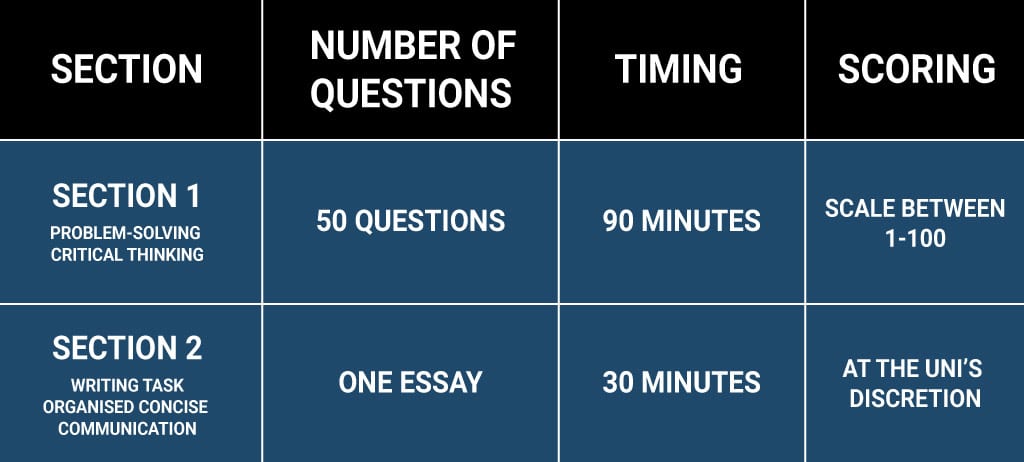
UCL only uses Section 1 of the TSA, whereas Oxford uses Section 1 and 2 for the majority of TSA degrees except for Economics and Management and History and Economics.
TSA Section 1: Identifying Conclusions
Conclusions are often confused with premises. For clarity, here is a definition of both:
- A conclusion is a summary of the arguments being made and is usually explicitly stated or heavily implied.
- A premise is a statement from which another statement can be inferred or follows as a conclusion.
- A conclusion is shown, implied or proven by a premise. Inversely, a premise shows, indicates or establishes a conclusion.
Consider this statement: My mom, being a woman, is clever as all women are clever.
Premise 1: My mom is a woman. Premise 2: Women are clever. Conclusion: My mom is clever.
This example is straight forward and the conclusion is explicitly stated, sometimes it might not be stated. Consider this statement: My mom is a woman and all women are clever. The same conclusion can be drawn from the statement.
Sometimes you will be asked to identify if any of the options “cannot be reliably concluded”. This is essentially asking you to identify why an option cannot be the conclusion. Some common reasons are:
- Over-generalising: My mom is clever therefore all women are clever.
- Being too specific: All kids like sweets so my son also likes sweets.
- Confusing correlation with causation: Lung cancer is much more likely in patients who drink water. Hence, water causes lung cancer.
- Confusing cause and effect: Lung cancer patients tend to smoke so it follows that having lung cancer must make people want to smoke.
TSA Section 1: Assumptions and flaws
Other types of critical thinking questions may require you to identify assumptions and flaws in a passage’s reasoning.
- An assumption is a reasonable assertion that can be made based on the available evidence.
- A flaw is an element of an argument that is inconsistent with the rest of the available evidence. It undermines the crucial components of the overall argument being made.
Consider this example: My mom is clever because all doctors are clever.
Premise 1: Doctor’s are clever. Assumption: My mom is a doctor. Conclusion: My mom is clever.
Note that the conclusion follows naturally even though there is only one premise because of the assumption. The argument relies on the assumption to work. Remember that the assumption could also be a flaw. If you consider the statement above, what if the mother was not a doctor? This would result in a flaw.
Watch this video of Ankit, an experienced TSA tutor explaining identifying assumptions (taken from our TSA Online Course):
TSA Section 1: Strengthening or weakening arguments
There is a holy trifecta to what strengthens an argument:
- Evidence: Arguments that are heavily based on value judgements and subjective statements tend to be weaker than those based on facts, statistics and available evidence.
- Logic: A good argument should flow and the constituent parts should fit well into an overriding view or belief.
- Balance: A good argument must concede that there are other views or beliefs (counter-argument). The key is to carefully dismantle these ideas and explain why they are wrong.
Thus, when asked to strengthen an argument, look for options that would increase the evidence basis for the argument, support or add a premise or address the counter-arguments. When asked to weaken an argument, do the opposite.
TSA Section 1: Matching Arguments
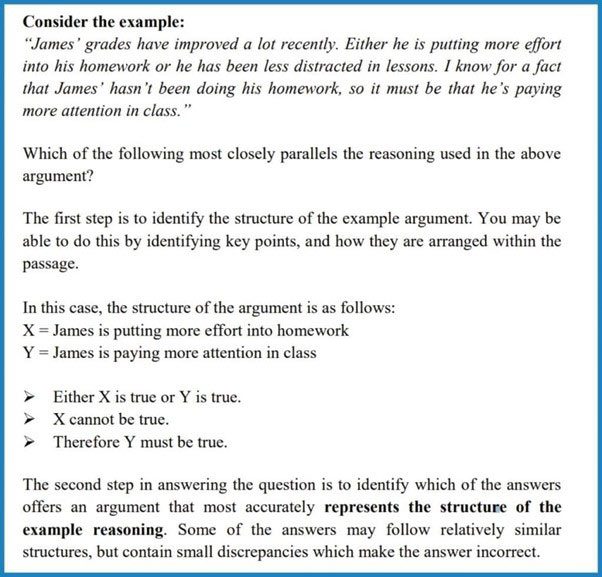
Some questions will test your ability to identify similarities between two arguments about different topics. The similarity you are looking for is in the structure or the pattern of the argument. A question of this type will ask you to find the option that most closely parallels the format of the example argument.
TSA Section 1: Identifying principles
Some questions will require you to identify an underlying principle within an argument.
A principle is a general recommendation that can be applied to a number of cases. You are expected to extract the fundamental principle from the case presented in the passage, then see where this principle has been applied in other cases.
Looking to boost your TSA score?
The UniAdmissions TSA Programme will rapidly boost your score and triple your chances of succeeding in your application.
Our expert tutors will guide you through past papers in mock exam scenarios so that you are well-prepared by the time your exam comes around. UniAdmissions helps students refine and hone their abilities so that they’re exam-ready on test day for all aspects of the TSA exam.