

Every year, thousands of students apply to universities across the UK, but not all secure a place. Some degrees are particularly competitive in terms of admissions, attracting far more applicants than there are spots available.
Competitiveness isn’t always about popularity or academic difficulty. Many highly sought-after degrees have rigorous entry requirements, including high grades, admissions tests, interviews, portfolios, or practical experience. These factors ensure universities select candidates who are best suited to the challenges of the programme.
In this guide, we explore the most competitive degrees in the UK, using the 2025 UCAS statistics and official admissions data from universities. You’ll find not only which courses are the toughest to get into, but also insights into what makes them so selective – and how you can prepare to maximise your chances of admission.

How We Measured Competitiveness
A degree is generally considered competitive when the number of applicants significantly exceeds the number of available places. To manage this, universities use rigorous entry requirements – such as high academic grades, admissions tests, interviews, and/or portfolios – to select the strongest candidates for their limited places.
The most reliable way to assess a course’s competitiveness at the decision-making stage is through its offer rate – the proportion of applicants who receive an offer. This metric provides a clear and consistent measure of selectivity: the lower the offer rate, the more competitive the course.
Offer Rate = (Offers Received / Total Number of Applicants) x 100
While acceptance rates (the proportion of applicants who ultimately enrol) are typically lower, they are influenced by factors beyond selectivity – such as applicants declining offers or not meeting conditions. For this reason, acceptance rates were not used as the primary metric in this analysis, ensuring a more accurate and comparable view of competitiveness across courses.
Want to study at Oxbridge? We can quadruple your chances of success.
UniAdmissions’ Oxbridge Preparation Programmes have been designed to maximise your chances of getting into the renowned universities of Oxford and Cambridge. Our success rate is 67% – that’s three times the national average of 16%.
You will receive world-class application support from start to finish. Our students have access to expert resources, one-to-one tuition, intensive courses and much more, all designed to give them the best possible chance of success.
What Data Was Used
UCAS data provides subject-level offer rates across the UK, allowing us to benchmark competitiveness at a national level based on the proportion of applicants who receive an offer.
In addition, we conducted a focused analysis of the G5 universities – University of Oxford, University of Cambridge, London School of Economics and Political Science, University College London, and Imperial College London – to identify the most competitive individual courses within these highly selective institutions.
By combining broad UCAS subject data with course-level insights from G5 universities, this guide provides a comprehensive view of competitiveness across UK higher education – helping you understand where competition is highest, and how this should inform your application strategy.
The Most Competitive Degrees in the UK (subject level)
In 2025, these undergraduate subjects had the lowest offer rates across all UK universities.
10. Social Sciences
| Year | Applications | Offers | Offer Rate |
|---|---|---|---|
| 2025 | 320,225 | 243,250 | 75.96% |
| 2024 | 318,610 | 243,670 | 73.7% |
As a broad subject area, Social Sciences encompasses disciplines such as sociology, politics, international relations, and social policy – fields that remain highly relevant in understanding contemporary global challenges. These degrees continue to attract strong interest from applicants aiming for careers in public policy, government, research, and international organisations. While now ranking lower in overall competitiveness (10th in 2025 while 9th in 2024), Social Sciences courses still require critical thinking, analytical skills, and the ability to engage with complex societal issues – ensuring they remain both academically demanding and highly respected pathways.
9. Computing
| Year | Applications | Offers | Offer Rate |
|---|---|---|---|
| 2025 | 186,230 | 140,660 | 75.53% |
| 2024 | 204,700 | 149,315 | 72.9% |
Computing continues to attract a high volume of applicants, although application numbers saw a slight decline in 2025. This led to a marginal increase in the offer rate, making the subject less competitive overall – dropping from 8th to 9th place in the rankings. This field covers areas such as programming, software development, cybersecurity, and data science, all of which are in high demand across industries. A computing degree can lead to rewarding careers in technology, finance, and research. While the subject is highly sought after, it can also be demanding due to the technical skills, problem-solving abilities, and consistent practice required to excel.
8. Engineering & Technology
| Year | Applications | Offers | Offer Rate |
|---|---|---|---|
| 2025 | 234,740 | 174,545 | 74.36% |
| 2024 | 205,950 | 153,820 | 74.7% |
Engineering and Technology is the only subject to shift position between 2024 and 2025. Previously ranked 10th, it has risen to 8th place, overtaking Computing.
7. Architecture, Building and Planning
| Year | Applications | Offers | Offer Rate |
|---|---|---|---|
| 2025 | 57,260 | 41,370 | 72.25% |
| 2024 | 53,780 | 37,670 | 70% |
Architecture, Building, and Planning attracted over 57,000 applicants in 2025. This field combines creativity, design, and technical knowledge to shape the spaces we live and work in. Degrees in these subjects can lead to careers as architects, urban planners, or construction managers. The courses are known for being rigorous, requiring strong design skills, technical understanding, and long hours of project work, but they offer highly rewarding outcomes.
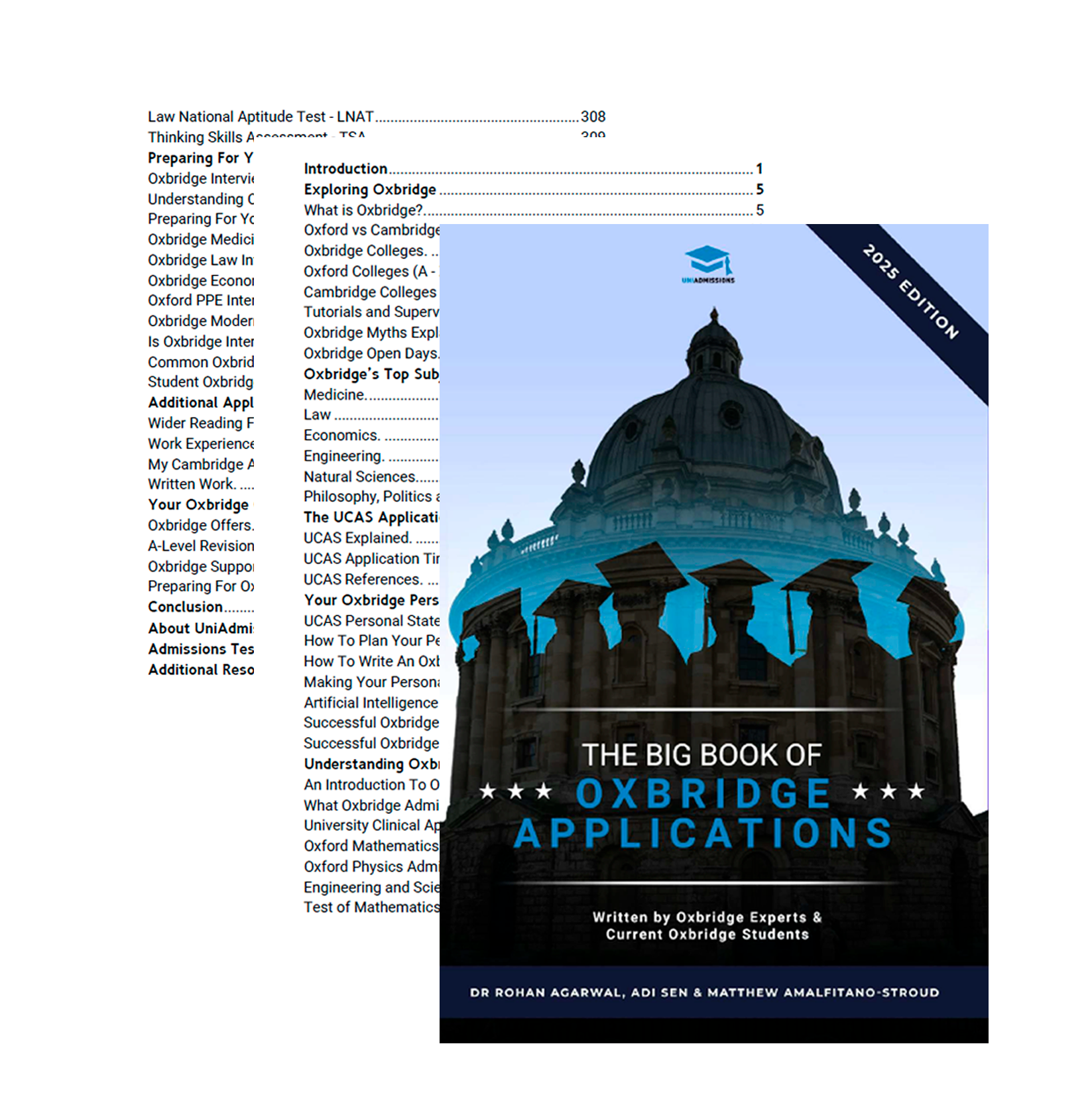
Access "The Big Book Of Oxbridge Applications" For FREE
- Over 40 admissions test practice questions
- 28 example Oxbridge Personal Statements
- Interviews with Oxbridge students and graduates
- Additional downloadable resources
6. Mathematical Sciences
| Year | Applications | Offers | Offer Rate |
|---|---|---|---|
| 2025 | 68,160 | 47,890 | 70.26% |
| 2024 | 63,855 | 43,825 | 68.6% |
Mathematical Sciences attracted over 68,000 applicants in 2025, showing a moderate to high popularity. This field covers areas such as pure and applied mathematics, statistics, and actuarial science, all of which are essential for careers in finance, research, data analysis, and technology. Degrees in mathematical sciences are challenging, requiring strong analytical skills, problem-solving abilities, and logical reasoning, which results in high entry requirements and rigorous admissions processes, such as the STEP. However, they can open doors to highly rewarding and specialised career paths, such as quantitative trading.
5. Education and Teaching
| Year | Applications | Offers | Offer Rate |
|---|---|---|---|
| 2025 | 66,710 | 44,380 | 66.53% |
| 2024 | 65,980 | 41,805 | 63.4% |
Education and Teaching attracts over 65,000 applicants, reflecting the ongoing interest in the UK in becoming a skilled educator. This field prepares students to become teachers, trainers, or education specialists, shaping the next generation of learners. Degrees in education can be challenging, requiring strong communication skills, patience, and practical teaching experience, but they lead to highly rewarding careers that make a lasting impact on society.
4. Design, and Creative and Performing Arts
| Year | Applications | Offers | Offer Rate |
|---|---|---|---|
| 2025 | 251,020 | 161,695 | 64.42% |
| 2024 | 259,090 | 159,100 | 61.4% |
The UK is home to some of the world’s most renowned art universities, and with a growing job market in creative professions, this broad field including disciplines such as graphic design, fashion, music, theatre, and fine arts, attracted over 250,000 applicants in 2025.
Students typically pursue a Bachelor of Arts (BA), Bachelor of Fine Arts (BFA), or Bachelor of Performing Arts (BPA). While these courses are highly rewarding, they can be demanding, requiring strong artistic skills, dedication, and a willingness to experiment and innovate. Admissions processes for these degrees can be extremely competitive, typically requiring evidence of independent engagement and creative skills through portfolios.
3. Subjects allied to Medicine
| Year | Applications | Offers | Offer Rate |
|---|---|---|---|
| 2025 | 400,750 | 217,760 | 54.34% |
| 2024 | 385,985 | 203,660 | 52.8% |
Subjects allied to medicine attracted 400,750 applicants, making it one of the most popular subjects in the UK (and the most popular in the list). This group includes courses such as nursing, pharmacy, medical technology, physiotherapy, radiography, and biomedical sciences, all of which play a vital role in healthcare. Degrees in these areas are challenging, combining rigorous academic study with practical, hands-on experience. Graduates can pursue rewarding careers in hospitals, clinics, research, and public health, contributing directly to patient care and the wider healthcare system.
2. Veterinary Sciences
| Year | Applications | Offers | Offer Rate |
|---|---|---|---|
| 2025 | 16,820 | 6,760 | 40.19% |
| 2024 | 15,920 | 6,165 | 38.7% |
Although Veterinary Sciences attracted only 16,820 applicants – the lowest number on the list – it has an exceptionally low offer rate of 38.7%, highlighting just how competitive the course is. Admission typically involves rigorous interviews and specialised tests (such as the ESAT), in addition to crafting a successful personal statement, reflecting the high standards required to train as a veterinarian. Graduates can pursue careers caring for animals in clinical, research, or public health settings, making it a highly in-demand, rewarding, but also demanding field.
1. Medicine and Dentistry
| Year | Applications | Offers | Offer Rate |
|---|---|---|---|
| 2025 | 119,110 | 33,160 | 27.84% |
| 2024 | 119,000 | 28,495 | 23.9% |
Medicine and Dentistry – which also happens to be at the top of the list with the highest paying degrees in the UK and fourth from the top of the degrees with the best job prospects – remain the most competitive courses in the UK for two years in a row, attracting over 119,000 applicants but offering just a 27.84% offer rate. These degrees demand exceptional academic ability, dedication, and resilience, combining intense study with practical clinical experience. Graduates can pursue careers as doctors, dentists, or specialists, making a profound impact on patient health and wellbeing. The rigorous admissions process often includes interviews and one of the most difficult entrance exams (UCAT), reflecting the high standards required to enter these vital professions.
Key Takeaways
As you can see, offer rates vary significantly, from around 76% for subjects like Social Sciences to just 28% for Medicine and Dentistry, meaning some fields are up to three times harder to get into. If you’re targeting elite institutions, like Oxbridge and other G5 universities, chances are the success rates will be even lower.
Popularity plays a role, but competitiveness is more closely linked to limited places, specialist requirements, and the intensity of the training involved. Highly competitive subjects often demand more than strong grades. Medicine, Dentistry, Veterinary Sciences, and Creative Arts courses frequently require admissions tests, interviews, portfolios, or extensive work experience. Similarly, analytical and technical subjects such as Mathematics, Architecture, and Computing require solid foundational skills and a genuine interest in the subject’s challenges.
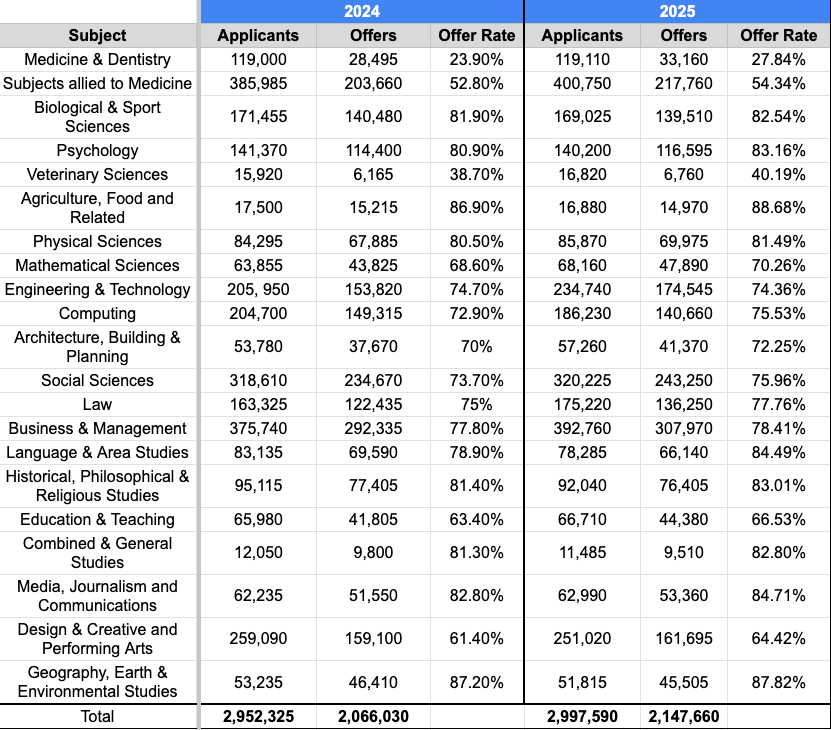
This information should help you make informed decisions, not discourage you. Choosing a degree is a significant investment, and your interests and long-term goals should always guide your choices. Competitiveness can be an indicator of future career opportunities, as many demanding degrees lead to respected, high-demand, or high-paying professions. Below you can find the full list of undergraduate subject areas in the UK alongside admissions data for both 2024 and 2025 (source: UCAS).
We know how to get students into the most competitive courses.
UniAdmissions’ Oxbridge Preparation Programmes have been designed to maximise your chances of getting into the most competitive courses in the UK. Our success rate is 67% – that’s three times the national average of 16%.
You will receive world-class application support from start to finish. Our students have access to expert resources, one-to-one tuition, intensive courses and much more, all designed to give them the best possible chance of success.
The Most Competitive G5 Degrees
For many applicants, securing a place at a G5 university represents the pinnacle of academic achievement. Institutions such as University of Oxford, University of Cambridge, London School of Economics and Political Science, and University College London are globally recognised for their academic rigour – and that selectivity is reflected clearly in their admissions data.
The G5 Universities


G5 Courses With The Lowest Offer Rates
To identify the most competitive courses, we analysed the latest offer rates (2025 and 2024) across each university. This provides the clearest measure of how selective a course is at the decision-making stage. The offer rates for these courses range from 3.5% to 10.1%.
| Rank | G5 University | Course/Department | Applications | Offer Rate |
|---|---|---|---|---|
| #1 | University of Oxford | Mathematics & Statistics | 142 | 3.5% |
| #2 | University College London (UCL) | Slade School of Fine Art | 1,110 | 6.4% |
| #3 | University of Oxford | Economics & Management | 1,517 | 6.1% |
| #4 | University of Oxford | Computer Science | 881 | 7.5% |
| #5 | London School of Economics and Political Science (LSE) | Politics & International Relations | 1,112 | 8.2% |
| #6 | University of Cambridge | Computer Science | 1,739 | 9.4% |
| #7 | London School of Economics and Political Science (LSE) | Finance | 1,113 | 9.7% |
| #8 | University of Oxford | Mathematics & Philosophy | 173 | 9.8% |
| #9 | University of Oxford | Biomedical Sciences | 494 | 9.9% |
| #10 | London School of Economics and Political Science (LSE) | ISPP (Politics) | 238 | 10.1% |
As we can see, Oxford dominates the rankings, with five of the ten most competitive courses. Mathematics and Statistics remains the most competitive course not only at Oxbridge but across all G5 universities, with an offer rate of 3.5%. However, this does not mean it is the most in-demand course. In fact, courses such as Economics & Management and Computer Science attract significantly higher application volumes. This highlights that competitiveness is not solely driven by popularity, but by the balance between application numbers and the limited number of places available.
At LSE, social science disciplines lead in competitiveness, particularly Politics, Finance, and interdisciplinary policy degrees. Meanwhile, specialist courses at University College London, such as Fine Art and Computer Science, demonstrate that selectivity is not limited to traditional academic routes – portfolio-based and technical skills are equally considered.
At University of Cambridge, STEM subjects remain highly selective, with Computer Science being the most difficult course to get into in 2025, overtaking Graduate Medicine, which took the top spot in 2024.
How To Prepare For Competitive Degrees
Getting into a highly competitive degree requires more than excellent grades. Universities such as Oxford, Cambridge, LSE, Imperial, and UCL look for applicants who demonstrate genuine interest in their subject, independent engagement, and strong analytical and critical thinking skills. Start by understanding each course’s requirements: required subjects, admissions tests, interviews, and any portfolio or written work you may need to submit.
Building your subject knowledge early is crucial. Read widely around your chosen course, keep up with recent research, and participate in activities that demonstrate genuine engagement, such as competitions, online courses, or relevant projects and work experience. Oxbridge and other top-tier institutions also assess how well you think critically during interviews. The goal is not to memorise facts but to demonstrate your actual reasoning clearly and confidently.
Effective preparation also involves identifying the areas where you need the most improvement and taking concrete steps to address them. For students seeking expert support, UniAdmissions offers specialised Oxbridge and G5 Preparation Programmes. These programmes provide one-to-one guidance on personal statements, admissions tests, interviews, and subject enrichment – all designed to maximise your chances of success when applying at Oxbridge and other competitive universities.
Aiming for an Oxbridge offer? We’ll help you secure one.
Applying to Oxbridge is immensely competitive, and you must give yourself the best chance of success. We help you craft the perfect personal statement, achieve a highly competitive admissions test score and teach you how to interview effectively – covering all areas of your Oxbridge application.
Discover our Oxbridge Full-Blue Programme today.

