

With architecture being one of the most competitive degrees in the UK, and Cambridge one of the most competitive universities in the world, the Cambridge Architecture entry requirements ask for more than academic excellence. Admissions tutors are looking for candidates who can think spatially, engage critically with the built environment, and demonstrate creative ability through a portfolio.
With only 93 offers made from 562 applications in the most recent admissions cycle, understanding exactly what makes a competitive Cambridge Architecture application is essential.
This guide covers every component of the Cambridge Architecture entry requirements in detail, from A-levels and the admissions assessment to the portfolio and interview, with data and expert tips to help you approach your application with clarity and confidence.
Cambridge Entry Requirements At a Glance
Academic Requirements:
Minimum A-level Offer: A*AA
Mandatory A-level Subjects: None
Recommended Subjects:
- Art & Design
- Mathematics
- Physics, History of Art
- a humanities/language subject
GCSEs:
- Strong overall profile expected
- Mathematics and English Language at minimum grade 4 (C)
Other Requirements:
- Portfolio
- A 30′ Architecture Drawing Assessment
- Interview (shortlisted candidates)
- Some Colleges may require a Written Assessment
- Personal Statement
- Proof of English Language Proficiency (if English is not your first language)

Why Study Architecture at Cambridge?
Architecture at Cambridge is not a conventional architecture degree. It sits at the intersection of the arts and sciences, combining rigorous academic study — history and philosophy of architecture, contemporary culture and urbanism, environmental design, structural design — with a studio-based creative practice that sits at the heart of everything.
The Department of Architecture at Cambridge was ranked 3rd in the Times Higher Education World Rankings for Architecture in 2026, and is one of only four Cambridge disciplines to have achieved first place in its Unit of Assessment in the Research Excellence Framework. Its staff-to-student ratio is notably favourable, which means close supervision and a genuinely collaborative learning environment.
From 2026, Cambridge Architecture runs as a four-year integrated MArch (UCAS code: K100) — a change driven by updated requirements from the Architects Registration Board (ARB). Rather than completing a three-year BA followed by a separate master’s degree, students will now have the option to graduate after four years with a Master of Architecture that carries both ARB/RIBA Part I and Part II exemption. In practical terms, this shortens the path to becoming a registered architect from seven years to six.
- Duration: 4 Years (MArch) or 3 Years (BA Hons)
- Colleges: All Colleges except St Catharine’s
- Study Mode: Full-time
Curious about what day-to-day life on the course looks like? Read our Day in the Life of a Cambridge Architecture Student for an insider perspective.

Secure your Cambridge Architecture offer with expert support from UniAdmissions.
For over ten years, UniAdmissions has been getting students into Oxford and Cambridge. Through our carefully crafted suite of resources and our vast team of tutors, we will triple your chances of getting your offer.
Discover our Cambridge Architecture Full-Blue Programme – click the button below to learn how we can quadruple your chances of success.
Cambridge Architecture Entry Requirements (Academic)
Now let’s have a closer look at each of the academic entry requirements for Architecture at Cambridge.
GCSE Requirements
Cambridge does not publish a fixed set of GCSE requirements for Architecture specifically, but a strong overall GCSE profile forms part of the holistic assessment of your application. As a general university-wide expectation, you should have at least grade 4 (C) in GCSE Mathematics and English Language.
In practice, competitive applicants to Cambridge Architecture will have a profile of predominantly 7s, 8s and 9s across their GCSEs. Cambridge admissions data shows that a typical competitive applicant will have achieved mainly 8s and 9s at GCSE. While individual subject grades matter less than your overall profile (with the exception of Mathematics and English), a strong GCSE record sends a signal of consistent academic ability — and that matters at a university where the standard offer is A*AA.
If you studied the International Baccalaureate and did not sit GCSEs, Cambridge accepts any IB Higher or Standard Level in English or Mathematics as satisfying its GCSE requirements in those subjects.
A-Level Requirements – What Grades Do You Need?
Minimum Offer Level
The standard minimum A-level offer for Cambridge Architecture is A*AA. This applies across all Colleges for 2026 entry. The A* can be in any of your subjects — Cambridge does not specify which subject it must come from at the university level — though individual Colleges may set their own conditions (see below).
Typical Offer Level
The admissions data tells an important story here. While A*AA is the minimum offer level, Cambridge’s own published statistics show that the majority of Architecture students who arrived having studied A-levels (data from 2018, 2019 and 2023 cohorts) achieved at least A*A*A. This is a critical distinction: meeting the minimum offer is not the same as being a competitive applicant. To put yourself in the strongest possible position, A*A*A should be your realistic target.
Which A-Level Subjects Are Recommended?
There are no mandatory A-level subject requirements for Cambridge Architecture at the university level. However, Cambridge publishes data on what subjects successful applicants tend to study — and this is worth taking seriously.
Around 90% of Cambridge Architecture students studied at least one of the following recommended subjects:
- Art & Design
- Mathematics
- Physics
Cambridge also recommends considering a humanities subject (such as History of Art) or a language-based subject as part of your combination. A third desirable subject from a list including Mathematics, Physics, Art & Design, History, History of Art, a language, or an essay-based humanities subject strengthens the profile further.
The breadth of this recommendation reflects what the course itself demands: Architecture at Cambridge is both a technical and a humanistic discipline. Students need quantitative reasoning for structural and environmental design, and analytical, essay-writing ability for its substantial history and theory components.
Does Art A-Level Matter?
This is one of the most commonly asked questions about Cambridge Architecture applications — and the honest answer is: not formally required, but practically very important.
Art & Design is not a mandatory subject at any Cambridge College for Architecture. However, data from Cambridge’s own admissions shows that around 90% of successful Architecture students studied Art & Design alongside either Mathematics, Physics, or both. Students from the Student Room who have received offers and current students consistently note that the vast majority of applicants hold Art A-level — and that the portfolio, which is central to the interview process, is significantly more challenging to produce without having spent two years building and practising artistic skills in a structured way.
If you are not studying Art A-level but have a genuine visual arts practice outside school — drawing, photography, painting, sculpture — this can be demonstrated through your portfolio and discussed at interview. But if you are still choosing your A-level subjects and Architecture at Cambridge is a serious ambition, Art & Design is a strong choice. It is generally preferred to Design Technology as an arts-based subject, and it will make your portfolio more developed and your interview performance more confident.
Are There Any College-Specific Subject Requirements Or Extra Conditions?
Yes — and this is one of the most important nuances of applying to Cambridge for Architecture. While the university publishes a minimum offer level, individual Colleges are free to set their own additional conditions. Some require specific A-level subjects; others do not. A few examples:
- Churchill College requires a minimum of A*A*A as a standard offer (or 43 IB points overall with 777 at Higher Level). You will also need to submit your own artwork prior to interview.
- Selwyn College requires A-level Mathematics or Physics or equivalent. Typical A-level offer is also more towards A*A*A here (Ib: 42-43 with 776 at Higher Levels)
- Clare College offers guidance that subjects from Mathematics/Physics, History and Art are favoured
- Downing College requires a visual portfolio to be submitted prior to a potential inteview, while it specifies useful subjects including Maths, Physics, Art, and Design & Technology
- Several Colleges set offers at the minimum level (A*AA) without specifying subjects — but this does not mean subject choice is irrelevant to your application
You should always check the entry requirements of each College you are considering before submitting your application. College-level requirements are detailed on Cambridge’s official course pages and on individual College websites, and they can differ meaningfully from the university-wide minimum.
Alternative UK Qualifications
In addition to A-Levels, there are several other qualifications students can pursue, though not all are accepted by Imperial. Let’s see which ones are accepted below:
Scottish Advanced Highers
Cambridge bases its Scottish offers on Advanced Highers rather than Highers. For a course with a minimum offer level of A*AA, the typical Scottish Advanced Higher offer is A1, A2, A2. Cambridge notes that in some cases where a student can only take two Advanced Highers (due to curriculum constraints), it may consider two Advanced Highers and an additional Higher — but this is assessed case by case. You should contact your shortlisted College(s) for guidance as early as possible.
Welsh Baccalaureate
Cambridge accepts the Advanced Skills Baccalaureate Wales (AdvSBW) as consideration in your application, though it is not normally included as part of a formal offer. Your offer will be conditional on at least three A-level subjects studied alongside the AdvSBW. Cambridge also notes that for Welsh applicants, UMS scores are requested because they provide more granular information about attainment within a grade boundary — useful context when making admissions decisions.
International Baccalaureate
The typical IB offer for Cambridge Architecture is 41–42 points overall, with grades of 7, 7, 6 at Higher Level. Cambridge’s published data shows that most IB students who have successfully entered the Architecture course achieved at least 43 points overall. Only ‘Mathematics: Analysis and Approaches’ is acceptable to meet any Higher Level Mathematics requirement — ‘Applications and Interpretation’ is not suitable. Note that Cambridge requires the full IB Diploma, not separately awarded IB Certificates.
Other Accepted Qualifications
Cambridge accepts a range of other UK and international qualifications equivalent to A-levels, including the Irish Leaving Certificate, European Baccalaureate, Cambridge Pre-U, and various international curricula. If you are taking a BTEC, VCE A-level, or Applied A-level, these cannot normally replace the A-level requirements for Architecture, though a six-unit VCE may be considered as a third or fourth broadening subject alongside standard A-levels. All non-standard qualification combinations are assessed individually.
Get expert support for your Cambridge Architecture application.
UniAdmissions’ Cambridge Architecture Full-Blue Programme provides one-to-one tuition with expert tutors, portfolio development support, personal statement guidance, and full interview preparation — everything you need to put forward the strongest possible application.
With a success rate of 67%, our students are four times more likely to receive an Oxbridge offer.
International Qualifications and English Language Requirements
Cambridge accepts a wide range of international qualifications. For many countries, Cambridge publishes guidance on equivalent grade thresholds and subject requirements. You should consult the official Cambridge entrance requirements page and your shortlisted College(s) directly for country-specific guidance.
English Language Requirements
All applicants to Cambridge whose first language is not English — regardless of visa requirements — must demonstrate English language proficiency. The standard requirements are:
- IELTS Academic: minimum overall score of 7.5, with at least 7.0 in each component
- TOEFL IBT: minimum overall score of 110, with at least 25 in each component
Tests must generally have been taken within two years of your course start date. Some Colleges may specify higher thresholds, so it is important to confirm requirements with your shortlisted College. For full details, including alternative accepted qualifications, see our dedicated guide to Oxbridge English Language Proficiency Tests.
Access "The Big Book Of Oxbridge Applications" For FREE
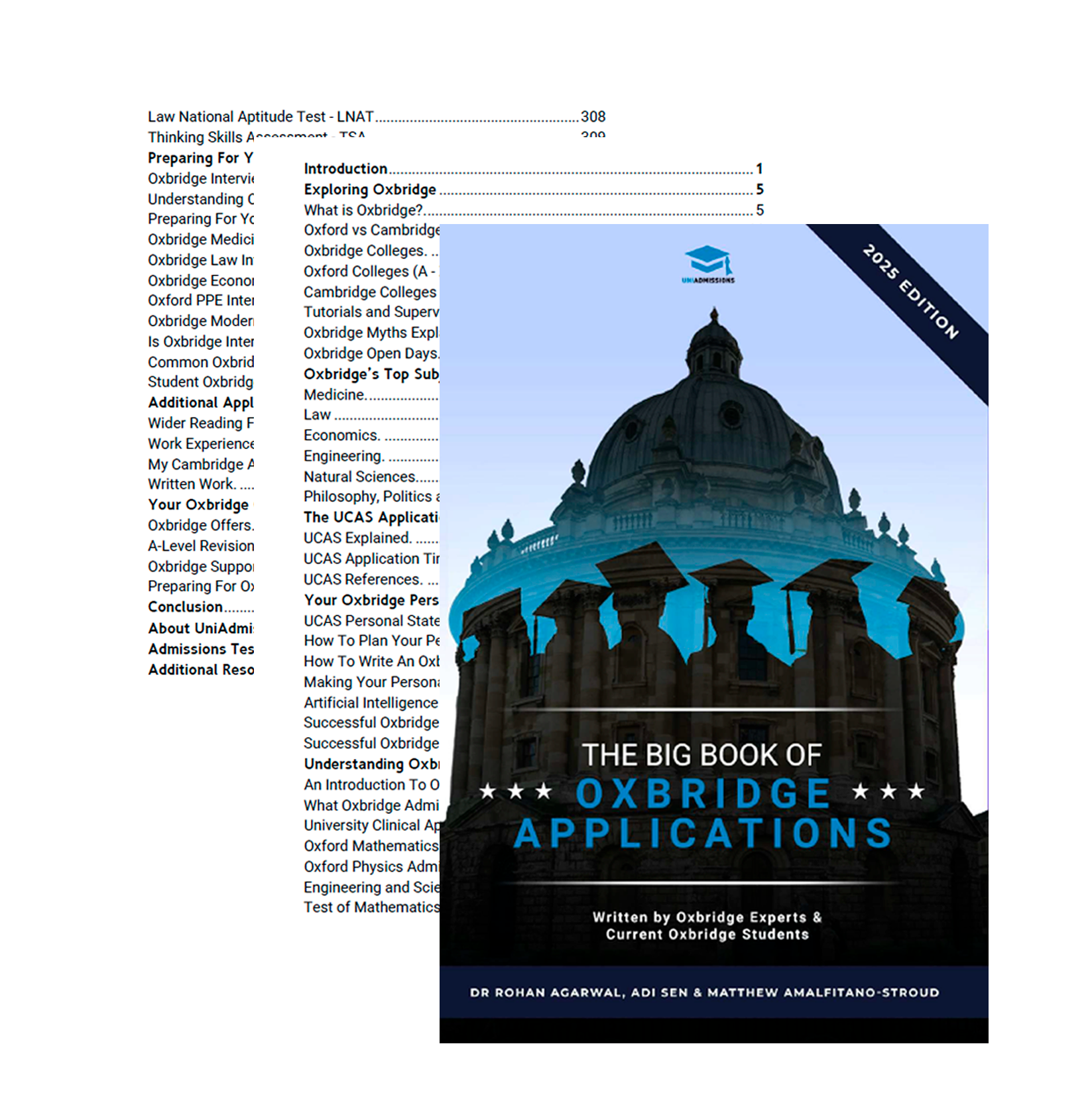
- Over 40 admissions test practice questions
- 28 example Oxbridge Personal Statements
- Interviews with Oxbridge students and graduates
- Additional downloadable resources
The Personal Statement for Cambridge Architecture
The personal statement for Cambridge Architecture is submitted as part of your UCAS application. UCAS has introduced a new format: the traditional 4,000-character free-form essay has been replaced by a series of structured questions relating to your chosen course. This is a significant change that many applicants are still adjusting to.
For Architecture specifically, your personal statement should demonstrate genuine intellectual engagement with the subject — not just enthusiasm for buildings, but evidence of thinking about architecture in a sustained, specific way. Cambridge admissions tutors are looking for:
- Evidence of independent reading and thinking beyond the school curriculum
- Visits to and engagement with real buildings — with reflection, not just tourism
- Supercurricular activities that show you have pursued architecture-related interests seriously
- A sense of why architecture, why Cambridge, and what kind of architect or thinker you want to become
The personal statement is not the primary decision-making tool in Cambridge’s process — that weight falls more heavily on grades, the admissions assessment, the portfolio, and the interview. But it contributes to the holistic picture of your application, and a strong statement can distinguish you in a competitive pool. Below you can watch a video explaining everything you need to know about the new UCAS personal statement.
Cambridge Architecture Interviews, Portfolio & Assessments
Interviews
Cambridge Architecture interviews are conducted by individual Colleges and typically involve one or more members of the academic staff. The interview is academic in nature: tutors are not looking for polished presentation skills, but for intellectual curiosity, the capacity to engage with new ideas, and evidence that you can think analytically about architecture and design.
You will be asked to bring your portfolio to the interview, and tutors will discuss your work with you. The conversation may begin with the work you have brought before moving into broader questions about architecture, design, buildings you have visited or are interested in, and your reading or independent study. Expect to be challenged, questioned, and pushed to think on your feet — this is by design.
How to prepare for your Cambridge Architecture interview
The best interview preparation for Cambridge Architecture combines intellectual breadth with a specific, deep engagement with the subject. Practically, this means:
- Visiting and thinking carefully about buildings — not just famous ones, but everyday ones
- Reading widely: architectural history, theory, criticism, and culture (not just design magazines)
- Being able to discuss your portfolio work with confidence, explaining what interested you, what you were trying to achieve, and what you would do differently
- Practising drawing from observation regularly, so the admissions assessment feels natural
The Portfolio
The portfolio is one of the most distinctive — and most misunderstood — elements of the Cambridge Architecture application. Unlike at many architecture schools, where you might be expected to show architectural drawings, plans or technical work, Cambridge explicitly takes a different approach.
What Should You Include?
Cambridge asks for a portfolio that illustrates your interests, experience and ability in the visual and material arts. Suitable content includes:
- Drawings and paintings (observational, expressive, or conceptual)
- Sculpture (shown through photographs if three-dimensional)
- Photography
- Any other creative visual work
The portfolio should include a variety of subject matter. Work prepared for school-leaving examinations is perfectly acceptable, but creative work you have done outside formal courses is equally — and often especially — welcome. Cambridge is looking for evidence of visual curiosity and creative thinking, not technical architecture skills.
Does It Need to Be Architecture-Specific?
No. Cambridge is explicit on this point: you do not need to include architectural work such as plans, sections or construction drawings. The portfolio is not an assessment of whether you can already do architecture — it is an assessment of whether you have the visual intelligence and creative sensibility to develop as an architect. Admissions tutors are interested in how you see and record the world around you, not in technical skills you have not yet been taught.
As one Cambridge admissions tutor has noted, what matters is demonstrating “an organic and committed interest in the subject” — showing an ability to observe and discuss the built environment in nuanced ways, whether through a sophisticated engagement with canonical architecture or through a careful, thoughtful reading of everyday environments: a school, a train station, a street corner.
How Colleges Differ on Portfolio Requirements
Portfolio requirements are not uniform across Cambridge Colleges, and this is a genuinely important consideration when selecting where to apply. Clare College, for example, requires all Architecture applicants to submit a PDF portfolio of artwork (six A4 pages, under 15MB) before interview as part of the initial application — not just at the interview stage. Other Colleges ask you to bring your portfolio to the interview itself and will let you know in advance what they would like to see.
Always check the specific portfolio guidance published by each College you are considering. If your College requires pre-submission, leaving it until interview is not an option.
The Admissions Assessment
There is an Architecture Admissions Assessment at all Cambridge Colleges for this course, taken by all shortlisted applicants. You do not need to register in advance.
What the Assessment Involves
The Architecture Admissions Assessment is a 30-minute drawing task, taken remotely via Cambridge’s assessment Moodle platform — you can take it at home or at school, whichever has the more reliable internet connection. The assessment is not invigilated, but answers are submitted through the platform and may be checked using anti-plagiarism software. You should not discuss your answers or the paper with anyone else.
Your drawing should be in landscape format on a single sheet (A3 or A4), using pen or pencil. You may make multiple sketches, but should upload only one sheet. You can photograph your drawing with a phone rather than scanning it. An additional 30 minutes is provided for downloading the paper and uploading your response (extended time applies for those with approved access arrangements).
What Cambridge Is Looking For
Cambridge is clear that this task is not about demonstrating technical or formal architectural skills. The drawing assessment is designed to evaluate four things:
- The ability to think in a visual and spatial manner
- The ability to record spatial impressions
- An awareness of your environment
- The ability to interpret your environment in visual terms
A sample task published by Cambridge asks applicants to draw the room in which they are sitting — from any viewpoint, with any combination of single or multiple sketches, with or without people or furniture. The same drawing may also be discussed with you during your subject interview.
This assessment rewards spatial awareness, observation, and the capacity to communicate ideas through drawing — not a pre-existing knowledge of architectural conventions.
Written Assessment
Shortlisted applicants may also be required to sit a subject-specific written assessment at interview. Details vary by College, so refer to the specific guidance published by your shortlisted College(s) and to Cambridge’s central admissions assessments page for up-to-date information.
How Competitive Is Cambridge Architecture?
Admissions data shows that Cambridge Architecture is genuinely competitive. In the 2025 admissions cycle, 562 applications were submitted for Architecture, resulting in 93 offers — an offer rate of 16.5%. Roughly 6 applications per offer. When taking into account the number of acceptances (65 in 2025), then around 9 applications compete for a place.
For context, Cambridge’s overall undergraduate offer rate across all subjects sits at around 22%. Architecture is therefore more selective than the university average, and among the five most competitive Cambridge courses for 2025. Cambridge’s own data on Architecture acceptances shows that offer rates have remained broadly consistent in recent years, making it a reliably competitive course rather than one subject to sharp annual fluctuations.
What the headline offer rate does not capture is the profile of the applicants competing for those places. Because Cambridge Architecture attracts candidates who have self-selected as strong, the 16.5% figure reflects a pool that has already been filtered for academic ambition and creative interest. The bar for receiving an offer is high in every dimension: grades, portfolio, admissions assessment performance, and interview.
The grade data is instructive here. While A*AA is the stated minimum offer level, the vast majority of successful applicants achieved at least A*A*A at A-level, and most IB students who gained entry achieved 43 points or above. Meeting the minimum is a necessary condition for being considered, not a sufficient one.
For a broader view of how selectivity varies by College and by subject across Cambridge, see our Cambridge Acceptance Rates Guide.
Choosing the Right Cambridge College for Architecture
One of the most distinctive features of applying to Cambridge is that you are applying to both the university and a specific College. For Architecture, this choice carries practical weight, because Colleges vary in their entry requirements, portfolio expectations, and admissions processes.
Key things to consider when choosing your Cambridge College:
Subject requirements
Some Colleges specify A-level subjects (e.g. Mathematics or Physics, or an essay-based subject) that others do not. If you do not have those subjects, applying to a College that requires them puts you at a structural disadvantage.
Portfolio pre-submission
Some Colleges (such as Churchill and Downing) require artwork to be submitted as part of the application, not just brought to interview. If your portfolio is not ready at the point of application, this matters.
Written work
Some Colleges require written work to be submitted before interview. Factor this into your preparation timeline.
Offer level
Most Colleges set offers at the minimum university level (A*AA), but a small number may make higher offers or specify which subject the A* must be in. Check each College’s conditions carefully.
Open Application
If you prefer not to name a College, Cambridge allows you to submit an Open Application. You will be assigned to a College based on capacity and suitability, and assessed on the same basis as any other candidate. This is a reasonable option if you have no strong College preference and find the choice overwhelming — it does not disadvantage your application.
The Cambridge Winter Pool also provides a second chance for strong candidates who were not successful at their first-choice College: Colleges with remaining spaces can make offers to pooled candidates, meaning a rejection at one College is not necessarily the end of the road.
Conclusion
Meeting the Cambridge Architecture entry requirements means satisfying a number of distinct components simultaneously — and doing each one well. The minimum A-level offer is A*AA, but data shows that most successful applicants achieve A*A*A or above. The portfolio and admissions assessment add a creative and spatial dimension that distinguishes this application process from almost every other undergraduate course in the UK. And the interview places you in direct academic conversation with the people who will teach you.
The right approach to a Cambridge Architecture application is one that prepares seriously for all of these elements together, rather than treating grades and creative work as separate concerns. Intellectual curiosity, visual intelligence, and academic rigour are not in tension here — Cambridge Architecture requires all three in combination.
If you are exploring other excellent options alongside Cambridge, our UCL Architecture Entry Requirements guide is a useful companion read.
For students who want structured, expert support through every stage of their Cambridge Architecture application — from subject choice and personal statement to portfolio development, admissions assessment practice, and interview preparation — UniAdmissions’ Cambridge Architecture Full-Blue Programme is designed precisely for this purpose.
FAQs
1. Can I apply to Cambridge Architecture without a portfolio?
No. A portfolio is a required component of the Cambridge Architecture admissions process for all shortlisted candidates. Some Colleges also require you to submit artwork before interview — so preparation should begin well before you apply, not after you receive an interview invitation.
2. Is there a gap year (deferred entry) option for Cambridge Architecture?
Yes. Cambridge accepts deferred entry applications for Architecture. You apply in your final year of sixth form as normal through UCAS, and simply indicate that you wish to defer. Colleges generally accept this, though it is worth confirming with your chosen College directly, as attitudes to deferral can vary.
3. Can I apply to Cambridge Architecture if I am resitting my A-levels?
Yes, Cambridge does accept applications from resit candidates. However, Colleges will want to understand the context behind the resit, and you should be prepared to explain this through your UCAS application or via your referee. Having a strong resit performance alongside a compelling overall application is essential — Colleges assess resit applicants holistically.
4: Do I need to have visited famous buildings or have work experience in an architecture firm before applying?
Neither is a formal requirement. Cambridge is more interested in how you think about and engage with architecture than in a CV of prestigious visits or placements. That said, demonstrating genuine curiosity — whether through visiting local buildings and reflecting on them thoughtfully, reading architectural criticism, or pursuing any form of creative practice — is important. Quality of engagement matters far more than the prestige of what you have done.
5: Is Cambridge Architecture open to mature or non-traditional applicants?
Cambridge welcomes applications from mature students and those with non-traditional academic backgrounds. If you are not presenting standard A-level qualifications, your application will be assessed individually. You will still need to demonstrate the academic and creative ability required for the course — typically through an equivalent qualification profile and a strong portfolio — but there is no rule that excludes non-traditional applicants from consideration.
Our expert tutors will guide you to Cambridge Architecture success
Applying to the University of Cambridge is tough, so let UniAdmissions give you the best chance of success. We will guide you through all areas of your Cambridge application.
Discover our Cambridge Architecture Full-Blue Programme for comprehensive admissions support by clicking the button below to enrol and triple your chances of success.

