

Understanding how different subjects perform in the job market can help you choose a degree with more clarity. Some degrees lead almost directly into stable, well-paid roles. Others offer slower or more competitive pathways, with graduates often pursuing further study before reaching secure employment. This guide looks beyond general assumptions and digs into the actual outcomes graduates experience after leaving university.
To provide a fair and meaningful comparison, we analysed official data and used a weighted scoring system to rank every major subject from highest to lowest job prospects.
The result is an evidence-based, four-tier breakdown showing which degrees deliver the strongest career outcomes – both immediately after university and further into graduates’ careers. Whether you’re choosing your degree, considering a career change, or simply curious about how different fields compare, this analysis highlights the subjects that consistently perform well, as well as those that follow more varied or indirect career paths.
Skip to your subject using the links below:

How We Calculated Our Rankings – Methodology
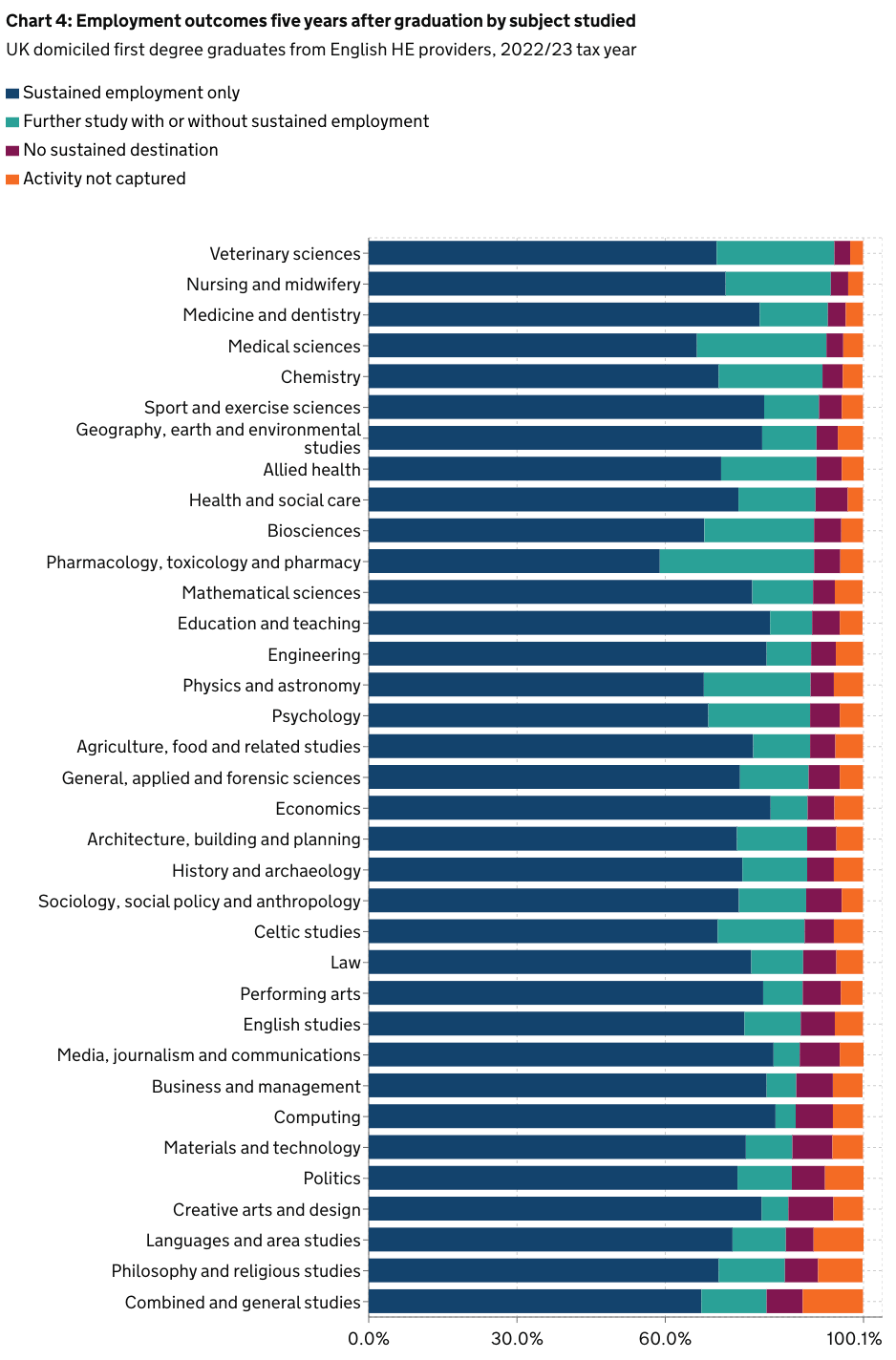
To identify which degrees offer the strongest job prospects, we focused on the latest available data from the Department for Education (DfE), specifically the Longitudinal Education Outcomes (LEO) Graduate and Postgraduate Outcomes publication.This dataset is the most reliable indicator of graduate success because it links real tax records to employment outcomes, providing an accurate picture of how each subject performs in the job market over time.
This data focuses on students who completed their first degree in the 2016-17 academic year, looking at their employment outcomes during the 2022–23 tax year – approximately five years after graduation.
We also consider HESA’s 15-month Graduate Outcomes survey. These additional insights help us identify which degrees perform best overall.
Because the five-year benchmark is widely used in educational research as it provides a clearer, more stable picture of career progression and stability, we gave LEO data a higher weight (70%) when calculating our rankings. This reflects how well graduates from each subject perform once they are established in the job market. The remaining 30% of the score comes from the HESA data, which offers a useful snapshot of early employability.
Data from DfE
According to the LEO publication, graduates from the subjects below have the highest rates of sustained employment (without further study) five years after graduation.
| Rank | Subject | Sustained employment only |
|---|---|---|
| 1 | Computing | 82.30% |
| 2 | Media, Journalism & Communications | 81.90% |
| 3 | Economics | 81.30% |
| 4 | Education & Teaching | 81.20% |
| 5 | Business Management | 80.50% |
Data from HESA
Now, if we look at employment outcomes from a 15 months post graduation perspective, the subjects offering the highest full-time employment rates are:
| Rank | Subject | Sustained employment only |
|---|---|---|
| 1 | Veterinary Sciences | 76.30% |
| 2 | Education & Teaching | 67.60% |
| 3 | Architecture, Building & Planning | 67.60% |
| 4 | Engineering & Technology | 67.50% |
| 5 | Medicine & Dentistry | 67% |
Contradictions Between The Two Data Sets Explained
Interestingly, some subjects show very different outcomes when comparing short-term and long-term data. For example, Pharmacology, Biosciences, Psychology and even Veterinary Sciences have some of the lowest long-term sustained employment rates in the DfE LEO dataset (ranging from 58.9% to 70.4%). This isn’t because graduates struggle to find work, but because a large proportion continue into postgraduate training or professional qualifications, which reduces the number counted as being in “sustained employment” five years on.
However, in the HESA Graduate Outcomes dataset, which looks just 15 months after graduation, Veterinary Sciences actually ranks first with a 76.3% full-time employment rate. This shows that short-term job entry is strong, but many vets later move into locum work, mixed roles, or extended professional development, which lowers the long-term “sustained” classification in LEO. Meanwhile, subjects such as Design and Creative/Performing Arts show the lowest short-term employment rates (43.4%), reflecting a slower entry into the workforce in creative fields.
Want to study at Oxbridge? We can triple your chances of success.
UniAdmissions’ Oxbridge Preparation Programmes have been designed to maximise your chances of getting into the renowned universities of Oxford and Cambridge. Our success rate is 67% – that’s three times the national average of 16%.
You will receive world-class application support from start to finish. Our students have access to expert resources, one-to-one tuition, intensive courses and much more, all designed to give them the best possible chance of success.
Subjects With Mixed Job Prospects (Lower Tier)
While many degrees lead to strong long-term outcomes, some subjects show more mixed job prospects based on both early-career and five-year employment data. These subjects typically have lower sustained employment rates, higher rates of further study, or more varied graduate destinations, resulting in combined scores between 60 and 65. This doesn’t mean they lack value – only that career pathways tend to be broader, less direct, or more competitive. These are:
35. Pharmacology, Toxicology and Pharmacy (59.74)
Graduates in this category show one of the highest rates of further study (31.2%), which lowers the proportion entering sustained employment within five years. Many roles also require postgraduate or professional qualifications, creating a longer route to stable employment. Despite lower early employment rates, long-term prospects improve significantly for those who continue into specialised training.
34. Combined & General Studies (60.49)
Because these degrees are highly interdisciplinary, graduates pursue widely scattered career paths, making employment outcomes more variable. The lack of a clearly defined vocational route contributes to lower sustained employment rates. However, students often benefit from transferable skills that are valuable across multiple fields.
33. Biosciences (62.05)
Biosciences is a popular but competitive field, and many students continue into postgraduate study, which suppresses early employment figures.
32. Philosophy & Religious Studies (63.24)
These humanities degrees equip students with strong critical-thinking and communication skills, but career routes are less directly aligned with specific occupations. This contributes to more mixed employment outcomes and a higher percentage of graduates entering further study.
31. Physics & Astronomy (63.45)
Although technically demanding, Physics and Astronomy graduates often require additional qualifications or specialised pathways to access high-level roles. Many go into postgraduate research, resulting in lower sustained employment at the five-year mark. Employment outcomes vary widely depending on whether graduates pursue academic, engineering, or finance-related careers.
30. Celtic studies (63.49)
As a niche humanities subject with a smaller graduate pool, employment destinations tend to be highly varied and often tied to regional or cultural sectors. Small sample sizes also make year-to-year outcomes more volatile.
29. Psychology (63.51)
Many professional careers in psychology require further postgraduate training, contributing to lower early and mid-term employment rates.
Subjects With Solid Job Prospects (Mid Tier)
These subjects fall within the 65-70 score range, placing them solidly in the mid tier. They generally show good outcomes in employment and career progression, although not as consistently strong as the top-tier fields. Still, graduates can expect stable job prospects with clear opportunities depending on specialisation and industry demand.
28. Medical Sciences (64.99)
This subject offers reliable employability, especially for students who move into specialist clinical or research pathways. Data shows that many choose to pursue further study, which contributes to a mid-tier 5-year post graduation employment rate.
27. Chemistry (65.55)
Chemistry provides versatile career options across research, pharmaceuticals, and industry. Employment rates are steady, though salaries vary widely by sector.
26. Languages and Area Studies (65.59)
Graduates from these subjects go to work in education, translation, and international sectors. Job prospects improve notably when paired with further study such as business or communications, which 10.8% of graduates choose to do.
25. General, Applied & Forensic Sciences (65.95)
Shows consistent outcomes thanks to applied scientific skills valued in labs, regulation, and technical roles. Forensic pathways are competitive but provide stable employment.
24. History & Archaeology (66.6)
Employment rates are decent, with many graduates moving into education, research, or public sector roles.
23. Materials & Technology (66.79)
Strong alignment with engineering and manufacturing sectors supports positive employment results. Skilled graduates are in steady demand across technical industries.
22. English Studies (67.27)
Graduates generally benefit from strong transferable skills that can apply to careers in media, education, and communications. Job prospects are generally solid but may require building experience early on – something that a relatively small portion of graduates from this subject do according to the data from HESA.
21. Allied Health
Allied Health degrees consistently have solid job outcomes due to ongoing demand in healthcare support professions, but sustained employment in the long run is not as strong as some allied to medicine degrees. That’s due to the fact that many graduates pursue further study after graduation.
20. Creative Arts & Design
The subject performs surprisingly well despite the competitive sector and weak early job prospects. Freelancing and mixed career paths are very common here. However, it’s worth noting that Creative Arts and Design is considered one of the hardest degrees in the UK, due to long studio hours, constant demands for original work, and the pressure of subjective assessment and feedback.
19. Performing Arts (68.82)
Employment is often portfolio-based but still relatively strong. Many graduates work across multiple creative areas, boosting overall career outcomes.
18. Nursing & Midwifery (69.05)
A high-demand field with strong employment rates and secure long-term career paths. Workforce shortages can often further boost opportunities.
17. Politics (69.86)
Graduates see solid outcomes across government, policy, and corporate roles. Analytical and communication skills give broad career flexibility.
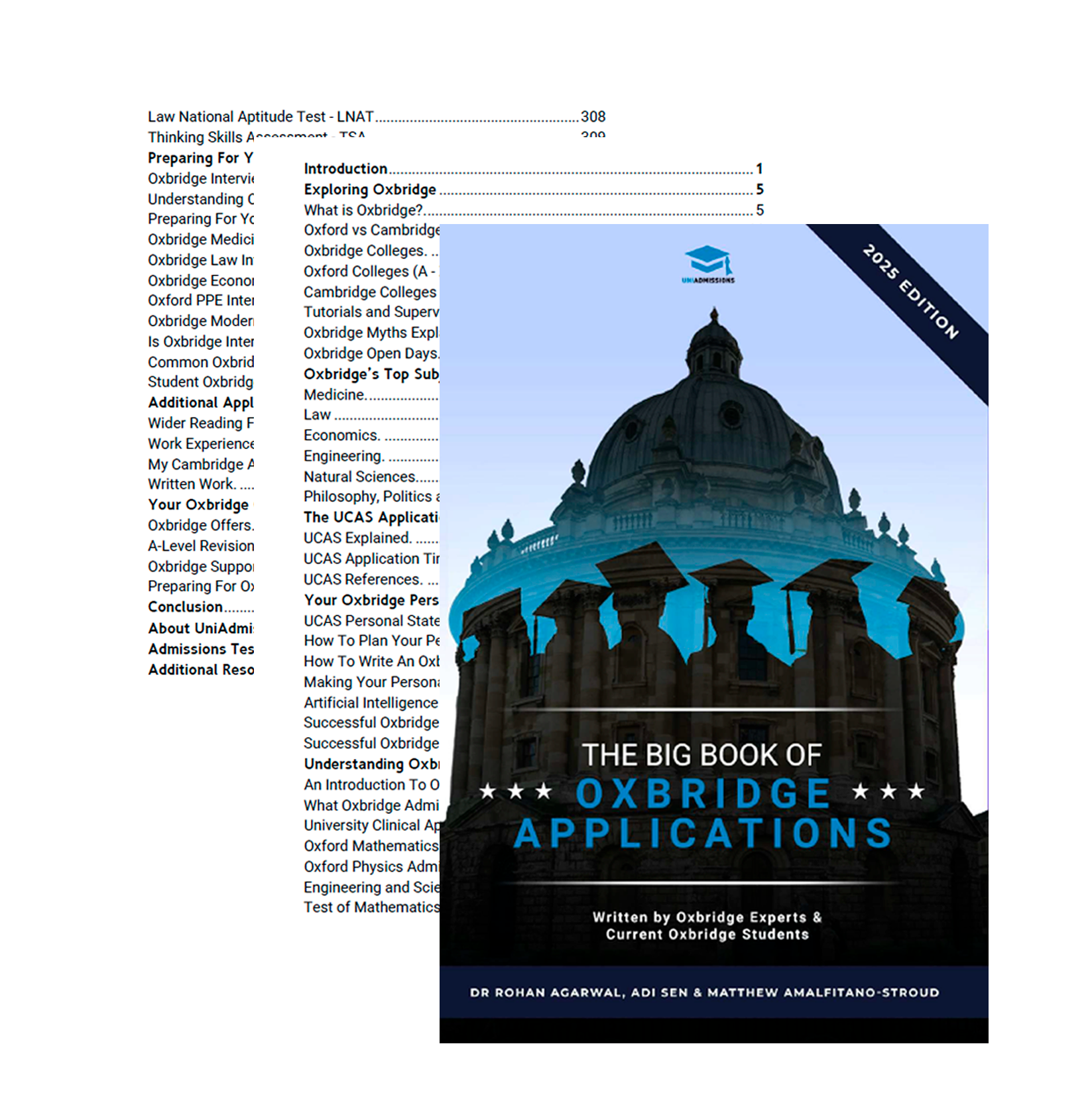
Access "The Big Book Of Oxbridge Applications" For FREE
- Over 40 admissions test practice questions
- 28 example Oxbridge Personal Statements
- Interviews with Oxbridge students and graduates
- Additional downloadable resources
- Free past papers for your specific admissions test to download
Subjects With Strong Job Prospects (Upper-Mid Tier)
The subjects below score 70–75, placing them in the upper-mid tier of our ranking. These degrees consistently show strong long-term employment rates in the DfE LEO dataset and solid early-career outcomes in Graduate Outcomes (HESA), though some fields show higher rates of graduates moving into further study.
16. Health & Social Care (70)
Strong 74.8% sustained employment rate, reflecting stable long-term job demand. The early full-time employment rate is lower because many graduates enter part-time health roles or further qualifications soon after graduating, delaying full entry into full-time work.
15. Sociology, Social Policy & Anthropology (70.07)
With 74.9% long-term employment in LEO, these subjects perform better over time than their early HESA outcomes suggest. HESA shows lower early full-time employment because a large proportion enter postgraduate study or part-time research/assistant roles within 15 months.
14. Mathematical Sciences (71.48)
Maths has 77.6% sustained employment in LEO, showing clear long-term strength. However, HESA full-time employment is lower because many graduates pursue further study (e.g., MSc) or take longer to transition into analytical or technical roles.
13. Law (71.79)
If you’re considering becoming a lawyer, law shows a solid 77.4% five-year employment rate. The modest early career prospect is mainly due to further study and qualifications law graduates pursue to improve their career progression potential.
12. Agriculture, Food & Related Studies (71.92)
This group has a strong 77.8% long-term employment rate, outperforming its HESA early-career score. The lower HESA figure (58.2%) reflects a sizable proportion pursuing technical specialisations or postgraduate environmental/agricultural training before entering full-time work.
11. Veterinary Sciences (72.17)
Vet Sciences are unusual: HESA shows the highest full-time employment rate of any subject (76.3%), yet the LEO long-term figure is a little more modest at 70.4%. This reflects the profession’s high immediate employability but also a trend of vets moving into locum or mixed employment patterns later on, which slightly lowers sustained-employment classification.
10. Architecture, Building & Planning (72.43)
Architecture performs strongly in both datasets: 74.5% sustained employment in LEO and one of the top three highest employments in HESA (67.6%). The slower early earnings trajectory is linked to the profession’s lengthy training stages, but the demand remains consistently strong.
9. Sport & Exercise Sciences (73.4)
With 80% long-term employment, this field performs significantly better in LEO than HESA suggests. The early HESA score is affected by high rates of graduates moving into further study or clinical postgraduate routes, which depresses the early full-time figure despite excellent long-term prospects.
8. Geography, Earth & Environmental Studies (73.97)
This subject ranks well in both datasets: 79.6% long-term employment, with HESA showing reasonable early full-time rates for both natural and social science pathways. Graduates often enter consulting, environmental roles, or technical work that stabilises after the 15-month period.
7. Media, Journalism & Communications (74.49)
Media shows exceptionally strong long-term employment (81.9%), far higher than its relatively low early HESA score (57.3%). And while this subject has one of the lowest further study rates, this pattern reflects a sector where graduates often begin slowly with freelance, part-time, or portfolio work, which later converts into sustained full-time roles.
6. Economics (74.54)
Economics ranks among the highest performers: 81.3% sustained employment in LEO and above-average early HESA outcomes. While many pursue taught master’s degrees, the combination of strong early and long-term results places it at the top of the upper-mid tier. Choosing the right university for economics can also have a huge impact on your career, as well as your salary potential.
Aiming for a degree with strong job prospects? We’ll help you secure an offer from one of the top UK universities.
Applying to Oxbridge and other G5 Universities is immensely competitive. We’ve helped over 1,000 students craft the perfect personal statement, achieve a highly competitive admissions test score, and perform well in their interviews – securing offers from top UK universities, including Oxford, Cambridge, Imperial, UCL, and LSE.
Discover our Full-Blue Programmes today to learn how we can support you during the competitive application process.
The Five Degrees With The Best Job Prospects (Top-Tier Subjects)
These degrees scored 75+ in our weighted ranking – meaning they combine excellent long-term employment outcomes with strong or stable early-career performance (without further study). Across all subjects, these five consistently rise to the top for job security, employability, and early-to-mid career progression.
5. Computing (75.31)
Computing graduates achieve an 82.3% sustained employment rate – the highest long-term figure of any subject. What makes this especially notable is that Computing’s HESA full-time employment rate is much lower (59.7%), and alongside the lowest further study rate of 4.1%, it suggests that many graduates initially take on contract roles, freelance work, or hybrid study–work routes. Despite the slower structured entry into the workforce, demand accelerates rapidly by the five-year mark. In short: early paths differ, but the long-term job market overwhelmingly favours computing graduates.
4. Medicine and Dentistry (75.4)
With 79.1% sustained employment and one of the strongest early employment rates (67%), Medicine & Dentistry (two of the highest paying degrees in the UK) are consistently stable across both timeframes. The alignment between short-term and long-term outcomes reflects the highly structured and professionally regulated pathway: almost all graduates move directly into full-time clinical training posts within 15 months, and the demand remains extremely high five years later. Unlike other subjects, further study contributes positively to employment, since postgraduate clinical training is effectively a guaranteed employment route.
3. Business and Management (75.42)
Business & Management is one of the most consistent all-round performers, with 80.5% long-term sustained employment and a strong early full-time rate of 63.4%. The field benefits from a broad labour market: business graduates enter finance, consulting, operations, marketing, HR, and tech-adjacent roles. A relatively small proportion go into further study, meaning most graduates enter the workforce quickly and progress steadily over five years. Its versatility, combined with strong employer demand across sectors, places Business & Management firmly in the top tier.
2. Engineering (76.55)
Engineering has one of the strongest combined scores thanks to an excellent 80.5% long-term employment rate and one of the highest early employment figures (67.5%). The data shows Engineering is a subject where graduates are employed early and stay employed, reflecting structured graduate schemes, placement-heavy degrees, and consistently high employer demand across civil, mechanical, electronic, and aerospace sectors. Engineering’s top-tier position is reinforced by the low proportion of graduates needing further study, meaning that if you’re considering engineering as a career, you’re very likely to step into a stable, and possibly highly paid technical role soon after graduation.
1. Education and Teaching (77.08)
Education & Teaching takes the top spot with an exceptional 77.08 combined score, driven by a high 81.2% sustained employment rate and the second-highest early full-time employment rate across all subjects (67.6%). The standout feature of this subject is its stability: almost all graduates move directly into employment via structured teacher training routes, and demand remains high five years later due to nationwide teacher shortages. Compared with other professional pathways like Law or Architecture, Education has one of the shortest, most direct routes into a full-time, secure career — and the data reflects this clarity.
Key Takeaways
Choosing a degree is one of the most important decisions you’ll make – and the data shows that the pathway from university to employment is far more nuanced than simple league tables suggest.
Degrees with structured professional pathways – such as Education, Engineering, and Medicine – deliver consistently strong job prospects, both early on and at the five-year mark. Meanwhile, fields like Computing and Media show that slower early employment rates don’t necessarily limit long-term success, as both see some of the highest sustained employment levels later on. Subjects with higher rates of further study, such as Pharmacology and Medical Sciences, illustrate a different pattern: career progression often takes longer, but postgraduate training typically leads to more specialised and rewarding roles.
Ultimately, there is no single “right” degree — only the degree that aligns with your strengths, ambitions, and the kind of future you want to build. Understanding the employment patterns behind each subject can help you make a more informed decision, but your priority should always be choosing a field that genuinely motivates you and supports the career direction you see yourself pursuing. When interest, ability, and long-term opportunity align, you’re far more likely to succeed — regardless of where a subject sits in the rankings.
At UniAdmissions, we specialise in helping students secure places on some of the most competitive degrees in the UK at top universities, including Oxbridge and the Russell Group. Our expert support covers every stage of the application process – personal statements, admissions tests, and interview preparation – designed to triple your chances of receiving an offer. Whether you’re aiming for Engineering, Computer Science, Medicine, Dentistry, or other, our tailored programmes give you the structure, insight, and confidence needed to stand out in an increasingly competitive admissions landscape.
Aiming for an Oxbridge offer? We’ll help you secure one.
Applying to Oxbridge is immensely competitive, and you must give yourself the best chance of success. We help you craft the perfect personal statement, achieve a highly competitive admissions test score and teach you how to interview effectively – covering all areas of your Oxbridge application.
Discover our Oxbridge Full-Blue Programmes today.

