

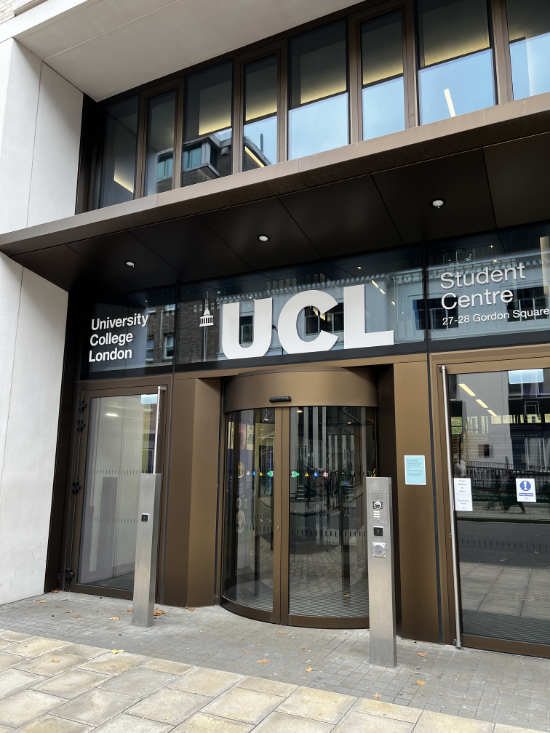
University College London (UCL) is ranked among the top ten universities in the UK for Psychology in 2026 by major national league tables, including The Guardian, The Complete University Guide, and The Times/Sunday Times Good University Guide. As a leading global research institution, UCL attracts a large volume of high-achieving applicants each year, making Psychology one of its most competitive undergraduate courses.
The main single-honours undergraduate Psychology degrees available at UCL include:
This guide breaks down the UCL Psychology BSc entry requirements in detail, covering A-levels, alternative qualifications, GCSE expectations, and key admissions considerations. We also review admissions data from previous cycles to provide insight into the course’s competitiveness and offer practical advice on writing a compelling personal statement.
Available Psychology Degrees At UCL
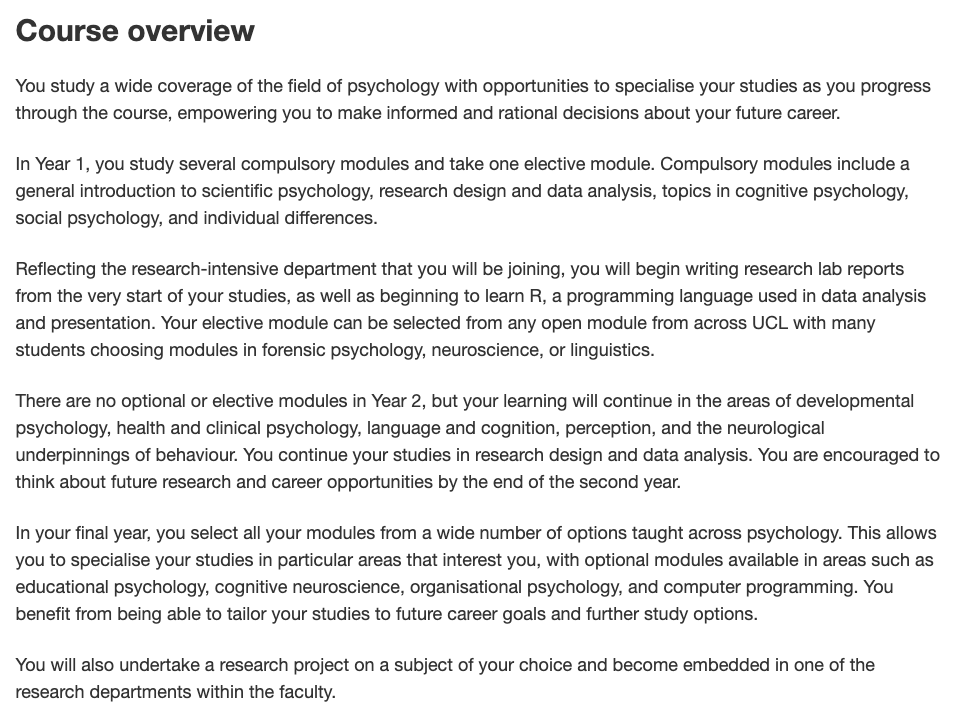
University College London offers two highly focused undergraduate Psychology degrees through its Division of Psychology and Language Sciences. Each course is research-led and designed to provide a strong scientific foundation in psychological theory, research methods, and data analysis.
The main single-honours undergraduate Psychology degrees available at UCL are:
A three-year full-time course providing a broad and rigorous introduction to scientific psychology. The programme covers core areas such as cognitive psychology, social psychology, developmental psychology, neuroscience, and research methods, while offering increasing opportunities to specialise in your final year.
A four-year integrated master’s course designed for students with a strong interest in research or postgraduate study. The MSci includes advanced research training, additional specialist modules, and a substantial research project, offering deeper engagement with psychological science than the BSc route.
Both degrees are accredited by the British Psychological Society (BPS), meaning graduates are eligible for Graduate Membership, which is the essential first step toward professional training in psychology (including clinical, educational, and occupational psychology).
The core structure and entry requirements for the BSc and MSci routes are closely aligned, with the MSci intended for students who already have a clear interest in research-intensive study or a future academic career. Any differences in entry requirements between these two programmes are highlighted in this guide.
UCL also offers several Psychology-related joint degree programmes, including:
The entry requirements for the joint BSc degrees are typically slightly lower than those for the single-honours Psychology BSc, often set around AAA, although this can vary by year. An exception is the Psychology and Language Sciences MSci, which generally requires higher grades due to its integrated master’s structure.
This guide focuses on the single-honours Psychology courses at UCL (Psychology BSc and Psychology MSci). Applicants considering alternative Psychology-related courses should consult the official UCL course pages for the most up-to-date entry requirements.
Secure an offer to study at UCL with support from UniAdmissions.
For over a decade, we’ve been getting students into the top univerisities in the UK, including UCL, Oxford, Cambridge and more. Through our carefully crafted suite of resources and our vast team of tutors, we will triple your chances of getting your offer.
Discover our UCL Preparation Programme by clicking the button below.
What Type of Psychology Student is UCL Looking For?
UCL’s Psychology courses are particularly well suited to students who are passionate about the scientific foundations of psychology. The programme is highly focused on evidence-based approaches, hypothesis testing, and data analysis from the first year. As a result, UCL is likely to favour applicants who are curious, analytical, and motivated by understanding human behaviour through scientific methods rather than purely theoretical discussion.
The course structure suggests that UCL values applicants who are comfortable engaging with research-led learning. Students begin writing lab reports early in the degree and develop quantitative and analytical skills throughout the programme, including the use of statistical tools and programming. Strong applicants are therefore likely to demonstrate an interest in research, experimentation, or critical evaluation of psychological evidence, either through their academic studies or wider reading.
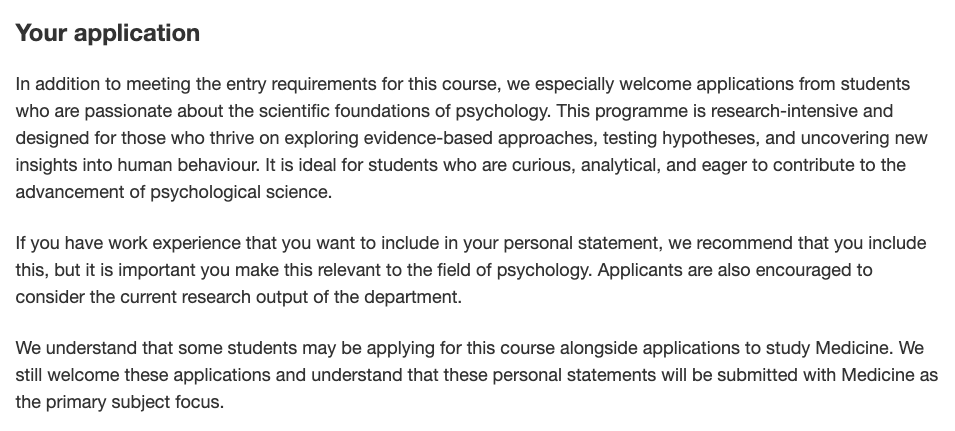
UCL also encourages applicants to reflect thoughtfully on relevant experience and academic engagement in their personal statement. Any work experience included should be clearly linked to psychology, while showing awareness of the department’s current research strengths can help demonstrate genuine interest in the course. Applications from students also applying to Medicine are welcomed, and UCL recognises that these personal statements may not be exclusively focused on psychology.
UCL Psychology Entry Requirements
Below are the entry requirements for UCL’s main Psychology programmes:
General GCSE Requirements
To meet the minimum GCSE requirements, you must have achieved:
- English Language – Grade 6 (B)
- Mathematics – Grade 6 (B)
- Two Science subjects – Grade 6 (B)
(Double Award / Combined Science is acceptable)
These requirements highlight the importance that UCL places on numeracy, scientific thinking, and academic literacy, all of which are essential for a research-led psychology degree. Mathematics and Science GCSEs are particularly relevant due to the course’s emphasis on data analysis, research methods, and evidence-based psychology from the first year.
While meeting these GCSE requirements does not guarantee an offer, strong performance – especially in Maths and Science – can help strengthen a competitive application.
A-Level Requirements
Compared to GCSEs, A-Levels hold much greater significance and are often the most crucial aspect of your application.
Typical A-Level Offer
Grades: A*AA
Your offer must include A*A in two subjects from the following list:
- Biology
- Chemistry
- Mathematics
- Physics
- Psychology
For example, common and well-aligned subject combinations include Psychology with Biology, Psychology with Mathematics, or Biology and Chemistry. This subject combination is particularly well suited to the research-led nature of the course, which places early emphasis on data analysis, research design, and evidence-based approaches to understanding human behaviour.
For a competitive application, it is highly recommended to also present at least one other traditional science or quantitative subject, as UCL values analytical and scientific preparation over purely essay-based study.
Contextual A-Level Offer
If you are eligible for a contextual offer, the A-level offer is:
Grades: A*AC
As in the standard A-level offer, your contextual offer must include A*A in two subjects from the following list:
- Biology
- Chemistry
- Mathematics
- Physics
- Psychology
Alternative Qualifications
UCL accepts several qualifications as alternatives to A-levels; however, Access to HE Diploma, BTEC National Diploma, T Levels, and UAL Extended Diploma are not accepted for entry to these two programmes. The Welsh Baccalaureate is accepted for the BSc route but it is not accepted for the MSc route.
If you are an overseas applicant or do not hold any UK qualifications, you should consult the official course pages to see which country-specific qualifications are accepted.
The following qualifications are typically accepted as alternatives to A-levels:
International Baccalaureate (IB) Diploma
UCL accepts the International Baccalaureate Diploma as an alternative to A-levels for entry to the BSc Psychology programme. Offers are made based on overall points as well as performance in Higher Level (HL) subjects, with particular emphasis on scientific and analytical preparation.
Typical IB Offer – Points: 39 overall
Applicants must achieve a total of 19 points across three Higher Level subjects, including grades 7 and 6 in two subjects from the following list:
- Biology
- Chemistry
- Mathematics
- Physics
- Psychology
For Psychology MSci applicants only: No Higher Level subject may be graded below 5. If Mathematics is offered at Higher Level, UCL accepts both Mathematics: Analysis and Approaches and Mathematics: Applications and Interpretation.
Contextual IB Offer – Points: 36 overall
Applicants must achieve a total of 17 points across three Higher Level subjects, including grades 7 and 6 in two subjects from:
- Biology
- Chemistry
- Mathematics
- Physics
- Psychology
For both programmes (PsychologyBSc and MSc), no Higher Level score may be below 5, and both Higher Level Mathematics pathways (Analysis and Approaches or Applications and Interpretation) are accepted.
Cambridge Pre-U Principal Subjects
UCL also accepts the Cambridge Pre-U as an alternative to A-levels. Applicants are required to achieve D2, D3, D3 in three Cambridge Pre-U Principal Subjects. This must include D2 and D3 in two subjects from the following list:
- Biology
- Chemistry
- Mathematics
- Physics
- Psychology
Scottish Advanced Highers
Scottish Advanced Highers are also accepted. The typical offer is:
- A1, A, A at Advanced Higher, or
- A1, A at Advanced Higher and A, A, A at Higher
- Applicants must achieve A1 and A at Advanced Higher in two subjects from the following list:
- Biology
- Chemistry
- Mathematics
- Physics
- Psychology
Welsh Baccalaureate
Applicants from Wales can apply to UCL’s BSc Psychology course only using the Welsh Baccalaureate when it is taken alongside A-levels. However, the Welsh Baccalaureate is not accepted for entry to the MSci Psychology route. The typical offer is:
- Successful completion of the Welsh Baccalaureate Advanced Skills Challenge Certificate, and
- Two GCE A-levels at A*AA overall.
- A*A must be achieved in two subjects from the following list:
- Biology
- Chemistry
- Mathematics
- Physics
- Psychology
Personal Statement
During your application, you will need to submit a personal statement. Personal statements can be up to 4,000 characters long, split across three questions.
How To Write A Strong Personal Statement For UCL Psychology
Your personal statement offers a great opportunity to show UCL why you are a strong candidate for Psychology. The admissions team is looking for students who are not only academically capable but also passionate about understanding human behaviour through a scientific and evidence-based approach. Around 75–85% of your statement should focus on Psychology, demonstrating your engagement with the subject. This could include examples from your studies, relevant projects or work experience, research experience, or wider reading that shows your curiosity about cognitive, social, developmental, or clinical psychology.
It’s also important to reflect on your experiences in detail. UCL values applicants who can think critically and analytically, so go beyond simply listing activities. For example, if you participated in a research project, attended a psychology lecture, or completed a relevant work experience placement, explain what you learned, how it sparked further interest, and which skills you developed, such as data analysis, problem-solving, or scientific reasoning. This reflective approach helps convey your readiness for a research-intensive programme where independent thinking and engagement with cutting-edge psychology research are central.
Finally, while the majority of your statement should focus on psychology, you should also highlight relevant extra-curricular activities, achievements, and personal qualities that illustrate your broader potential. Evidence of teamwork, leadership, volunteering, or participation in competitions can show how you might contribute to the UCL community. Keep your examples specific, avoid vague statements or clichés, and ensure your statement is well-structured and carefully proofread. Above all, let your enthusiasm for psychology shine – admissions selectors want to see applicants who are genuinely motivated and prepared to thrive in one of the UK’s most competitive psychology programmes.
English Language Requirements
If you are not a national of one of the following countries, you will need to provide recent evidence of one of the following before you become a student at UCL Psychology:
- 12 months education which leads to an academic qualification in a majority English-speaking country
- An English language qualification or test result accepted by UCL, such IELTS or other at a level equivalent to Level 3
- Completed a school leaving qualification containing English, accepted by UCL
Recognised English-speaking countries:
- Antigua and Barbuda
- Australia
- the Bahamas
- Barbados
- Belize
- the British overseas territories
- Canada
- Dominica
- Grenada
- Guyana
- Ireland
- Jamaica
- Malta
- New Zealand
- St Kitts and Nevis
- St Lucia
- St Vincent and the Grenadines
- Trinidad and Tobago
- UK
- USA
Interviews
UCL Psychology programmes do not typically require interviews. Offers and admissions decisions are based on your UCAS application, including predicted and actual grades, your personal statement, your school reference and, where relevant, English language proficiency.
UCL Psychology Acceptance Rate
You might be wondering, “How competitive is admission to Psychology at UCL?” By examining available admissions data from previous cycles, we can provide insight into how selective the programme is and what your chances are if you meet the minimum entry requirements.
Three-Year Total (2023-2025)
Applications: 7,936
Offers: 1,004
Places: 429
Offer Rate: 12.7%
Offer-holder Acceptance Rate: 42.7%
Overall Enrolment Rate: 5.4%
2025 Entry
Applications: 2,428
Offers: 423
Places: 169
Offer Rate: 17.4%
Offer-holder Acceptance Rate: 40%
Overall Enrolment Rate: 7.0%
2024 Entry
Applications: 2,815
Offers: 301
Places: 139
Offer Rate: 10.7%
Offer-Holder Acceptance Rate: 46.2%
Overall Enrolment Rate: 4.9%
2023 Entry
Applications: 2,693
Offers: 280
Places: 121
Offer Rate: 10.4%
Offer-Holder Acceptance Rate: 43.2%
Overall Enrolment Rate: 4.5%
How Competitive is UCL Psychology?
Three-Year Overview (2023-2025)
Across the three most recent admissions cycles (2023–2025), Psychology at UCL has been highly competitive. A total of 7,936 applications were submitted for just 429 available places, resulting in an overall enrolment rate of 5.4%. This means that only around 1 in 19 applicants ultimately secured a place. Even reaching the offer stage is challenging: only 12.7% of applicants received an offer over this period. Of those who received an offer, fewer than half went on to enrol, with an offer-holder acceptance rate of 42.7%. The remainder either did not meet their offer conditions (such as academic grades) or chose to decline their offer in favour of other options.
Recent Trends
The 2025 entry cycle shows a notably higher offer rate (17.4%) compared with 2023 (10.4%) and 2024 (10.7%), alongside a higher overall enrolment rate (7.0%). This suggests that, in the most recent cycle, applicants had a slightly better chance of receiving an offer and ultimately enrolling. One likely explanation is a reduction in application volume in 2025 compared with 2024, combined with a higher number of offers issued, possibly as part of yield management to ensure all places were filled in a competitive sector-wide admissions environment.
However, this should not be interpreted as a substantial easing of competition. Even in 2025, fewer than 1 in 6 applicants received an offer, and only 7% of applicants ultimately enrolled. The dip in offer rates seen in 2024, followed by a rebound in 2025, points more towards year-on-year fluctuations in applicant demand and institutional offer-making strategies rather than a sustained trend towards lower selectivity. Overall, UCL Psychology remains a very competitive programme, and applicants should approach it as a high-risk choice within a balanced UCAS application strategy.
Conclusion
Applying for Psychology at UCL is highly competitive, and meeting the minimum entry requirements is just the first step. Successful applicants are those who not only achieve strong grades but also demonstrate genuine curiosity and engagement with psychology, as evidenced through their personal statement. Thoughtful reflection on research involvement, work placements, and wider reading can help your application stand out, particularly for a research-intensive programme like UCL Psychology.
Overall, careful planning, attention to UCL’s entry requirements, and clear demonstration of your analytical, scientific, and research-focused skills will help strengthen your application.
If you are not sure whether Psychology at UCL would be a good fit, you can learn about Pscyhology at Oxbridge through our dedicated guides: Oxford Psychology Entry Requirements and Cambridge Psychology Entry Requirements.
UniAdmissions’ UCL Programme offers tailored support to help students strengthen their applications and approach the process with confidence. Book a free consultation to learn more.
Our expert tutors will guide you to UCL success
If you want to compete amongst the top applicants for UCL, you’ll need support from experts.
Discover our UCL Full-Blue Programme for comprehensive admissions support by clicking the button below to enrol and triple your chances of success.
fAQs
1. What if I don’t meet the entry requirements for UCL Psychology?
If your current qualifications do not meet UCL’s standard or contextual offers, you may consider completing an Undergraduate Preparatory Certificate (UPC) or foundation programme. These courses are designed to help students strengthen their academic skills and gain eligibility for undergraduate entry.
2. Can international students apply to UCL Psychology?
Yes. International applicants are welcome, but you must meet the required academic qualifications equivalent to UK standards and provide proof of English language proficiency at Level 3 (e.g., IELTS, TOEFL, or equivalent).
3. Do I need work experience to apply?
Work experience is not mandatory, but relevant placements or research exposure in psychology or related fields can strengthen your personal statement. Make sure to reflect on what you learned and how it developed your analytical and scientific skills.
4. How important is my personal statement for UCL Psychology?
Extremely important. UCL looks for students who are not only academically capable but also genuinely interested in psychology. Around 75–85% of your statement should focus on the subject, demonstrating curiosity, research engagement, reflection, and critical thinking, while the remaining portion can highlight transferable skills and extra-curricular achievements.

