Durham University is ranked among the top ten universities in the UK for Mathematics by major national league tables, including The Guardian University Guide and The Complete University Guide. As a member of the Russell Group, the Durham Maths entry requirements reflect the academic rigour of the programme.
Although the Durham Maths entry requirements may initially appear less demanding than those of some other Russell Group Mathematics courses– such as Warwick Maths – applicants are still expected to achieve strong academic results. Prospective students are also encouraged to take a mathematics admissions test, such as the TMUA or STEP, to strengthen their application.
In this guide, we examine the Durham Maths entry requirements in detail and use admissions data from previous cycles to provide context on competitiveness. We also outline specific requirements for international students and practical steps applicants can take to improve their chances of admission.
Available Mathematics Degrees At University of Durham
Within Durham’s Department of Mathematical Sciences, there are four courses, including two MMath options. These are:
- BSc Mathematics (UCAS code: G100), which is a 3-year full-time course leading to a Bachelor’s degree
- MMath Mathematics (UCAS code: G103), which is a 4-year full-time course leading to a Master’s degree
- BSc Mathematics and Statistics (UCAS code: G111), which is a 3-year full-time course leading to a Bachelor’s degree
- MMath Mathematics and Statistics (UCAS code: G114), which is a 4-year full-time course leading to a Master’s degree
The first two years of both MMath courses follow a similar structure to their BSc counterparts, but from the third year onwards offer a broader range of modules that explore advanced mathematical and statistical techniques in greater depth.
The entry requirements for these four degrees are identical, and Durham University recommends that applicants take the TMUA or STEP.
Secure an offer to study Maths at Durham with support from UniAdmissions.
For over a decade, we’ve been getting students into the top univerisities in the UK, including Durham, UCL, Oxford, Cambridge and more. Through our carefully crafted suite of resources and our vast team of tutors, we will triple your chances of getting your offer.
Discover our Maths Preparation Programme by clicking the button below.
What Type Of Maths Student Is Durham Looking For?
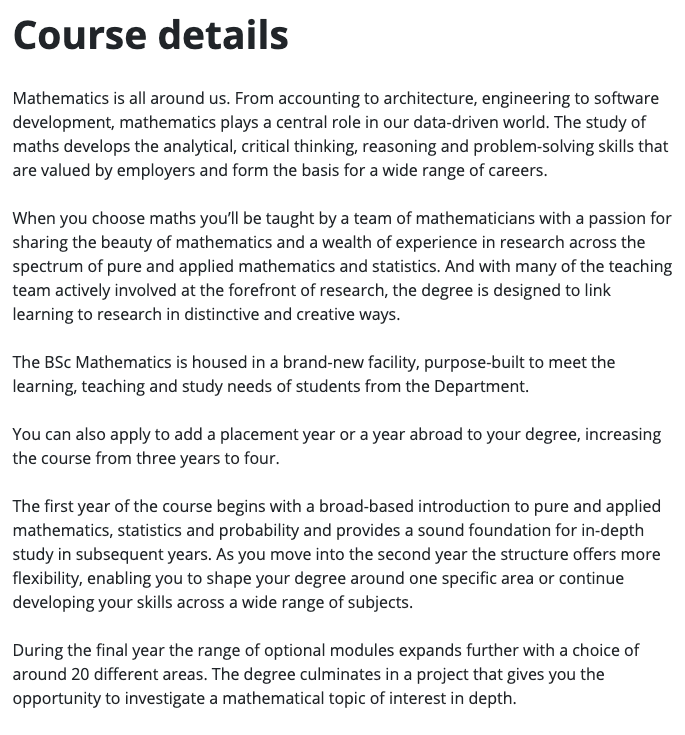
Mathematical Sciences at Durham University offer broad and rigorous curriculums covering Pure Mathematics, Applied & Computational Mathematics, Statistics, Mathematical & Theoretical Physics and Probability. Teaching is strongly research-led, with many members of the department actively involved in current mathematical research. As a result, the courses place particular emphasis on analytical thinking, problem-solving, and the ability to engage with abstract concepts in depth.
The structure of the Mathematics BSc (G100) course reflects this academic focus. The first year provides a broad foundation across core areas of mathematics, while the second and final years offer increasing flexibility, allowing students to specialise or continue studying a wide range of mathematical disciplines. In the final year, students complete an independent project, which further highlights the importance Durham places on independent thinking and academic exploration.
For applicants, this means that meeting the Durham Maths entry requirements is only one part of a strong application. While high grades are essential, successful applicants are also expected to demonstrate genuine academic interest in the subject beyond the syllabus. You may include evidence of independent problem-solving, wider reading in Mathematics, participation in maths competitions or enrichment activities, or engagement with mathematical topics outside the classroom.
The personal statement is a key opportunity to demonstrate this academic curiosity. You should aim to show not only what you have studied, but why you are interested in mathematics and how you have developed your skills in reasoning, analysis, and independent learning.
Durham Maths Entry Requirements
Below are the entry requirements for Mathematical Sciences at Durham University.
General GCSE Requirements
For Mathematics at Durham University, A-level qualifications are the primary focus of the admissions process. While GCSE performance is considered, it plays a secondary role compared to post-16 study.
Durham does not specify formal GCSE subject or grade requirements for Mathematics. However, as with most competitive UK university courses, applicants are generally expected to have achieved at least a Grade 4 (C) in GCSE Mathematics and English. These are standard baseline expectations across UK higher education rather than specific requirements set by Durham.
The particular GCSE subjects taken are unlikely to have a significant impact on an application, as Mathematics is a compulsory subject at GCSE level. While some schools offer GCSE Further Mathematics, holding this qualification is not required and typically does not provide a meaningful advantage in the admissions process. Similarly, optional GCSEs such as Statistics or ICT are not decisive for Maths admissions.
Overall, GCSEs are best viewed as a supporting component of an application, with far greater emphasis placed on A-level Mathematics (and Further Mathematics, where available) and overall academic performance.
A-Level Requirements
For applicants taking A-levels, Durham University sets high academic expectations for the Mathematics BSc (G100), reflecting the quantitative and theoretical demands of the course.
Typical A-Level Offer
A-Level Offer: A*A*A:
- A*A* in Mathematics and Further Mathematics, and
- A in another subject
Alternatively, applicants may receive an offer of A*AA, including A*A in Mathematics and Further Mathematics, provided they achieve a suitable performance in an accepted mathematics admissions test.
A-Level Offer: A*AA:
- A*A in Mathematics and Further Mathematics, and
- Suitable performance in either the TMUA or STEP
Contextual A-Level Offer
Durham also makes contextual offers to eligible applicants. The typical contextual A-level offer is A*A*C, which must include A*A* in Mathematics and Further Mathematics. In some cases, contextual applicants may receive an offer of A*AB or A*AC, including A*A in Mathematics and Further Mathematics, again subject to a suitable performance in an accepted mathematics admissions test.
Grades: A*A*C
- A*A* in Mathematics and Further Mathematics, and
- Suitable performance in either the TMUA or STEP
Alternative Qualifications
In addition to A-levels, Durham University accepts several alternative UK, EU, and other international qualifications for entry to its courses. If you’re applying with alternative qualifications you will need to consult the official university pages, as requirements can vary depending on factors such as the country of study. Some UK qualifications, such as the Welsh Baccalaureate, are not normally accepted toward offers for Mathematics.
These qualifications include but are not limited to:
BTEC/OCR
Applications from students taking a BTEC Level 3 National Extended Diploma or OCR Cambridge Technical Extended Diploma are also accepted, with expected grades of D*D*D to D*DD. Applicants must also meet the A-level requirements outlined above where applicable.
BTEC/OCR Offer:
- D*D*D to D*DD and
- A-level requirements
International Baccalaureate Diploma (IBD)
Standard offer: 38 points, including 7 in Higher Level Mathematics (Analysis & Approaches), and 7–7–6 in the remaining Higher Level subjects or 7-6-6 in higher level subjects, including a 7 in Higher Level Mathematics (Analysis & Approaches) and a suitable performance in an accepted mathematics test.
Scottish Highers and Advanced Highers
- Recognised in place of A-levels, with grade requirements depending on the combination
- Advanced Highers are preferred where available; Highers may be considered if Advanced Highers are not offered
- Specific subjects are usually required at Advanced Higher level (e.g., Mathematics)
Admissions Test Recommendations
While Durham University does not require an admissions test for entry to the Mathematics BSc (G100) or related courses, applicants are strongly encouraged to sit an additional mathematics test if available.
The purpose of the test is to demonstrate mathematical ability and problem-solving skills beyond standard qualifications which helps the admissions team identify candidates most likely to succeed on the course. Additionally, by taking a test and achieving a sufficiently high score may entitle you to a reduced offer, lowering the grade requirements for entry. For more details on scoring, consult our TMUA Scoring & Results 2025 Guide.
Personal Statement
As is standard for any university application in the UK, you will need to write and submit a personal statement as a part of your UCAS Application. The statement will be submitted digitally, is written in three parts and cannot exceed 4,000 characters.
The personal statement provides context for your application and acts as a short sales pitch for yourself as a potential student, all based on three questions that have been set by UCAS. It’s your chance to explain why you want to study mathematics, discuss your experiences with the subject both in and out of school, and showcase what you can contribute to the university if accepted.
Durham University doesn’t have formal scoring or specific requirements for personal statements, but generally, most universities consider factors like your motivation, community involvement, work experience, leadership skills, and extracurricular activities.
English Language Requirements
If you have not recently completed a qualification equivalent to a UK degree in one of the recognised English-speaking countries, you will need to prove your knowledge of English. This is commonly achieved through English Language Proficiency Tests, such as Academic IELTS and PTE, which generally should be taken within two years and one month before the start date of your course. The language level required for Mathematical Sciences at Durham is Band B.
Recognised English-speaking countries:
- Antigua and Barbuda
- Australia
- the Bahamas
- Barbados
- Belize
- the British Overseas Territories
- Dominica
- Grenada
- Guyana
- Ireland
- Jamaica
- Malta
- New Zealand
- St Kitts and Nevis
- St Lucia
- St Vincent and the Grenadines
- Trinidad and Tobago
- UK
- USA
You also do not need to prove your knowledge of English if:
- You’re a national of Canada
Interviews
For Maths at Durham you will not need to give an interview as part of your application.
How Competitive is Maths at Durham University?
While some admissions data from more recent entries were excluded from the University’s response to a FOI (Freedom of Information) request, data from previous years provides useful context when assessing how competitive Maths at Durham University is..
For example, in the 2022/23 admissions cycle, the G100 Mathematics BSc course had an offer rate (offers divided by applications) of approximately 80%. However, success rates beyond the offer stage were significantly lower, with an offer-holder acceptance rate (enrolled students divided by offers) of around 29% and an overall enrolment rate (enrolled students divided by applications) of approximately 23%.
This gap indicates that while a large proportion of applicants may meet the minimum entry requirements, successful applicants are typically those who achieve the required grades comfortably and present a strong overall academic profile.
2025/26 Entry
Applications: 1,918
Offers: 436
Places: 139
Offer Rate: 22.7%
Offer-holder Acceptance Rate: 31.9%
Overall Enrolment Rate: 7.2%
2024/25 Entry
Applications: 2,428
Offers: 423
Places: 169
Offer Rate: 17.4%
Offer-Holder Acceptance Rate: ≈40%
Overall Enrolment Rate: ≈7%
How Competitive is UCL Psychology?
The admissions data from the past two cycles highlights just how competitive Psychology at UCL is. With 1,918 applications in 2025/26 and 2,428 in 2024/25, only around 17–23% of applicants received an offer, demonstrating that meeting the minimum entry requirements alone does not guarantee a place. High-achieving applicants also present a strong personal statement as part of their UCAS application, including relevant experience or interests in psychology to stand out.
Not all offer-holders ultimately accept their place, which is reflected in the offer-holder acceptance rates of approximately 32–40%. This shows that not all applicants who receive offers go on to enrol, highlighting the difference between being offered a place and actually securing one. Acceptance depends on meeting conditions set in conditional offers (such as grades), as well as on individual choices, including competing offers from other universities and personal circumstances.
The overall enrolment rate of just 7–7.2% underscores the programme’s competitiveness. While both cycles show slight fluctuations in application numbers and offers, the pattern is consistent: UCL Psychology is a highly sought-after programme.
Overseas applicants should also be aware that competition is often more intense for international places, and additional factors such as visa requirements and funding can influence enrolment outcomes.
Conclusion
Applying for Psychology at UCL is highly competitive, and meeting the minimum entry requirements is just the first step. Successful applicants are those who not only achieve strong grades but also demonstrate genuine curiosity and engagement with psychology, as evidenced through their personal statement. Thoughtful reflection on research involvement, work placements, and wider reading can help your application stand out, particularly for a research-intensive programme like UCL Psychology.
Overall, careful planning, attention to UCL’s entry requirements, and clear demonstration of your analytical, scientific, and research-focused skills will help strengthen your application.
UniAdmissions’ UCL Programme offers tailored support to help students strengthen their applications and approach the process with confidence. Book a free consultation to learn more.
Our expert tutors will guide you to UCL success
If you want to compete amongst the top applicants for UCL, you’ll need support from experts.
Discover our UCL Full-Blue Programme for comprehensive admissions support by clicking the button below to enrol and triple your chances of success.
fAQs
1. What if I don’t meet the entry requirements for UCL Psychology?
If your current qualifications do not meet UCL’s standard or contextual offers, you may consider completing an Undergraduate Preparatory Certificate (UPC) or foundation programme. These courses are designed to help students strengthen their academic skills and gain eligibility for undergraduate entry.
2. Can international students apply to UCL Psychology?
Yes. International applicants are welcome, but you must meet the required academic qualifications equivalent to UK standards and provide proof of English language proficiency at Level 3 (e.g., IELTS, TOEFL, or equivalent).
3. Do I need work experience to apply?
Work experience is not mandatory, but relevant placements or research exposure in psychology or related fields can strengthen your personal statement. Make sure to reflect on what you learned and how it developed your analytical and scientific skills.
4. How important is my personal statement for UCL Psychology?
Extremely important. UCL looks for students who are not only academically capable but also genuinely interested in psychology. Around 75–85% of your statement should focus on the subject, demonstrating curiosity, research engagement, reflection, and critical thinking, while the remaining portion can highlight transferable skills and extra-curricular achievements.